
Most enterprise agent demos still start in the browser. The agent opens a page, reads the interface, clicks a button, waits for a spinner, misreads a table, recovers, and eventually completes the task. It looks impressive because it looks human.
But a browser is often the noisiest way to operate a business system. It is full of layout changes, hidden state, pagination, modals, iframes, and visual context the model has to interpret one step at a time. If the underlying system already has APIs, making an agent wear a browser costume may be an architectural detour.
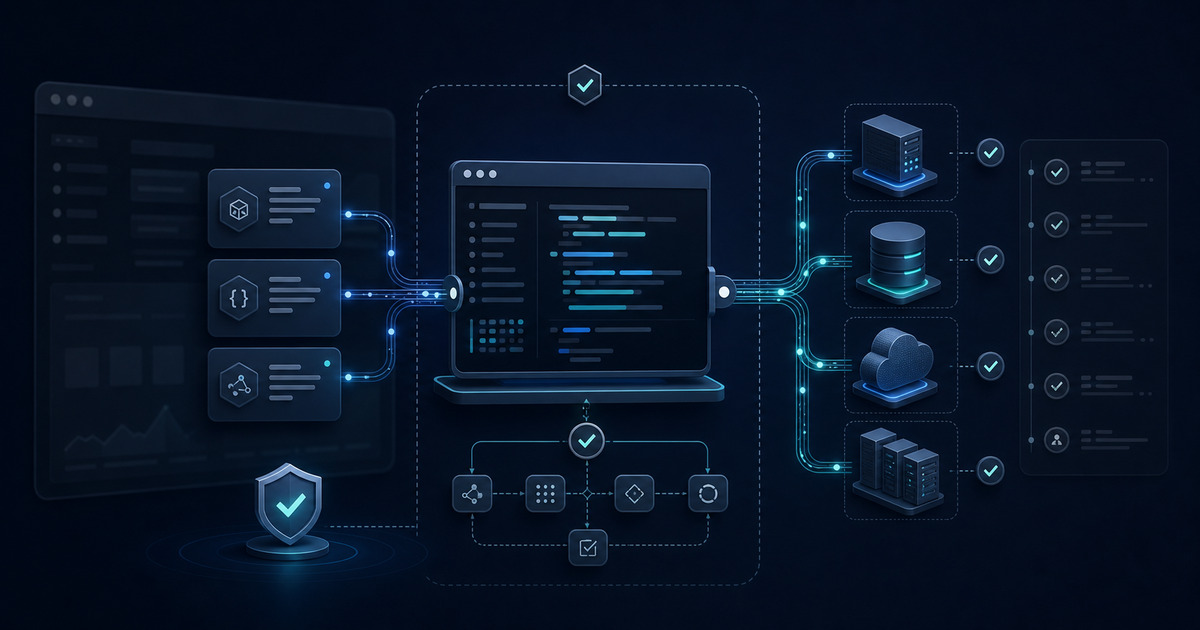
A better default is emerging: give the agent a small, locked-down API bench. Not an unconstrained shell. Not a magic prompt. A sandboxed terminal and filesystem where the agent can read documentation, call approved APIs, inspect structured responses, run dry-runs, leave logs, and hand a diff or transaction plan to a reviewer.
The point is not that every agent should become a sysadmin. The point is that enterprise automation should be designed around contracts, not costumes.
The useful surprise in terminal agents
A 2026 paper, [“Terminal Agents Suffice for Enterprise Automation”](https://arxiv.org/html/2604.00073v2), makes this argument concrete. The authors compare tool-augmented agents built around predefined schemas, web or GUI agents that operate through browser interfaces, and a minimal terminal/filesystem agent called StarShell.
Their claim is intentionally provocative: a coding agent equipped with a terminal and filesystem can solve many enterprise automation tasks by interacting directly with platform APIs. In the paper’s framing, the terminal agent can discover capabilities, read documentation, generate scripts, call APIs, transform JSON, recover from endpoint or quoting errors, and compose operations that were not anticipated by a prebuilt tool wrapper.
That matters because enterprise work rarely fits inside one button. A request might require looking up a user, checking inventory, changing a record, attaching evidence, and notifying another system. A narrow tool may cover only the happy path. A browser agent may reach the same outcome, but at the cost of long action chains and high observation noise. A terminal/API bench gives the agent a more direct surface: request, response, error, retry, artifact.
This should not be read as “just give the model shell access.” That would be reckless. The real lesson is that the interface shape matters. If the agent’s environment is designed like a workbench, each action can become more inspectable than a click.
Why browsers create the wrong intelligence test
Browser agents are sometimes necessary. Many legacy systems have no complete API. Some workflows are only exposed through a human-facing interface. In those cases, browser automation may be the bridge.
But when the browser becomes the default, the agent is forced to solve problems that have little to do with the business task. It has to infer state from UI fragments. It has to decide whether a button is disabled because a form is incomplete or because a request is still loading. It has to navigate presentation layers that were never designed as machine contracts.
That adds context pressure. Anthropic’s [context engineering guidance](https://www.anthropic.com/engineering/effective-context-engineering-for-ai-agents) frames context as a finite resource with diminishing marginal returns: more tokens do not automatically make the model more reliable. Browser traces can flood the model with screenshots, DOM fragments, repetitive page text, and accidental distractions. API traces tend to be smaller and more structured: inputs, outputs, status codes, schemas, diffs, and exceptions.
For enterprise systems, that difference is operational. A screenshot says, “something appeared to happen.” An API trace says, “this request with this payload produced this response under this credential scope.” The second one is much easier to test, replay, audit, and constrain.
What belongs on the API bench
An API bench is not a single product category. It is a deployment pattern for agents that need to act on business systems.
First, it needs scoped credentials. The agent should not inherit a broad human service account. It should receive task-limited access, ideally with expiration, resource targeting, and clear revocation. The [MCP authorization specification](https://modelcontextprotocol.io/specification/2025-06-18/basic/authorization) points in this direction for HTTP transports by grounding access in OAuth-related standards, protected resource metadata, authorization server discovery, and resource indicators. The details will vary by platform, but the principle is stable: the agent should know which resource a token is for, and the system should know which action used it.
Second, it needs local documentation and examples. Put schemas, endpoint examples, error codes, and known workflow recipes near the execution environment. Do not make the model reverse-engineer the API from production failures.
Third, it needs fixtures and dry-runs. Before an agent updates a real account, it should be able to run against safe data, compare expected and actual responses, and generate a plan. This turns agent work from improvisation into a testable workflow.
Fourth, it needs durable traces. Anthropic’s [Managed Agents architecture](https://www.anthropic.com/engineering/managed-agents) separates the “brain,” the “hands,” and the session log. That separation is important here. The terminal, sandbox, API client, and model loop should not be a fragile pet container where evidence disappears when the session dies. The bench should preserve commands, inputs, outputs, generated files, and decision points.
Fifth, it needs review and policy gates. Many enterprise actions can be represented as proposed changes: create this ticket, update this field, send this message, apply this configuration. Some should be blocked, some should require confirmation, and some should be allowed only in a dry-run environment. The terminal interface is powerful precisely because it is composable. That power must be bounded by sandboxing, allowlists, network controls, and audit hooks.
Simplicity still needs governance
The appeal of the terminal-agent result is its simplicity. But simplicity at the agent surface does not remove the need for governance around the system.
NIST’s [AI Risk Management Framework](https://www.nist.gov/itl/ai-risk-management-framework) emphasizes trustworthiness considerations across design, development, use, and evaluation. An API bench gives organizations a practical place to implement those considerations. It creates a controlled boundary where tasks can be mapped, risks can be measured, failures can be reproduced, and release criteria can be made explicit.
That is much harder if the agent’s work is only a sequence of visual impressions. It is easier when the work is a trail of structured operations.
This is also where curated tools and MCP servers still matter. A terminal bench does not mean every action must be handwritten from scratch. Good wrappers are valuable when they encode stable contracts, permissions, and validation. The danger is treating wrappers as the whole architecture. If a tool covers only part of the workflow, the agent either fails or falls back to an uncontrolled path. A well-designed bench lets teams combine wrappers, direct API calls, test fixtures, and review gates without hiding the mechanics.
A practical adoption path
Start with one workflow that is painful but bounded: triaging support escalations, updating CRM records, preparing procurement requests, reconciling invoices, or generating a configuration change for review.
Build three versions of the task environment. One uses the browser if that is how humans do it today. One uses curated tools if those already exist. One uses an API bench with docs, fixtures, scoped credentials, and trace capture. Then compare them on the metrics that actually matter: completion quality, recoverability, cost, review burden, failure modes, and how easy it is to explain what happened after the run.
The output should not be a vague agent transcript. It should be a package: task intent, inputs, API calls, responses, generated artifacts, proposed changes, policy decisions, and unresolved risks. If the agent cannot produce that package, it is not ready to operate the workflow autonomously.
The future of enterprise agents may look less like a person clicking through software and more like a careful junior engineer working inside a locked-down terminal: reading docs, testing payloads, checking errors, writing notes, and asking for approval before touching production.
That is not less impressive. It is more operationally honest.
Browsers are for humans. APIs are for systems. If we want agents to become reliable parts of enterprise operations, we should stop judging them by how convincingly they imitate human clicking. We should judge them by whether they can work inside a bench where every action is scoped, logged, replayable, and reversible.
The costume can still hang in the closet for legacy workflows. But the default uniform for enterprise agents should be an API contract, a sandbox, and a trace.
Sources
- https://arxiv.org/html/2604.00073v2
- https://www.anthropic.com/engineering/managed-agents
- https://www.anthropic.com/engineering/effective-context-engineering-for-ai-agents
- https://modelcontextprotocol.io/specification/2025-06-18/basic/authorization
- https://www.nist.gov/itl/ai-risk-management-framework
Build Agents That Prove Their Work
If you are wiring agent workflows into real operations, Alchemic can help design the checkpoints, traces, and validation gates that keep automation honest.
Get the Field Guide - $10 ->