
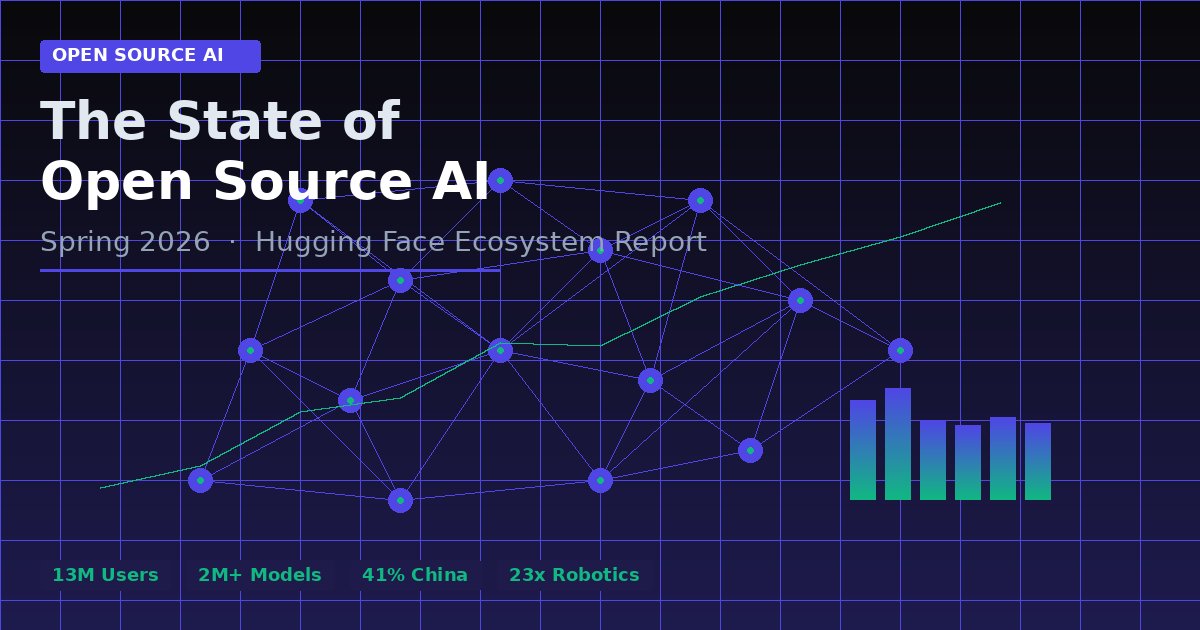
Hugging Face just dropped its State of Open Source report for Spring 2026, and the numbers paint a picture that would have seemed implausible two years ago. On Hugging Face, China now accounts for 41% of model downloads. Independent developers — not corporations — contribute more to the ecosystem than any single country's industry. Robotics datasets grew from 1,145 to nearly 27,000 in a single year. And the gap between open and closed models keeps narrowing.
Here's what the data actually says, why it matters, and what it means for anyone building with AI right now.
The Raw Numbers
Let's start with the scale of what Hugging Face has become:
| Metric | 2024 | 2025 | Change |
|---|---|---|---|
| Users | ~7M | 13M | ~86% ↑ |
| Public Models | ~1M | 2M+ | ~100% ↑ |
| Public Datasets | ~250K | 500K+ | ~100% ↑ |
| Robotics Datasets | 1,145 | 26,991 | 2,258% ↑ |
| Mean Downloaded Model Size | 827M params | 20.8B params | 25x ↑ |
Everything roughly doubled — except robotics, which grew 23x. But the headline numbers tell a much less interesting story than what's happening underneath them.
China Flipped the Script
The most significant shift in the report: China surpassed the U.S. in monthly model downloads during 2025 and now accounts for 41% of all downloads — the single largest share by any country.
This didn't happen gradually. It happened in a year, triggered by DeepSeek's R1 release in January 2025. The ripple effects were massive:
- Baidu went from zero Hugging Face releases in 2024 to over 100 in 2025
- ByteDance and Tencent each increased releases 8-9x
- MiniMax, previously closed-source, shifted decisively to open releases
- Alibaba's Qwen family now has over 200,000 derivative models — more than Google and Meta combined
That last stat deserves a moment. Alibaba's Qwen — a model family that barely registered in Western AI discourse two years ago — now has more community-built derivatives than the two companies that defined open source AI (Meta's Llama and Google's Gemma). The community voted with their keyboards.
Why this matters for builders: If you're fine-tuning models and haven't evaluated Qwen or DeepSeek-family models as base options, they're worth benchmarking for your use case. The community-created derivatives (quantized versions, LoRA adapters, domain-specific fine-tunes) around these Chinese models now rival or exceed the ecosystem around Llama.
The Rise of the Independent Developer
Here's the number that should make Big Tech uncomfortable: independent or unaffiliated developers now account for 39% of all downloads, up from 17% before 2022. At times during 2025, independents accounted for more than half of total downloads.
Meanwhile, industry's share of overall development fell from 70% to 37%.
What are these independents doing? Mostly quantizing, adapting, and redistributing base models. They're the supply chain of practical AI — taking a 70B parameter model and making it runnable on a consumer GPU, or fine-tuning a general model for a specific vertical. They decide what most users actually run.
This looks a lot like the dynamic Google's leaked 2023 memo warned about: value increasingly shifts from the original release to the ecosystem that forms around it. The ecosystem has restructured itself so that community modifications, quantizations, and fine-tunes play a much larger role in what people can actually run.
Model Popularity: A One-Year Transformation
The most-liked models on Hugging Face tell the story of shifting attention:
| Spring 2025 (Top Liked) | Spring 2026 (Top Liked) |
|---|---|
| Meta Llama 3 variants dominated | DeepSeek-R1 at #1 |
| Predominantly U.S.-developed | International mix (U.S., China, Korea, France) |
| Big lab models dominated | Individual creator models in top rankings |
The fourth most popular entity for developing new trending models? Not a corporation. Individual users. Creating competitive models at an individual level is more accessible than it's ever been — and the data proves it.
Robotics: From Afterthought to Largest Category
The robotics numbers are genuinely staggering. In 2023, robotics datasets were ranked 44th on Hugging Face. By 2025, they were the single largest dataset category — larger than text generation (which had ~5,000 datasets).
Several factors drove this:
- Hugging Face acquired Pollen Robotics, opening open-source robotic hardware sales to everyone from industry labs to hobbyists
- LeRobot, Hugging Face's open-source robotics library, nearly tripled its GitHub stars in a year
- RoboMIND released over 107,000 real-world trajectories across 479 tasks and multiple robot embodiments
- The Learning to Drive (L2D) dataset from a LeRobot/Yaak collaboration became the largest multimodal dataset for spatial intelligence
Broadly, the pattern resembles earlier open-source waves in text and image models: an explosion of community-contributed data followed by faster model development. Robotics data is harder to collect because it depends on physical systems, which makes the community contribution here especially notable.
What to watch: Robotics looks like one of the fastest-moving open-source sub-communities right now. The infrastructure is being built, the datasets are arriving fast, and the model ecosystem is still early enough that builders can help shape it.
Small Models Win in Practice
There's a consistent gap in the report between what gets attention and what gets used. The median size of downloaded models barely changed — from 326M to 406M parameters. The mean jumped to 20.8B, but that's pulled up by power users running quantized 70B+ models.
What this means in practice: most real-world deployments use models under 10B parameters. The report notes that performance differences between frontier and smaller models "often narrow rapidly through fine-tuning and task-specific adaptation." Models in the single-digit billions handle coding, reasoning, and multimodal tasks. Models in the hundreds-of-millions handle search, tagging, and document processing.
Every major model developer now releases families spanning multiple sizes — not because they want to, but because the market demands it. The "just use GPT-5" approach doesn't survive contact with latency requirements, cost constraints, and data privacy concerns.
The Six-Week Shelf Life
One of the most striking findings: the mean engagement duration for an open model is approximately six weeks. Downloads peak almost immediately after release, then decline rapidly.
DeepSeek's strategy of successive releases (V3, R1, V3.2) explicitly targeted this dynamic — each release renewed interest before the previous one decayed. Organizations that released a model and moved on lost share to those with continuous updates.
For practitioners, this has real implications:
- Don't lock into a base model for a long-lived project without a migration plan
- The model you fine-tune on today may not be the best option in two months
- Community ecosystem (adapters, quantizations, guides) matters as much as raw benchmarks — a well-supported model beats a slightly better unsupported one
AI for Science: The Quiet Revolution
While robotics grabbed the growth headlines, scientific AI has been building steadily. Protein folding, molecular dynamics, drug discovery, and scientific data analysis all show increasing open-model adoption.
The report highlights something interesting about scientific papers: the most impactful papers (by community upvotes) tend to come from large organizations, but the most open-source-adopted papers come from diverse, often non-Big-Tech sources. Medical AI papers are particularly influential in driving open-source adoption.
Community-led science projects now involve hundreds of contributors working across institutions — the kind of large-scale interdisciplinary coordination that open source enables and traditional academic structures struggle with.
Sovereignty: Governments Get Serious
Open source AI has become a national security and sovereignty issue. The report documents several government-level initiatives:
- South Korea's National Sovereign AI Initiative — named five national champions (LG AI Research, SK Telecom, Naver Cloud, NC AI, Upstage) to produce competitive domestic models. Three Korean models trended simultaneously on Hugging Face in February 2026
- Switzerland's Swiss AI initiative and EU-funded projects prioritize open models for data sovereignty
- The UK's "public money, public code" principle influences government-backed AI development
- China's domestic chip push — Alibaba invested in inference-focused chip architectures designed to run open models on Chinese-made hardware
The pattern: models and datasets tend to be most used in the regions where they're developed. Countries investing in their own open AI ecosystems get AI that works for their languages, regulations, and technical requirements.
The Compute Question
Hardware remains the fundamental bottleneck. NVIDIA dominates, but AMD support keeps expanding — Stability AI now optimizes for both, and Hugging Face launched a Kernel Hub for GPU-optimized kernels targeting both platforms.
The efficiency gains are dramatic. Open models now achieve performance at 10x to 1,000x lower cost than flagship closed models. But the gap between what's computationally available to big labs versus the open-source community remains wide.
Public funding for open AI compute infrastructure is becoming a real policy discussion, especially in Europe. The argument: if open models create downstream value far exceeding their cost to produce (which studies of open software suggest), then public investment in training compute is economically rational.
What This Means for Builders
If you're building AI-powered products or fine-tuning models for your use case, the report's findings distill into concrete action items:
1. Evaluate Chinese Base Models
Qwen 3.5 and DeepSeek V3 have the largest derivative ecosystems. If your current base model is Llama, at minimum benchmark against Qwen for your use case. The community tooling (quantizations, adapters, training recipes) is now comparable.
2. Target Sub-10B Parameters
Unless your task specifically requires frontier-scale reasoning, a well-fine-tuned 7-8B model will likely match your needs at a fraction of the cost. The data shows this is what the ecosystem is actually deploying.
3. Plan for Model Rotation
With a six-week attention cycle, your base model choice should be revisited quarterly. Build your fine-tuning pipeline to be model-agnostic — invest in data quality rather than model-specific optimization.
4. Watch the Independents
The best quantization of a new model often comes from an individual contributor, not the original lab. Follow community quantizers and adapter creators — they're effectively your R&D department for deployment optimization.
5. Consider Robotics Data
If your work touches physical systems, IoT, or embodied AI, the robotics dataset explosion means pre-trained policies and transfer learning opportunities that didn't exist 18 months ago.
The Bigger Picture
The Hugging Face report confirms what many practitioners have felt on the ground: open source AI is no longer just an alternative track. It is where a huge amount of practical AI development happens. The top 200 models account for about half of all downloads, but the remaining long tail represents specialized, adapted, domain-specific work that keeps widening the ecosystem's practical reach.
The concentration of power is shifting — from a handful of U.S. labs to a distributed network of organizations and individuals across continents. From industry to independents. From monolithic models to model families and derivative ecosystems.
The Bottom Line
In my read, open source AI crossed a meaningful threshold in 2025. On Hugging Face, China leads adoption. Independents command a much larger share of contribution. Small models still lead real-world deployment. And the six-week attention cycle suggests that model choice alone is not enough — teams also need strong data, evaluation, and adaptation workflows.
If there's a defensible takeaway for builders, it's this: the advantage is getting less about a single model and more about how fast your workflow can evaluate, adapt, and ship.
Source: State of Open Source on Hugging Face: Spring 2026 by Avijit Ghosh, Lucie-Aimée Kaffee, Yacine Jernite, and Irene Solaiman.
Build Your Own AI Stack
Our Self-Host AI Guide walks you through setting up open source models on your own hardware — from model selection to deployment.
Get the Self-Host Guide — $10 →