
The first serious production failure in an AI agent system usually does not look like science fiction. It looks like a stale API response, a half-completed workflow, a document retrieved from the wrong customer account, a notebook cell that silently failed, or a memory record that was true last month and dangerous today.
Most teams respond to that class of problem with a retry loop. If the call fails, try again. If the model gets confused, ask it to reflect. If the answer looks thin, run the tool one more time.
That is not a recovery strategy. It is optimism in a while loop.
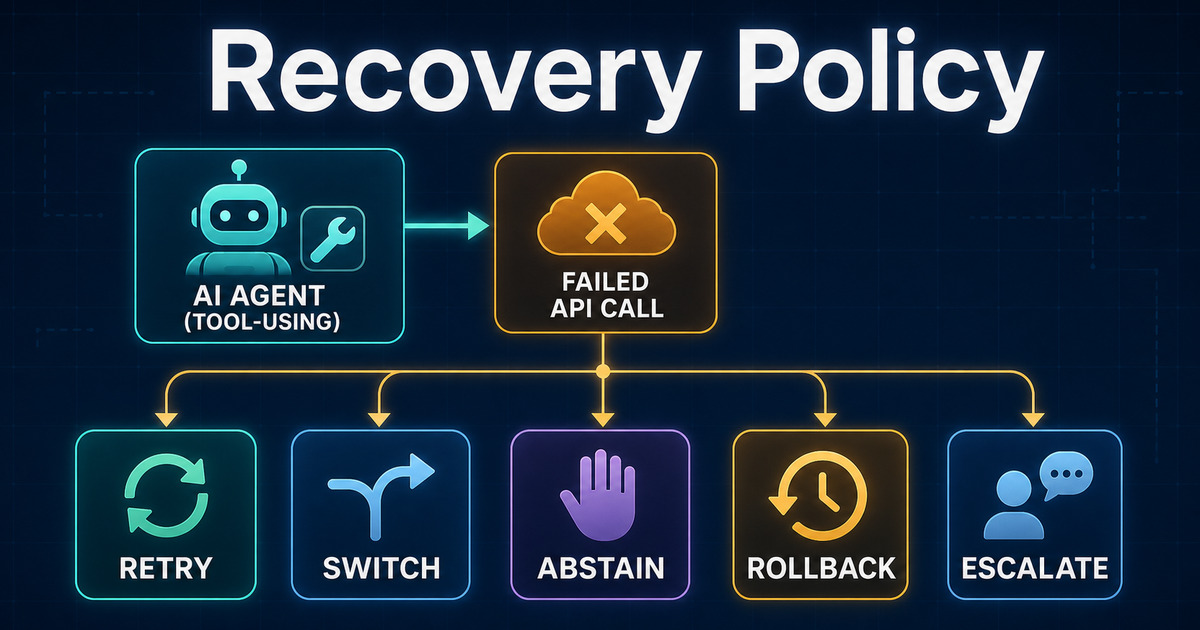
A better question is emerging from recent agent research: when a tool-using agent hits trouble, does the surrounding system know whether to retry, switch paths, abstain, roll back state, or escalate? For enterprise builders, that distinction is the difference between a clever demo and software you can safely attach to a real workflow.
Sunny-day tool use is the wrong reliability target
The paper “Retry, Switch, or Abstain?” states the production problem plainly: tool-using LLM agents are often trained and evaluated in settings where tool calls succeed reliably, while deployed tools can fail transiently, persistently, or silently.
Those three failure modes are operationally different. A transient timeout might deserve a bounded retry. A persistent outage might require a different service or a human handoff. A silent failure is worse: the tool returns something plausible enough for the agent to keep moving, but wrong enough to contaminate the workflow.
The authors introduce BENCH2ROBUST, a framework that converts failure-free tool-use benchmarks into controlled stochastic environments where episodes require retrying, switching, or stopping after available paths are exhausted. Their results show a broad robustness gap across seven models from four families. They also test two interventions: Bayesian Tool Memory, which provides structured runtime recovery context, and curriculum-controlled reinforcement learning. On held-out retail tasks, Bayesian Tool Memory improves robustness by up to 16.8 percentage points without retraining; combining it with RL reaches 40.8–45.5% under injection while preserving failure-free performance.
The exact numbers matter less than the shape of the finding. Agents do not merely need to know how to call tools. They need to know what kind of failure they are in.
A retry loop treats every failure as temporary. A recovery policy starts with classification.
Enterprise workflows have policy traps, not just broken APIs
The recovery problem gets harder when the agent must reason across APIs, documents, and natural-language policies. VAKRA, a benchmark for API and retrieval agents, pushes in that direction with more than 8,000 executable APIs across 62 domains. Its tasks include varied API interaction styles, multi-hop reasoning over structured APIs, and multi-source reasoning under natural-language tool-use policy constraints.
That last phrase is the one enterprise teams should notice. In the real world, a task is not just “call the endpoint.” It is “call the correct endpoint, with the correct entity, after checking the right source, while obeying a policy that may make the request unanswerable.”
VAKRA verifies predicted tool calls by re-executing them against live APIs and allows multiple valid paths. In a fixed ReAct harness, the best model reaches 70.4% on single-hop endpoint-style tasks, but drops to 50–51% on compositional APIs. Performance degrades by more than 50% as reasoning depth increases, and policy-constrained unanswerable questions expose severe failures.
That points to a practical lesson: the agent’s “recovery” layer cannot only watch for HTTP status codes. It must also understand policy states. There should be explicit outcomes such as:
- proceed with evidence,
- retry because the failure is transient,
- switch because another authorized path exists,
- abstain because the task is unanswerable under policy,
- escalate because the consequence is too high or the evidence is inconsistent.
Without those states, the model will often keep searching for an answer the system should refuse to invent.
Long workflows need checkpoints, not vibes
Data work makes this visible. DSAgentBench evaluates agents on end-to-end data-science workflows in real computer environments. The benchmark includes 275 tasks spanning wrangling, exploration, modeling, visualization, and validation across tools like notebooks, IDEs, terminals, browsers, and databases. Its evaluators check analytical correctness, visual outputs, and model performance rather than only whether code ran.
The reported success rates are sobering. In the authors’ experiments, the strongest agent, Claude-4.6-Sonnet, reaches 56.70% task success, while open-source agents remain below 1%. Frequent failures include tool orchestration, operating-system grounding, and multi-step reasoning.
For a builder, this argues for checkpointed agent workflows. At each major step, the system should know what evidence was produced, what assumptions were made, what tool state changed, and what downstream actions now depend on that state. If a later step fails, the agent should not blindly rerun the whole job or patch the final answer. It should know which checkpoint is still trustworthy.
That is boring infrastructure. It is also the difference between an assistant that can make a chart and an agent that can be trusted near a reporting pipeline.
Recovery includes state repair
Long-lived agents introduce another problem: they remember their mistakes. The paper “From Faulty Memories to Corrected Actions” focuses on memory-augmented agents and argues that poisoned, stale, or misattributed memories can alter reasoning, tool use, answers, and subsequent memory writes.
Simply deleting the bad memory is not enough. Derived claims and actions may already have propagated. Resetting the entire store is also expensive and destructive because it discards benign state. The authors propose dependency-guided rollback repair: build a typed memory-to-action graph from runtime provenance, trace downstream dependencies, preserve independently supported candidates, deactivate unsupported memory state, and selectively replay affected computation.
On their controlled benchmark, this approach reaches 85.3% recovery versus 77.3% for the best competing recovery method, while removing diagnosed faulty memories and preserving benign ones. Again, the implementation details will vary by product. The core pattern is portable: recovery requires provenance.
If your agent writes memory, caches tool results, drafts records, updates tickets, or stages business actions, you need to know what depends on what. Otherwise “fixing” an error can leave the real contamination in place.
What a recovery policy looks like
Anthropic’s “Building effective agents” makes a useful distinction between predefined workflows and agents that dynamically direct tool use. The more dynamic the system becomes, the more explicit the surrounding control structure needs to be.
A practical recovery policy can be simple. Start with six pieces:
1. Failure taxonomy. Label failures as transient, persistent, silent-suspected, policy-blocked, evidence-conflicted, state-contaminated, or high-risk. 2. Retry budgets. Define how many times a path can be retried, with backoff and stop conditions. Infinite retries are not resilience. 3. Switch criteria. Specify when the agent may use another tool, data source, model, or workflow path, and what evidence must carry over. 4. Abstention rules. Make “no valid path remains” a first-class answer, especially for policy-constrained or safety-critical tasks. 5. Rollback and provenance. Track intermediate artifacts, memory writes, tool outputs, and downstream dependencies so repair can be selective. 6. Escalation contracts. Decide what gets handed to a human: the goal, current state, failed paths, evidence, risk level, and recommended next action.
None of this requires pretending the agent will never fail. It assumes failure and designs the surrounding system to make failure legible.
That is the mindset shift. Tool use is not just a model capability; it is an operational surface. Every call can fail, every retrieved fact can be stale, every memory can be misattributed, and every workflow can reach a state where continuing is worse than stopping.
The winning agent stack will not be the one that hides those cases behind a bigger prompt. It will be the one that can say, with evidence: this path failed, this state is still trustworthy, this alternate path is allowed, this memory must be rolled back, and this task now needs a human.
A retry loop asks the agent to try harder. A recovery policy tells the system how to fail safely and continue only when continuing is justified.
Build AI Systems That Survive Contact With Real Work
We help teams turn AI research into practical automations, agent workflows, and operational systems that can be evaluated and improved.
Get the Field Guide — $10 →