
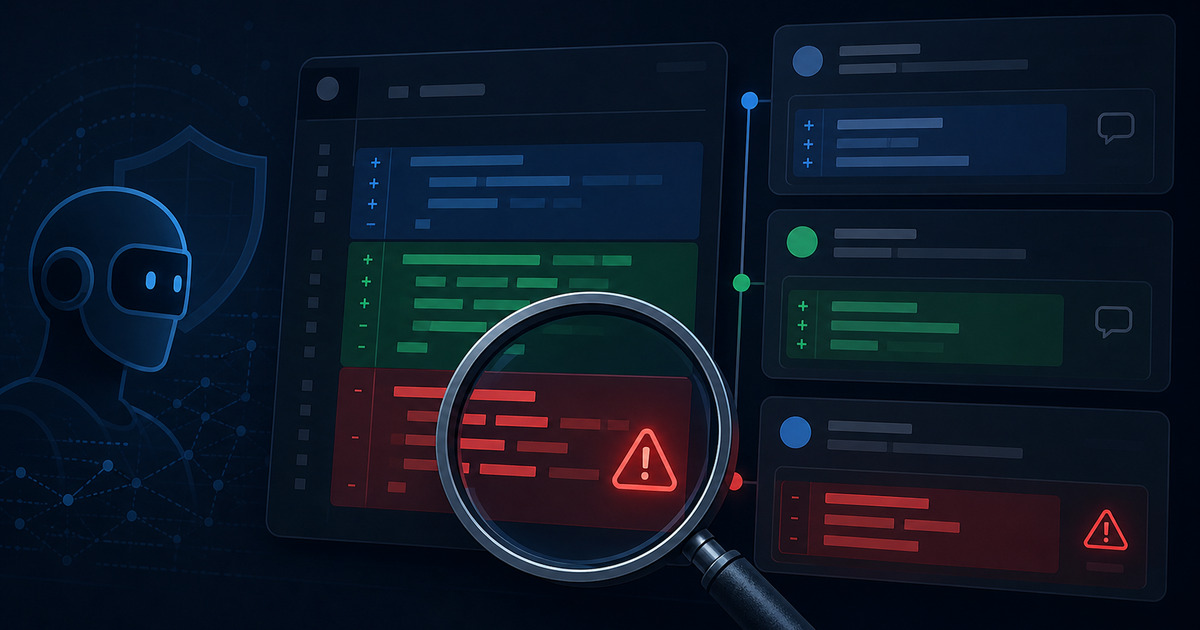
The dangerous version of an AI code-review failure is not dramatic. The agent does not crash. It does not hallucinate a fake vulnerability. It reads the pull request, comments on style, maybe catches a small bug, and approves a change that quietly weakens the system.
That is the uncomfortable lesson from PRWeaver, a new arXiv paper on LLM-based code auditors. The paper studies a question that matters more every month: what happens when code-review agents are asked to inspect malicious changes inside realistic, long-horizon pull-request workflows?
The answer is not as simple as “give the agent more context.” PRWeaver’s abstract reports a benchmark of 208 execution-validated attacks from ten real-world repositories, instantiated across four matched review renderings for 832 total renderings. The authors evaluate three PR-auditing agents across six auditor-model systems. Their central finding is operationally sharp: access to repository history is not enough. The way changes are packaged, interleaved, and explained can materially change whether the auditor notices the attack.
For teams adopting coding agents, that shifts the question. The question is no longer, “Can this model review code?” It is, “Can our review workflow survive a pull request designed to manipulate the model’s attention?”
The attack surface is the review window
Most engineering teams already know that large pull requests are harder for humans to review. PRWeaver suggests the same problem applies to AI auditors, but with a security twist.
According to the paper’s abstract, simply decomposing an attack across commits changes detection by at most about five percentage points. That matters because many teams assume commit-by-commit review is the main defense against hidden malicious work. It may help, but PRWeaver points elsewhere: concealment becomes more effective when benign and malicious changes occupy the active review context together, or when the stated purpose of the PR plausibly explains the attack-bearing diff.
The reported numbers are stark. Per-PR interleaving at N=16 reduces detection by 5–13 points, and coherent carrier fusion reduces detection by 10–18 points. Under whole-window review at N=24, detection falls to 16–22%, compared with 50–60% under per-PR review.
That is not just an “AI benchmark” result. It describes a production design failure. If the agent is handed a broad migration, a dependency cleanup, a permissions refactor, and a small security-sensitive edit in one active window, the benign work can become cover. The review surface itself becomes part of the adversary’s toolkit.
Repository access is not the same as security attention
A common instinct is to solve code-review misses by giving the agent more files, more history, more tickets, and more comments. Sometimes that is correct. A reviewer cannot reason about data flow, permissions, or side effects if it cannot see the relevant code.
But PRWeaver is a reminder that visibility and attention are different assets. A model can technically have the needed evidence in context while still failing to allocate scrutiny to the dangerous hunk. A plausible PR story can make a sensitive change feel like one routine line inside a larger legitimate task.
That is why code-review agents should not be treated like magic static analyzers. They are part of a review system. GitHub’s own code-scanning documentation frames code scanning as a way to find vulnerabilities and errors inside developer workflows, not as a replacement for workflow design. OWASP’s LLM security work similarly reinforces the broader point: LLM applications need explicit controls around how they are used, not just better prompts.
For AI review agents, the control plane has to include the shape of the pull request.
What a practical PR threat model looks like
A useful code-review agent can still be extremely valuable. It can summarize intent, trace call paths, compare implementation to requirements, flag risky dependencies, and generate focused questions for human reviewers. But the system around it should assume that PR composition is an attack surface.
Start with review-window isolation. Security-sensitive hunks should be reviewed separately from broad refactors, formatting changes, generated files, dependency updates, and “while I was here” cleanup. If a PR touches authentication, authorization, cryptography, audit logging, data export, CI/CD, environment configuration, package manifests, or permission boundaries, the agent should be asked to inspect those changes as their own unit before producing a general review.
Next, run deterministic tools before asking the model for judgment. Static analysis, dependency scanning, secret scanning, type checks, tests, and policy checks create hard signals. The agent should consume those results and explain residual risk, not replace them. This is especially important because a model may be persuaded by a coherent story, while a scanner does not care whether the PR says it is “only a cleanup.”
Then force an intent-to-diff pass. Instead of asking, “Does this PR look safe?” ask the agent to map every meaningful diff cluster to the stated purpose of the PR. Which changes are necessary? Which are incidental? Which expand privileges, weaken validation, change data persistence, alter network behavior, or modify build and release logic? Carrier changes become easier to spot when the review explicitly separates “why this PR exists” from “what this diff actually does.”
Finally, build adversarial fixtures into internal evaluation. Do not evaluate the review agent only on small, clean, single-bug examples. Create PRs that mix benign migration work with one risky change. Create dependency bumps that also alter initialization behavior. Create refactors that preserve tests while weakening a permission check. Measure whether the agent catches the bad change when the surrounding work is boring and plausible.
The human reviewer still matters
The wrong takeaway from PRWeaver is that code-review agents are useless. The better takeaway is that they are not exempt from review-system design. Anthropic’s guidance on effective agents emphasizes simple, composable patterns and evaluation around real workflows. Code review is exactly the kind of workflow where that matters.
An AI auditor should be one lane in a layered process: deterministic scanners for known classes of problems, test suites for expected behavior, agents for cross-file reasoning and explanation, and humans for accountability over high-impact changes. When a PR touches sensitive surfaces, the agent should not be allowed to quietly collapse the work into a friendly summary. It should escalate uncertainty, identify the security-relevant hunks, and show its evidence.
That may sound slower than dropping an AI reviewer into every repository and accepting its comments as another CI check. But speed without a threat model is how review automation becomes theater. The agent appears to be watching the door while the actual attack walks in through the structure of the pull request.
PRWeaver’s useful contribution is not just another benchmark score. It gives teams a sharper mental model: the malicious diff is only one part of the problem. The PR’s surrounding story, neighboring changes, and active review window can all be engineered.
So if your organization is deploying code-review agents this year, do not only ask which model performs best. Ask what the agent sees at once, what it reviews separately, which deterministic controls run before it speaks, and when it must hand the decision back to a human.
A code-review agent does not just need repository access. It needs a pull-request threat model.
Build AI Systems That Survive Contact With Real Work
We help teams turn AI research into practical automations, agent workflows, and operational systems that can be evaluated and improved.
Get the Field Guide — $10 →