
Every serious agent product now wants to say it has memory. The pitch is easy to understand: a personal assistant should remember preferences, a coding agent should remember project conventions, a support agent should remember prior escalations, and an operations agent should remember the routine that worked last time.
The harder question is whether that memory actually makes the agent better tomorrow.
That is the question behind PAST-Bench, a new benchmark for persistent personal agents published on arXiv this week. Instead of scoring isolated one-off tasks, PAST-Bench asks whether an agent can turn accumulated experience into improved behavior across fresh sessions. The distinction matters. A long transcript can look like memory. A vector store can look like memory. A pile of saved summaries can look like memory. None of those prove the agent is learning from its past in a way that survives context resets, task variation, stale facts, and changing user needs.
For builders, this is the line between a feature and a capability.
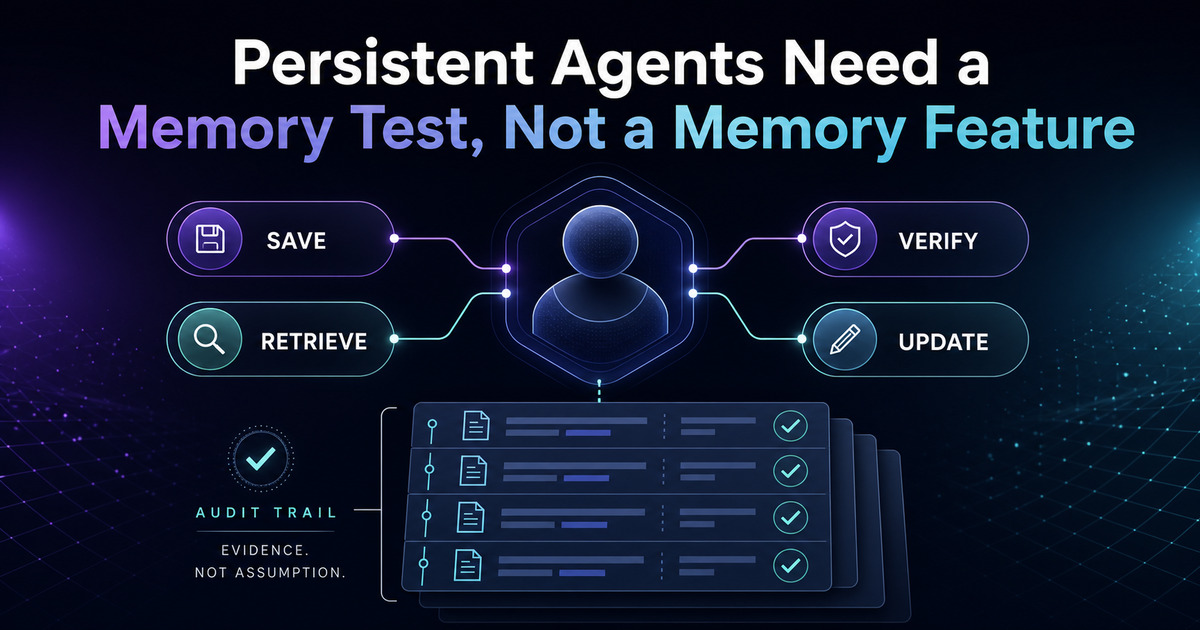
PAST-Bench frames persistent improvement as something that has to be tested longitudinally. The benchmark uses ordered task sequences where earlier episodes create an opportunity to save useful experience and later fresh-session episodes test whether that experience improves future behavior. It includes matched controls with persistence on and off, then looks beyond final scores to ask whether the apparent improvement followed the intended pathway: save, retrieve, reuse, and update.
That pathway evidence is the important part. If an agent performs better on a later task, there are several possible explanations. Maybe it remembered the relevant instruction. Maybe the base model simply handled the second task better. Maybe the evaluation leaked a clue. Maybe the agent retrieved an old note but ignored it. Maybe it reused a procedure that happened to work once but should have been retired. A production system cannot treat all of those as equivalent.
According to the PAST-Bench paper record and repository, the benchmark spans 26 task families and 204 episodes across four capability areas: memory, procedural reuse, proactive information gathering, and update ability. Those categories map cleanly onto the operational questions teams should already be asking.
First, can the agent retain stable preferences, constraints, and prior cases without needing them repeated every session? This is the most obvious version of memory, but it is also the easiest to fake with shallow summaries. A useful test should show not just that the agent stored a preference, but that it retrieved the right preference when the future task made it relevant.
Second, can the agent reuse procedures? This is where memory becomes leverage. A coding agent that rediscovers the same test command every morning is not compounding. A workflow agent that relearns the same vendor portal sequence each run is not improving. Procedural memory should reduce repeated investigation while still preserving verification.
Third, does the agent proactively gather prior context before acting? This is often where real deployments fail. The memory exists, but the agent does not know when to look. It answers from the current prompt, misses the historical constraint, and only after a human correction does it discover that the relevant context was already stored. In production, the retrieval trigger is as important as the memory store.
Fourth, can the agent update stale information? This is the dangerous side of persistent memory. A system that remembers old facts forever will eventually become worse than a stateless system, because it can confidently apply obsolete procedures, expired policy, old credentials, deprecated APIs, or superseded customer preferences. Long-lived agents need a staleness gate and an update path, not just more retention.
The PAST-Bench authors report that improvement from retained experience is real but uneven across models, frameworks, and capabilities. That nuance is useful. The practical lesson is not “persistent agents are solved.” It is that persistent agents need diagnostics precise enough to separate genuine cross-session improvement from accidental score movement.
The paper also introduces Hermes+, a diagnosis-driven framework with interventions named Plan, Render, Route, Gate, and Close. The names are implementation-specific, but the architecture lesson is broader: memory has to be integrated into the agent loop. The agent needs a moment to decide what prior experience may matter, a representation that can be inspected, a route for retrieving the right artifact, a gate for checking whether it still applies, and a close step that writes back what changed. Without those steps, memory becomes a drawer full of notes the agent may or may not use.
This is also where agent memory stops being only a product feature and becomes a governance surface. NIST’s AI Risk Management Framework is not about telling teams to add more AI features; it is about mapping, measuring, managing, and governing system behavior. Persistent memory deserves that treatment. What can be stored? Who can see it? When must it expire? How is it corrected? Which future actions relied on it? Can a reviewer reconstruct why the agent believed an old procedure still applied?
For enterprise teams, the minimum viable memory layer should look less like a magic notebook and more like a small evidence system.
Start with a memory ledger. Each saved item should have a source, scope, timestamp, owner, and intended reuse condition. “Use pnpm in this repo” is different from “the user prefers short status updates” and very different from “this vendor portal changed its workflow on July 29.” If those all collapse into the same untyped memory bucket, retrieval and update become guesswork.
Add retrieval triggers. The agent should know which classes of tasks require a memory lookup before action: repo work, customer-specific workflows, regulated operations, recurring jobs, and anything involving durable preferences. If the trigger never fires, the memory feature is decorative.
Add staleness checks. Some memories should be durable. Others should be reviewed after a version change, a policy update, a failed run, or a set number of days. The agent should not be rewarded merely for remembering; it should be rewarded for knowing when memory is no longer safe.
Finally, replay the pathway. For important workflows, evaluate whether the agent saved the right thing in episode one, retrieved it in episode two, applied it correctly, and updated it when contradicted. This is the lesson PAST-Bench makes concrete: final outcome alone is not enough. Process evidence matters because memory failures are often invisible until they compound.
The teams that win with persistent agents will not be the ones with the biggest context bucket. They will be the ones that can prove their agents get better without becoming harder to audit. That means treating memory as an engineered loop: capture, retrieve, apply, verify, update, and retire.
Ship the memory feature if you want. But before you trust it, ship the memory test.
Build AI Systems That Survive Contact With Real Work
We help teams turn AI research into practical automations, agent workflows, and operational systems that can be evaluated and improved.
Get the Field Guide — $10 →