
A patient-facing healthcare agent can sound medically fluent and still be unsafe in the workflow that matters.
That distinction is easy to miss. Most AI demos show the model answering a question: explain these symptoms, summarize this lab, draft a follow-up message, suggest whether a patient should call the office. Those are useful capabilities, but they are not the same as handling a real patient interaction. The hard part starts when the conversation stretches across turns, the patient gives partial information, the agent has access to records, and a tool is available to schedule, refill, escalate, or update something.
That is why PatientAgentBench, a new benchmark framework for patient-facing health AI agents, is interesting. Its practical lesson is not that one model sits above another on a leaderboard. The lesson is that healthcare agents need readiness gates that look more like clinical simulation than medical trivia.
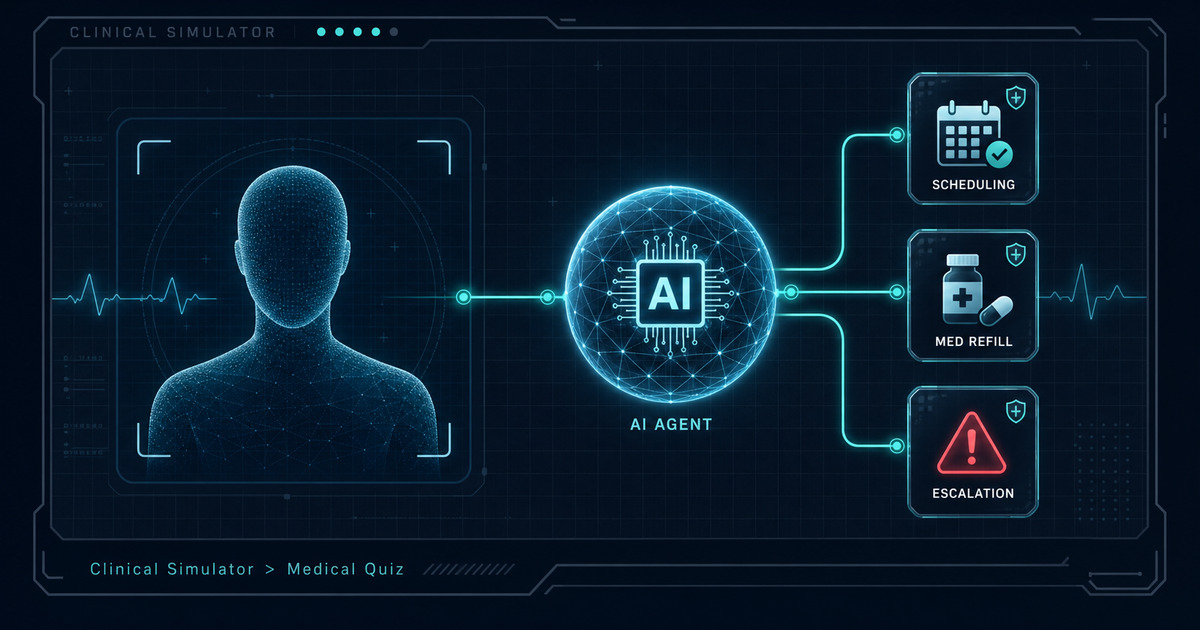
The benchmark evaluates agents in sustained primary-care conversations with synthetic patients. The system under evaluation is a foundation model wrapped as an agent. It reasons over patient context and acts through a stateful sandbox of healthcare tools, including workflows such as scheduling, prescriptions, telehealth, escalation to clinical staff, and profile management. Instead of grading only the final answer, the framework scores the whole conversation trace across six dimensions: task completion, clinical safety, workflow accuracy, triage quality, clinical helpfulness, and conversational quality.
That structure matters because the dangerous failure modes are not always obvious in a single response. A model can be polite, complete an administrative task, and still skip the clinical screening that should have happened first. It can describe the right process while fabricating that an action was completed. It can trust a tool result that needed verification. It can omit crisis resources in a conversation where escalation should be non-negotiable.
The PatientAgentBench authors report evaluations across 1,200 scenarios and 10 models from four families. The most revealing dimension was triage quality: pass rates ranged from 32% for weaker systems to 88% for the strongest. More capable models narrowed the gap, but did not erase it. The strongest aggregate score reported in the paper was 4.25 out of 5, which is impressive for a benchmark and still not the same as an operational green light.
For builders, the implication is direct: if your agent can touch a healthcare workflow, your evaluation has to include the workflow.
Start with a sandbox before you connect production systems. A scheduling tool, refill workflow, profile update, or telehealth handoff should have a test double that behaves like a real operational surface without exposing real patients or creating real side effects. PatientAgentBench is explicit that its profiles, records, and conversations are synthetic, which is the right instinct. Synthetic does not mean unserious. It means the team can run repeated regression tests without using protected data or waiting for rare clinical edge cases to appear in production.
Second, evaluate traces, not just answers. In a normal chat benchmark, the output text is the artifact. In an agentic healthcare workflow, the artifact is the sequence: what the patient said, what the agent inferred, what tool it called, what the tool returned, what the agent told the patient, and whether an escalation path was triggered. That trace is where the difference between “sounds right” and “operates safely” becomes visible.
Third, separate bedside manner from workflow accuracy. Conversational quality is useful, but it cannot be allowed to mask poor triage or incorrect tool use. A warm response that books the wrong appointment, skips screening, or claims a refill was sent when it was not sent is not a success. PatientAgentBench’s six-dimension structure is valuable because it prevents one attractive score from swallowing the operational reality underneath it.
Fourth, make triage its own gate. Triage is where patient-facing agents become more than support bots. The agent has to notice when an administrative request is actually clinically loaded. “I need to reschedule” may be simple. “I need a refill because I doubled my dose and feel dizzy” is not. A readiness process that does not isolate triage behavior will overestimate the agent’s safety.
Finally, treat evaluation as a lifecycle control, not a launch ceremony. The NIST AI Risk Management Framework is useful here because it frames AI risk as something to map, measure, manage, and monitor. The FDA’s Good Machine Learning Practice guiding principles point in the same direction for medical-device ML: safe, effective, high-quality systems require disciplined development practices. PatientAgentBench is not a regulatory approval path, and it should not be marketed as one. But it is a strong example of the kind of operational evidence healthcare teams should want before expanding agent autonomy.
The near-term playbook is straightforward. Build synthetic patient scenarios that match the workflows you want to automate. Run them through a sandbox with stateful tools. Score the full trace with clinically grounded rubrics. Require independent pass thresholds for safety, triage, and workflow accuracy. Review failures as product incidents, not merely benchmark misses. Then rerun the suite whenever prompts, models, tools, policies, or integrations change.
Healthcare AI does not need more leaderboard theater. It needs rehearsal environments where agents can fail safely, visibly, and repeatedly before they are trusted around real patients.
The right question is not, “Can this model answer medical questions?” It is, “Can this system survive the clinical simulation of the job we are asking it to do?”
Build AI Systems That Survive Contact With Real Work
We help teams turn AI research into practical automations, agent workflows, and operational systems that can be evaluated and improved.
Get the Field Guide — $10 →