
Most teams discover prompt optimization the same way they discover incident response: after something embarrassing happens.
A support agent gives the wrong refund explanation. A coding agent passes the toy task but mangles the real repository. A research assistant answers confidently from stale context. Someone opens the prompt, adds another paragraph of instructions, ships it, and hopes the next failure lands somewhere else.
That is not an improvement system. It is prompt patching by vibes.
A new paper, “Naive Prompt Optimization: Rethinking the Need for Complex Prompt Search,” is useful because it pushes against the opposite overreaction. When prompts become important, the instinct is often to reach for a sophisticated optimizer: evolutionary search, planning trees, reinforcement learning loops, or a compiler-driven pipeline framework. Those tools can be valuable. But the paper’s core result is a reminder that production AI systems do not always need the cleverest optimizer first. They need a disciplined feedback loop.
The authors introduce Naive Prompt Optimization, or NPO: a lightweight single-lineage method that revises a prompt iteratively using rollout feedback and a stronger teacher model. Instead of maintaining a large population of candidate prompts or running an elaborate search process, NPO keeps moving one prompt forward. Run the task. Inspect the failures. Ask the teacher to revise the prompt. Test again.
According to the paper’s abstract, NPO achieves comparable or better performance than GEPA with fewer rollouts in the evaluated settings, and its advantage increases with stronger teacher models. The authors also report that optimized prompts can transfer when applied verbatim to other student models, especially within the same model family. Those are preliminary research claims, not a universal law. But they point to a very practical enterprise lesson: if the improvement loop is cheap, auditable, and easy to roll back, it is often more useful than a complex optimizer nobody can explain during an incident review.
GEPA, PromptAgent, and DSPy each represent an important part of the broader prompt-optimization story. GEPA argues that language itself is a rich learning medium, using reflective prompt evolution as an alternative to rollout-heavy reinforcement learning in some tasks. PromptAgent treats prompt optimization as a strategic planning problem, using search over expert-level prompt states. DSPy reframes prompt and pipeline design as a programming problem: declare modules, define metrics, and compile better behavior instead of hand-editing long prompt strings.
Those are serious ideas. The mistake is not using them. The mistake is importing their complexity before the organization has the operational basics in place.
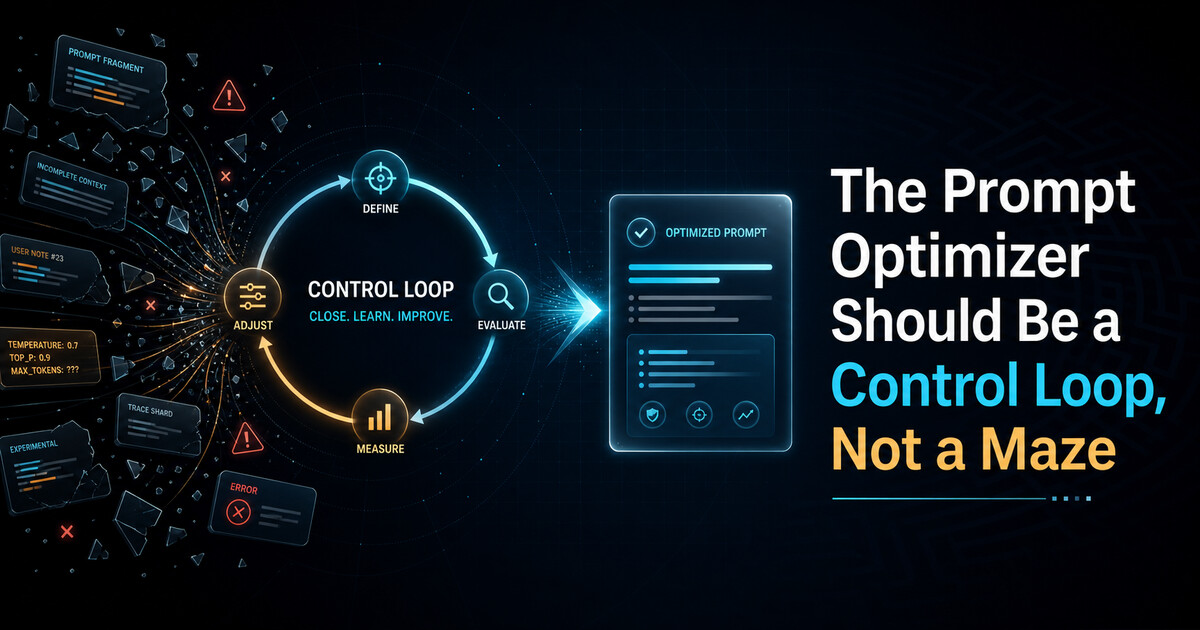
For most teams, the first prompt optimizer should look less like a maze and more like a control loop.
Start with traces. Not anecdotes, not screenshots, not “the model felt worse this week.” Capture the input, relevant retrieved context, tool calls, model output, expected outcome, latency, cost, and any policy decision that mattered. If the agent failed because it used the wrong source, preserve that fact. If it failed because the prompt over-prioritized speed, preserve that too.
Then separate the training examples from the promotion gate. The examples that inspire a prompt revision should not be the only examples that approve it. A teacher model can be very good at explaining why a trace failed, but it can also overfit the prompt to the visible failures. The held-out harness is what keeps the optimizer honest.
Next, require minimal prompt diffs. A production prompt is not just prose. It is an executable policy artifact. If every optimization pass rewrites the whole thing, reviewers cannot tell whether performance improved because the instruction got clearer, because a safety rule disappeared, or because the output format became easier to grade. A useful loop proposes small changes with a reason attached: “tighten source priority,” “move refusal condition above summarization,” “add explicit tool-selection criterion.”
After that, test for more than task success. A prompt revision that improves the benchmark while doubling latency may still be a bad release. A revision that improves happy-path accuracy while weakening escalation rules is not an improvement. Promotion should check success rate, cost, latency, refusal behavior, citation quality, tool-call validity, and any domain-specific policy constraints. If the system touches regulated workflows, the prompt optimizer is part of the control surface, not a side experiment.
Finally, version and roll back. Every promoted prompt should have a version, a source trace set, a test report, and a clear owner. When performance drifts, the team should be able to answer: what changed, why was it promoted, what did it beat, and how do we revert it?
This is where NPO’s simplicity becomes operationally interesting. A single-lineage optimizer naturally produces a readable chain of revisions. That chain is easier to review than a sprawling search tree. It is easier to attach to a change request. It is easier to explain when a customer asks why an agent’s behavior changed between Tuesday and Friday.
The same simplicity has risks. A teacher-guided loop is only as good as the feedback it sees. If the rollout set is narrow, the prompt may become brittle. If the teacher model silently introduces new assumptions, the prompt may drift away from policy. If cross-model transfer is treated as guaranteed, a prompt tuned on one model family may disappoint or fail on another. NPO should not become an excuse to skip evaluation. It should lower the cost of running evaluation more often.
The practical playbook is straightforward. Keep a failure ledger. Convert failures into test cases. Let a strong model propose small prompt changes. Evaluate those changes on both visible failures and held-out work. Promote only when the new prompt wins across capability, cost, latency, and safety constraints. Store the prompt diff with the evidence that justified it.
That may sound less exciting than autonomous recursive self-improvement. Good. Production systems usually get safer when the magic is forced through boring interfaces.
The real moat in agent engineering is not the fanciest optimizer. It is the harness around the optimizer: the traces, metrics, review process, rollback path, and discipline to reject a clever prompt that wins the wrong game. NPO is a timely reminder that before teams buy a maze, they should build the loop.
Build AI Systems That Survive Contact With Real Work
We help teams turn AI research into practical automations, agent workflows, and operational systems that can be evaluated and improved.
Get the Field Guide — $10 →