
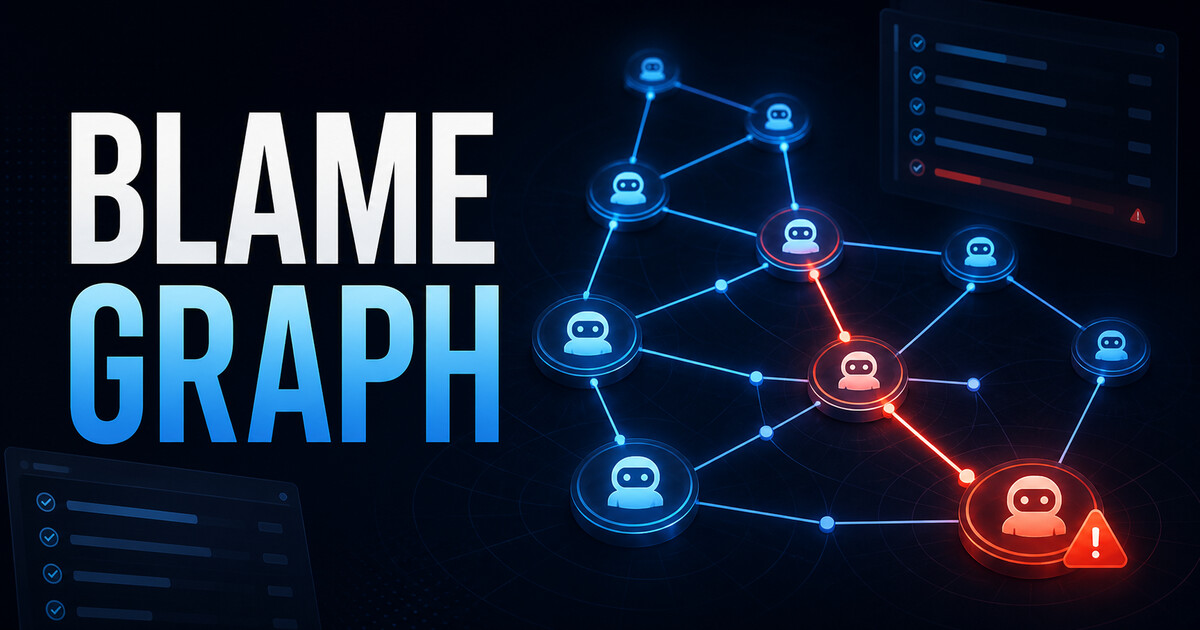
A multi-agent workflow fails. The planner picked the wrong path, the researcher followed it faithfully, the executor called the requested tool, and the reviewer only checked the final shape of the answer. The usual response is dangerously broad: rerun the whole system, ask every agent to reflect, add another critic, or write a new rule for everyone.
That may feel disciplined. It is often how agent systems quietly get worse.
When every agent learns from a failure, even the agents that behaved correctly can absorb a false lesson. The researcher may become less assertive because the plan was wrong. The executor may hesitate on valid tool calls because a downstream review failed. The reviewer may add noisy checks that catch yesterday's bug while missing tomorrow's. What looked like “team learning” becomes memory contamination.
The better question is smaller and more operational: where did the run first become unrecoverable?
That is why recent work on multi-agent failure attribution is worth watching. In “Finding Where the Buck Stops,” the authors argue that failed multi-agent runs often have a decisive error agent and decisive error step, while other agents merely carry out their normal responsibilities. Their DoCtOR framework first diagnoses that decisive failure point, then uses counterfactual reasoning to produce targeted correction rather than forcing the entire group to reflect.
A companion idea appears in “Adaptive Influence Graphs for Failure Attribution in Multi-Agent Systems.” The paper starts from a familiar engineering observation: humans do not debug complex distributed systems by reading raw logs from top to bottom. We use observability tools that organize traces around components, actions, dependencies, and likely causal paths. The authors apply the same intuition to agent teams by transforming a failed trace into a structured influence graph, then navigating that graph to identify the critical error.
A third thread, “Autonomous Repair for Multi-Agent Systems via Monte-Carlo Tree Search,” pushes the next step. Attribution matters because it can feed repair. If the system can localize a bad handoff, mistaken assumption, or failed validation point, repair becomes a bounded search problem instead of a vague instruction to “do better next time.”
For enterprise AI teams, the immediate takeaway is not to install a giant supervisor agent above every workflow. Anthropic’s practical guidance on building effective agents has repeatedly emphasized simple, composable patterns over unnecessary orchestration. A blame graph should be treated as infrastructure, not theater: a compact record of who knew what, who decided what, which tool calls changed state, which checks passed, and where the first consequential divergence occurred.
A useful implementation can start with five fields for every agent step.
First, record the local instruction. What was this agent asked to do at this point in the workflow? Without the local instruction, failure analysis collapses into vibes.
Second, record the evidence boundary. Which files, messages, sources, database rows, screenshots, or API responses was the agent allowed to rely on? If the planner used stale evidence, do not blame the executor for following the plan.
Third, record the decision. This does not need to be a full chain-of-thought transcript. It can be a structured claim: selected vendor A, escalated ticket B, rejected source C, generated patch D, approved release E.
Fourth, record the side effect. Did this step merely draft text, or did it send an email, modify a file, create a ticket, call a payment API, update a patient-facing field, or publish a page? Side effects are where attribution becomes governance.
Fifth, record the validator result. Which check, if any, examined the output before the next agent consumed it?
Once those fields exist, a failure review can ask more precise questions. Did the first bad state enter through evidence acquisition, task decomposition, tool selection, execution, review, or memory writeback? Did a later agent have enough context to catch it? Did the system make the failure more expensive by copying the bad assumption into downstream prompts? Was the memory update justified by a verified correction, or was it just a frustrated postmortem?
This changes the repair loop. Instead of “all agents reflect,” the default becomes “no agent writes durable lessons until attribution passes.” The system can quarantine the failed trace, construct the influence graph, identify candidate decisive steps, and generate a repair item tied to the narrowest affected component. Maybe the planner needs a routing rule. Maybe the researcher needs a freshness check. Maybe the executor needs a pre-action confirmation. Maybe the reviewer needs access to intermediate evidence rather than only the final artifact.
The operational win is humility. A multi-agent system should not assume that a failed run is a team-wide character flaw. Sometimes one component made the wrong turn and everyone else did exactly what the architecture told them to do.
Blame graphs also make human review more useful. A manager, compliance lead, or senior engineer does not need to reread the full transcript of a ninety-minute agent run. They need to see the small set of causal candidates: the first unsupported claim, the first unsafe action, the first missed validator, the first handoff that dropped a constraint. That is reviewable. It is also auditable.
The same structure helps with product decisions. If most failures originate in planning, buy or build better decomposition. If most originate in stale retrieval, invest in data contracts. If failures cluster around tool calls, tighten permissions and preflight checks. If failures happen after review, the reviewer is probably not seeing the right evidence. Without attribution, every roadmap conversation becomes “use a better model.” With attribution, the model may not be the bottleneck at all.
There is a cultural benefit too. Teams are understandably nervous about the word blame. But in this context, blame is not punishment. It is locality. It means the system can say, “this is where the run left the rails,” without turning every downstream component into a suspect. That is how mature engineering organizations handle incidents. They do not ask every microservice to rewrite its identity after a bad deploy. They preserve traces, isolate the causal path, repair the responsible boundary, and improve the detector that should have caught it earlier.
Agent teams need the same discipline. The future of multi-agent reliability will not come from giving every agent more memory and a more dramatic reflection prompt. It will come from making failures smaller, more legible, and less contagious.
Before your agents learn from a failed run, make them prove where the failure started.
Build AI Systems That Survive Contact With Real Work
We help teams turn AI research into practical automations, agent workflows, and operational systems that can be evaluated and improved.
Get the Field Guide — $10 →