
An embedding upgrade can fail without looking broken. Requests succeed. The vector database accepts the dimensions. Search returns plausible documents. Yet the answer that used to be near the top has slipped out of view, and the assistant starts assembling responses from weaker evidence.
The deployment dashboard stays green because the infrastructure is healthy. What changed was the meaning of the numbers flowing through it.
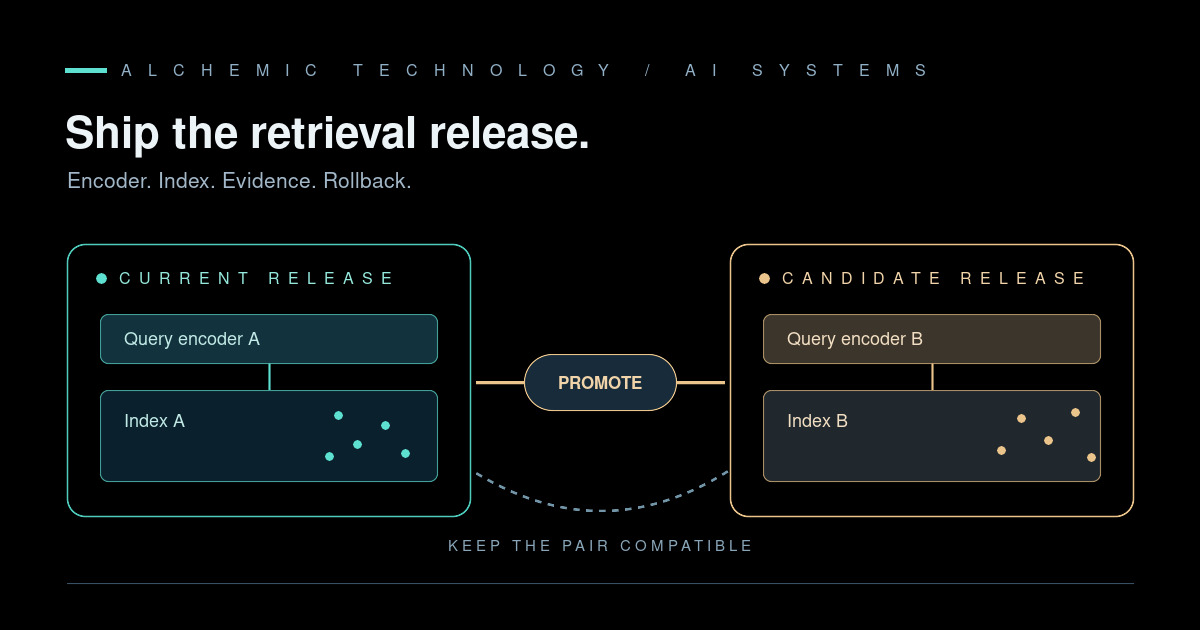
For teams running enterprise search or retrieval-augmented generation, the useful deployment unit is not an embedding model name. It is a retrieval release: a compatible encoder configuration, corpus representation, index, and query path that can be evaluated and rolled back together.
A vector shape is not a compatibility guarantee
OpenAI's embedding guide describes embeddings as vector representations whose distances measure relatedness. It also exposes dimensionality as a configuration choice. That makes vector length an obvious thing to validate, but not a sufficient one.
Two encoders can produce vectors of equal length without producing a shared coordinate system. A database's ability to calculate a distance does not prove that the distance means what your application expects.
The same distinction appears at the storage layer. Qdrant documents dimensionality and distance metrics as collection configuration, including separate configurations for named vectors. Those checks establish storage compatibility. They do not certify your model pairing.
Keep the query encoder and document encoder within the pairing the model supports. They need not be identical: some retrieval systems deliberately use different query and document encoders or instructions. The invariant is compatibility, not symmetry. Changing either side deserves a retrieval test, even when the API accepts every request.
Name the whole release
Start with a small manifest, not a new orchestration framework. Give each retrieval release an identifier and record:
- The supported query/document encoder pairing and configured dimensions.
- Text preprocessing, chunking rules, and document version identifiers.
- The index target and distance metric.
- Authorization filters, ranking configuration, and any reranker version.
- The corpus watermark used to establish ingestion completeness.
These are application design recommendations, not a universal database feature. Their purpose is to make a concrete question answerable: which retrieval system produced this result?
Resolve that manifest once per request. Carry its identifier through query embedding, search, reranking, and answer generation. Otherwise, an in-flight request can obtain a vector under one configuration and search an index selected after the deployment pointer changes.
Keep cache entries release-aware too. A query-embedding cache keyed only by text can quietly reintroduce the old encoder after the rest of the system has moved on.
Build beside production, not through it
A safer migration usually starts with a second retrieval target. Keep the existing path serving traffic while the candidate path receives embeddings generated under its own configuration.
The details depend on the product. Pinecone's current index documentation declares dense-vector dimensions and metrics in its schema; it also describes integrated embedding that handles document text on write and query text during search. Its document-index fields are not freely mutable after creation. That is a product-specific constraint, not a rule for every vector store, but it illustrates why migration planning belongs above a single model setting.
The hard part is often content parity. A candidate index built from yesterday's export is not comparable to production if documents changed this morning.
Establish a source watermark, backfill a known corpus version, then apply subsequent changes until the candidate catches up. Preserve stable source identifiers even if the new chunking strategy changes chunk boundaries. Track updates, removals, and access changes—not just successful inserts.
If you dual-write, do not assume two successful enqueue operations mean two synchronized indexes. Record completion separately and reconcile gaps. A deleted document that survives only in the candidate is a release defect, not an acceptable relevance difference.
Compare evidence, not just similarity scores
Run a fixed evaluation set through both releases. Include exact terminology, paraphrases, ambiguous requests, rare documents, and queries that should produce no useful evidence. Use synthetic or approved data and identical authorization context.
Look first at retrieval: did the relevant source appear, was its version current, and did the system respect access boundaries? Then inspect the downstream answer. A better-looking result list is not enough if the assistant still cites the wrong passage or cannot distinguish insufficient evidence from an answerable question.
Do not carry a similarity cutoff across releases without testing it. A score is a measurement inside a particular representation and ranking setup, not a universal probability of correctness. Calibrate abstention and relevance thresholds against labeled examples for the candidate.
Shadow traffic can expose production query patterns, but it introduces another processing path. Review its data handling before enabling it, and prevent shadow runs from taking downstream actions. Compare latency and resource use as well as quality; backfill and parallel serving must not consume the headroom the live system needs.
Set acceptance criteria before looking at the results. Otherwise, a persuasive demonstration can become an excuse to ignore a regression in the queries your users actually depend on.
Cut over a pair, and keep rollback current
Qdrant's collection aliases provide a useful mechanism: build a second collection in the background, then switch the alias. Its documentation states that alias changes happen atomically.
That guarantee has a boundary. An atomic database alias update does not atomically deploy your application configuration, replace a remote encoder, or invalidate query caches. If the new index receives old query vectors, the cutover is still wrong.
Promote the release mapping that selects the compatible encoder and retrieval target together. Pin each request to an immutable, version-specific target—not a shared alias that can change mid-request—so already-pinned requests finish on their original release. The exact routing mechanism can be simple; the compatibility rule cannot be optional.
Keep the previous release usable for a defined rollback window. That means preserving its encoder configuration and keeping additions, content updates, removals, and permission changes synchronized during that window. Returning to an old index that resurrects withdrawn material is not recovery.
A useful release review ends with a plain question: can we identify the complete retrieval configuration behind an answer, compare it fairly with its predecessor, and return safely if it disappoints?
If not, the next embedding upgrade is not ready—even if every vector has exactly the right length.