
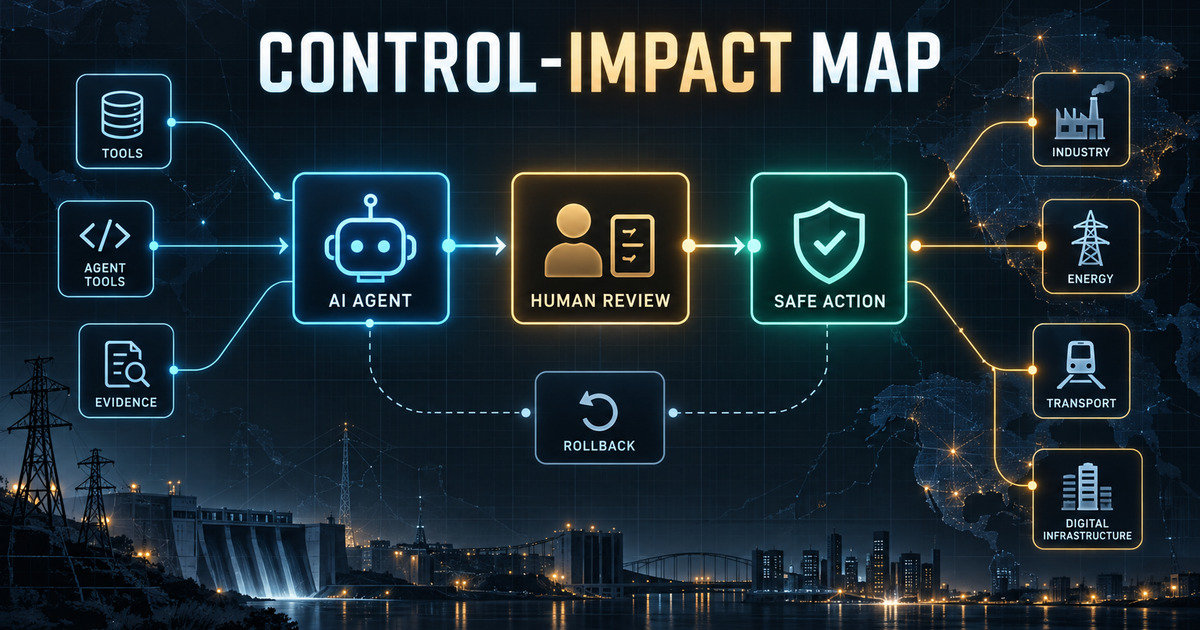
The easiest way to underestimate an AI agent is to describe it by the model it uses. The safer way is to describe what it can move.
A chatbot that summarizes a maintenance note is one kind of system. An agent that can open a work order, change a schedule, approve a record, query a sensitive database, update an access list, or trigger a downstream operational process is another. The difference is not only intelligence. It is impact.
That distinction matters more as agent tooling becomes normal infrastructure. Model Context Protocol servers can expose discoverable tools. Agent SDKs can wrap hosted tools, function calls, and even other agents as callable surfaces. App and tool descriptors can carry schemas, security schemes, and metadata. These are useful advances. They make agent systems more legible and easier to compose. They also make it easier for a team to grant real operational authority before it has written down what that authority means.
For critical infrastructure and other high-consequence environments, the missing artifact is a control-impact map.
A control-impact map is not a policy memo and it is not a model card. It is a small operational table that connects every proposed autonomous action to the thing it can affect, the authority it uses, the evidence it must leave behind, and the way a human can stop or recover the work. It answers a question that broad AI governance often leaves too abstract: which actions can this agent be trusted to take today, under which controls, with what proof?
NIST’s AI Risk Management Framework is useful here because it keeps the conversation anchored in functions an organization can actually perform: govern, map, measure, and manage. NIST’s 2026 concept note for an AI RMF profile on trustworthy AI in critical infrastructure pushes that framing into an even sharper context. Critical infrastructure operators do not only need AI systems that appear accurate in a demo. They need practices that account for safety, continuity, accountability, and operational consequence.
That does not mean every agent workflow needs a year-long compliance program before it can be useful. It means autonomy should be granted by action, not by vibe.
Start the map with the action surface. Name the tool, function, hosted capability, MCP server method, or agent-as-tool entry point the system can call. Do not write “maintenance assistant can manage tickets.” Write “can create a work order,” “can update work order priority,” “can attach a diagnostic note,” and “can close a work order.” Those are different controls. Tool discovery mechanisms such as MCP’s tools/list and tool descriptors in modern app SDKs make this inventory possible, but the inventory still has to be interpreted by the workflow owner.
Next, identify the impacted asset or process. A tool that reads a public status page is not the same as a tool that changes access to a plant system, modifies a care pathway, updates a billing record, or dispatches a technician. This column should be written in business language, not only API language. If nobody can explain what breaks when the call is wrong, the agent is not ready for autonomy on that action.
Then map the authority source. Which credential, scope, service account, delegated user right, or authorization flow lets the agent act? MCP’s authorization specification and OAuth-style patterns are reminders that tool access is never just a function signature. It is a boundary of trust. The map should make clear whether the agent acts as itself, as a user, as a service, or through a brokered approval path. It should also name expiration, revocation, and scope limits where they exist.
The fourth column is the human intervention threshold. Some actions should be fully automated. Some should be draft-only. Some should require approval above a dollar amount, safety class, data sensitivity level, operational region, or uncertainty threshold. The point is to replace a vague “human in the loop” promise with a testable rule. Who sees the request? What context do they see? Can the agent revise and resubmit? What happens if the human rejects, times out, or is unavailable?
The fifth column is evidence. If the agent takes the action, what record proves what happened? At minimum, teams should capture the user intent, tool target, input parameters, policy decision, approval ID if any, model or workflow version, external side effect, and final receipt. This evidence is not only for audits. It is how operators debug an agent that behaved oddly at 2:00 a.m. It is also how teams learn whether a proposed autonomy boundary is working in practice.
The sixth column is safe failure. Agent systems are risky when uncertainty turns into improvisation. For every action, the map should say what the agent does when the tool fails, the environment is stale, the policy check is ambiguous, the result conflicts with another source, or the downstream system returns a partial success. Safe behavior might be retry, pause, escalate, create a draft, open an exception queue item, or run a compensating action. It should not be hidden inside a prompt paragraph that nobody tests.
Finally, add a release probe. Before an action moves from draft mode to autonomous mode, what exact check proves the control works? A good probe is small and mean. It tries a missing approval, a revoked credential, a malformed tool response, a stale context packet, a forbidden asset, or a simulated downstream failure. The goal is not to prove the model is brilliant. The goal is to prove the system refuses, pauses, records, or recovers when the control boundary is touched.
This is where modern agent tooling becomes an advantage rather than a source of mystery. MCP tool schemas and authorization boundaries can feed the action and authority columns. OpenAI-style tool descriptors and security schemes can help expose what the application believes the tool requires. Agent SDK concepts such as hosted tools, function tools, and agents-as-tools make composition explicit enough to review. Anthropic’s guidance on building effective agents reinforces a practical principle: reliable agents are usually assembled from clear workflows and simple patterns, not from unbounded autonomy.
A control-impact map does not make an agent safe by itself. It makes the safety claim inspectable. It gives security, operations, product, and compliance teams the same object to argue over. It also prevents the most common enterprise failure mode: approving “the agent” as if all of its actions carry the same consequence.
They do not. Reading a record, drafting a recommendation, updating a field, issuing a command, and closing an incident are different risk events. Treating them as one permission bundle is how teams accidentally turn a helpful assistant into an unreviewed control plane.
The practical recommendation is simple. Before an agent touches a critical workflow, make the team fill out the map for its top ten actions. If an action cannot be tied to an impacted process, authority source, intervention threshold, evidence trail, safe-failure behavior, and release probe, keep it in draft mode. If the map is clear and the probes pass, grant autonomy narrowly and revisit it when the workflow changes.
The future of critical infrastructure AI will not be decided only by larger models or smoother demos. It will be decided by whether organizations can connect machine action to operational control before something important moves. Autonomy should arrive one mapped action at a time.
Build AI Systems That Survive Contact With Real Work
We help teams turn AI research into practical automations, agent workflows, and operational systems that can be evaluated and improved.
Get the Field Guide — $10 →