
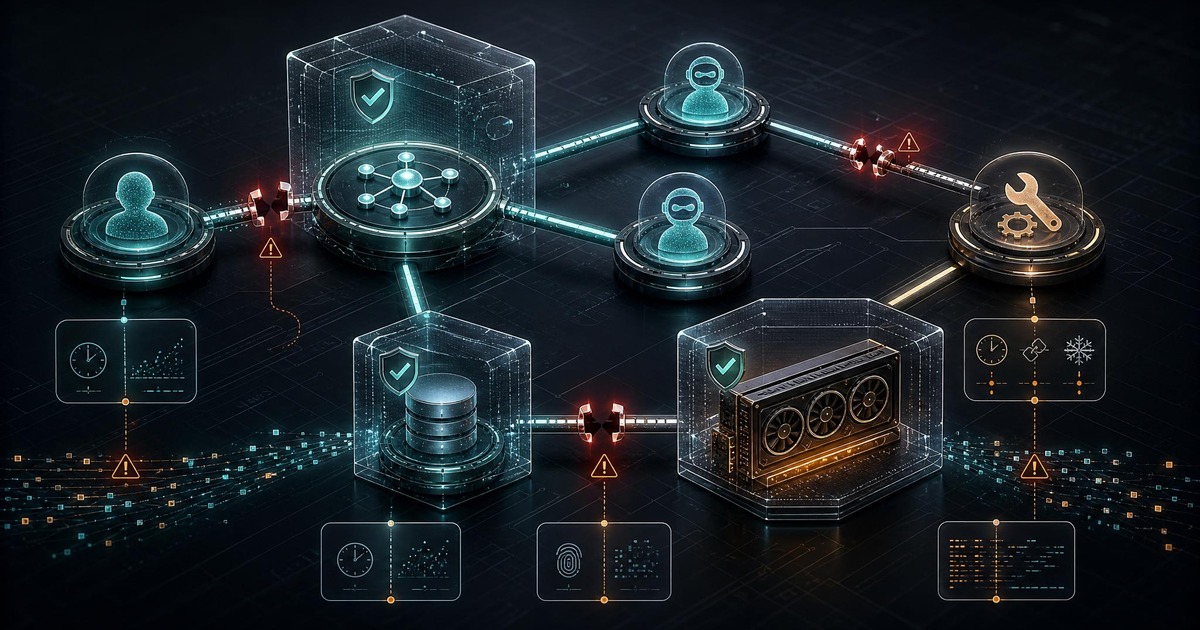
The uncomfortable part of deploying useful agents is not that they can answer questions. It is that they eventually need to hold secrets, read private context, call tools, write to systems, and delegate work across components that do not share one clean trust boundary. A chatbot can be sandboxed like a model endpoint. An agent starts to look more like a distributed operating system with a language model in the middle.
That is why the new arXiv survey "When Agents Handle Secrets: A Survey of Confidential Computing for Agentic AI" is worth attention. The paper does not claim that confidential computing solves agent security. Its value is more practical than that: it gives teams a map for deciding where hardware-backed trust helps, where it does not, and why agent systems need different security architecture than standalone LLM inference.
The core distinction is simple. A normal model call has inputs, weights, outputs, and maybe a logging path. An agent has perception, planning, memory, action, and coordination layers. It may keep long-running memory, hold credentials, interact with MCP or A2A-style protocols, ask another agent for help, and send tool outputs back into a shared context window. Each step creates a new place where data can leak, messages can be forged, stale state can be replayed, or a compromised provider can see more than it should.
The survey argues that software-only defenses are structurally limited against a sufficiently privileged adversary, including a compromised cloud operator. That is the opening for confidential computing. Trusted Execution Environments, or TEEs, are designed to isolate code and data from privileged system software. Remote attestation then lets another party verify what code is running before trusting it. In agent terms, the question becomes: which component needs an attested boundary, and what exactly should that attestation prove?
That question matters because "put the agent in a TEE" is too blunt to be useful. The survey compares six platform families: Intel SGX, Intel TDX, AMD SEV-SNP, ARM TrustZone, ARM CCA, and NVIDIA H100 Confidential Compute. The useful takeaway is not a leaderboard. It is a deployment map. SGX is better framed as protection for narrow sensitive components. TDX and SEV-SNP fit cloud confidential runtimes. TrustZone and CCA matter for edge and Arm deployments. H100 Confidential Compute is relevant when the sensitive computation is large-model inference on a GPU-heavy stack.
The H100 point is especially important for teams buying "confidential AI" claims. GPU confidentiality can protect model weights, activations, and KV-cache state during inference, but the survey notes that it still depends on a CPU-side trust root such as TDX or SEV-SNP for end-to-end system integrity. A confidential GPU is not a standalone trust architecture. It protects one part of the path. Tool calls, logs, memory stores, orchestration code, network messages, and provenance still need their own design.
The paper's most practical design lesson is to protect the highest-value layer, not necessarily the whole stack. If your agent handles customer credentials, the action boundary and secret store may matter more than the model runtime. If it performs retrieval over private documents, the vector store and retrieval path may be the sensitive layer. If it delegates to specialist agents, message authenticity, freshness, and provenance may matter more than encrypting every token of model context.
This is where agent security diverges sharply from ordinary inference security. The survey warns that inference protection transfers poorly to memory and coordination. A system can keep model inference confidential and still leak through persistent memory. It can attest an enclave and still accept a replayed result. It can run a tool server in a trusted environment and still fail to prove which downstream component influenced a delegated answer. Attestation is necessary, but without freshness and provenance it is not enough.
The MCP discussion makes that concrete. The survey summarizes a protocol-level security analysis that identified three weaknesses: no capability attestation, bidirectional sampling without origin authentication, and implicit trust propagation across multi-server configurations. In the cited evaluation, 847 attack scenarios showed MCP architectural choices amplifying prompt-injection success by 23 to 41 percent relative to equivalent non-MCP integrations. The point is not that MCP is unusable. The point is that protocol plumbing becomes part of the security boundary once tools can inject information into model context.
That shifts the builder's checklist. Before adding another tool, teams should ask whether the tool can prove what capabilities it has, whether messages carry origin and integrity metadata, whether outputs are separated by provenance before entering the context window, and whether a compromised or malicious server can inherit trust through the orchestrator. These are not UX details. They are the difference between a tool-using assistant and a distributed system that cannot explain why it trusted an action.
The survey also points to confidential shared memory as an emerging frontier for multi-agent deployments. In its discussion of CAEC on ARM CCA, the paper reports up to a 209x reduction in CPU cycles compared with encryption-based sharing through hypervisor-mediated memory, plus a 16.6 to 28.3 percent total memory footprint reduction when sharing an LLM between two CCA realms. That matters because multi-agent systems often duplicate model state, memory state, or context state. Hardware-supported shared memory under mutual attestation could make some secure multi-agent patterns more practical, especially at the edge.
But this is not mature enough to treat as a default architecture. The survey is clear that confidential shared memory depends heavily on platform semantics. AMD SEV-SNP, for example, uses per-VM encryption keys that make CAEC-style cross-CVM sharing architecturally infeasible without hardware changes. That is a good example of why confidential computing cannot be reduced to a procurement checkbox. The same security goal can be easy, awkward, or unavailable depending on the TEE family.
The open problems are the part practitioners should read twice. Production agent pipelines are multi-hop: user to orchestrator, orchestrator to specialist agents, specialist agents to tools, tools back to memory and planning. Current attestation frameworks are mostly bilateral: one verifier checks one enclave. The survey argues that no current TEE architecture natively provides the kind of transitive, multi-hop attestation calculus needed for agent chains. In plain English: we still lack a clean way to prove the whole path, not just one box in the path.
The same gap appears in RAG. Long-term vector stores are among the most sensitive assets in agent systems, but the survey says they remain unprotected in deployed confidential-computing frameworks. A TEE-backed vector store would need to prove retrieval freshness and provenance without exposing the whole index, support multi-user access control, and integrate with existing retrieval engines. That is exactly the kind of unglamorous infrastructure work that will separate demo agents from operational agents.
So what should a team do now? Start with a threat model by layer. Label what must remain confidential, what must be authentic, what must be fresh, and what must be attributable. Then choose trust boundaries around the highest-risk assets. For many teams, the first useful move will not be confidential GPU inference. It will be attested tool servers, provenance-preserving context assembly, isolated memory services, and a clear policy for which agent outputs are allowed to affect real actions.
The survey's message is not that confidential computing is the answer. It is that agents have made the old answer incomplete. Once software can plan, remember, delegate, and act, security has to follow the chain of influence. TEEs can anchor parts of that chain. They cannot design the chain for you.
Sources
- https://arxiv.org/abs/2605.03213
- https://arxiv.org/html/2605.03213v2
- https://doi.org/10.48550/arXiv.2605.03213
Build Agents That Prove Their Work
If you are wiring agent workflows into real operations, Alchemic can help design the checkpoints, traces, and validation gates that keep automation honest.
Get the Field Guide - $10 ->