
Browser-agent failures are easy to describe and hard to fix. The agent clicked the wrong button. It missed the modal. It copied a stale price. It submitted before the page finished loading. It followed a malicious instruction hidden inside the page instead of the user’s actual goal.
The usual artifact is a screenshot or a screen recording. That helps a human understand the embarrassment, but it rarely gives the engineering team what they need: a repeatable case. If the run cannot be replayed, inspected, and promoted into a regression test, the team is not operating a browser agent. It is operating a very expensive remote intern with amnesia.
The next serious layer for browser automation is not a prettier screenshot. It is a replay harness.
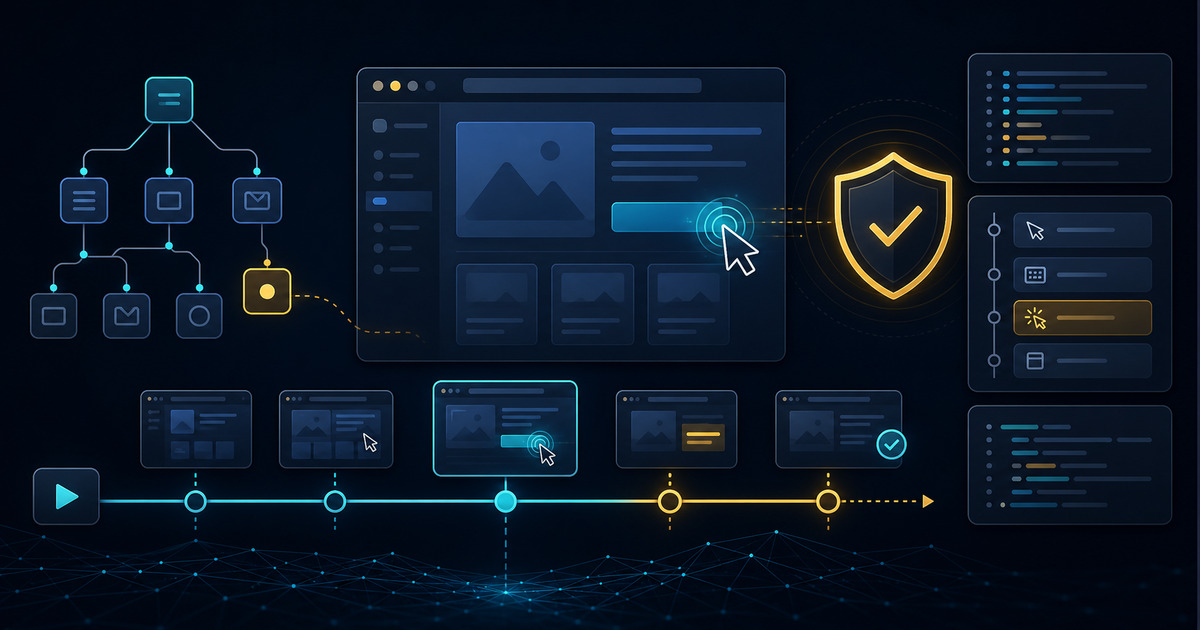
A replay harness treats each browser-agent run as an episode with durable structure: the user instruction, policy context, page observations, element identities, tool calls, timing, network status, errors, intermediate reasoning summaries, and final verdict. It should let the team answer three questions after every failure: what did the agent believe, what did the browser actually expose, and which action should never happen again?
This matters because browser agents sit at the worst possible intersection of AI uncertainty and web fragility. They operate across pages designed for humans, not for models. A button may be visible but disabled. A form may be complete but blocked by an async validation request. The DOM may be huge, noisy, and full of irrelevant elements. A screenshot may reveal layout but hide semantic structure. An accessibility tree may expose structure but miss visual hierarchy. A network event may explain the failure better than either one.
The research direction is already pointing there. The paper [“Building Browser Agents: Architecture, Security, and Practical Solutions”](https://arxiv.org/html/2511.19477v1) argues that browser-agent success is shaped by architecture, context management, execution tooling, safety boundaries, and specialization—not only by model scale. One useful pattern in that paper is the separation of perception from execution: screenshots, accessibility trees, and page snapshots are observation layers; clicks, typing, navigation, and bulk actions are execution layers. In production, that separation should be explicit and recorded.
A screenshot-only workflow collapses all of that into a single picture. A replay harness keeps the layers apart.
The scale problem is real. [Mind2Web](https://osu-nlp-group.github.io/Mind2Web/) was built to evaluate generalist web agents across 2,350 tasks from 137 websites and 31 domains. Its project page notes that real-world HTML can be too large for an LLM context window, and that filtering page content before model use improved effectiveness and efficiency. That is a quiet but important lesson: “give the model the page” is not an operating strategy. The team needs a controlled observation contract that says which parts of the page were visible to the agent, which were filtered out, and why.
That contract becomes more important when the website changes. The [WebArena](https://webarena.dev/) family frames web-agent evaluation around realistic web environments, visual web tasks, evolving environments, and consequential simulated-company work. In the real world, drift is the default. A checkout flow changes. A CRM vendor moves a field. A government site adds an interstitial. A browser agent that passed yesterday can fail tomorrow without any model update at all.
A replay harness should therefore support at least two modes. First, deterministic replay: rerun the exact captured episode against the saved observations to test the agent’s decision logic. Second, live replay: rerun the same task against the current site to detect whether the page, selectors, timing, or policy conditions have drifted. The first mode catches reasoning and control bugs. The second catches environment drift.
Safety adds another layer. The paper [ST-WebAgentBench](https://arxiv.org/html/2410.06703v5) argues that web-agent benchmarks should measure not just task completion, but completion under policy. It introduces policy-aware metrics such as Completion under Policy and models a hierarchy of organizational policies, user preferences, and task instructions. That framing is exactly what enterprise browser agents need. A run that completes the user’s request by violating a data boundary, skipping a confirmation, or taking an irreversible action is not a success. It is a policy failure wearing the costume of productivity.
So the replay artifact should include policy state, not just page state. Was the action destructive? Did it require confirmation? Was the target record inside the agent’s authorized scope? Did the user instruction conflict with an organizational rule? Was a human handoff required? These cannot be reconstructed reliably from a screenshot after the fact.
Good browser-agent infrastructure also needs a debugging interface built for traces, not anecdotes. Browser Use’s engineering writeup on [Online-Mind2Web](https://browser-use.com/posts/online-mind2web-benchmark) is useful here precisely because it describes the operational mess. The company says browser-agent traces can contain millions of tokens, so it built hierarchical trace inspection and found that compact formats mattered for agent-readable debugging. Treat its benchmark claims as vendor-reported, but the engineering lesson is broadly applicable: if every failure requires someone to scroll through an enormous transcript, the team will stop learning from failures.
A practical replay harness has a few concrete parts.
First, capture multiple observation layers. Store the URL, selected DOM or accessibility tree, visible text, a screenshot, relevant console and network events, and any generated element references. Do not dump everything forever. Redact cookies, tokens, personal data, and anything outside the policy boundary. The goal is replayable evidence, not a new data leak.
Second, record the action contract. Every browser action should have a type, target, precondition, postcondition, and policy check. “Clicked submit” is not enough. The useful record is closer to: “clicked the visible Submit button associated with form X after validating required fields Y and Z, under policy P, expecting confirmation state Q.” When that expectation fails, the failure is diagnosable.
Third, make verdicts first-class. The final state should separate task completion, policy compliance, user-visible quality, and operational confidence. A browser agent can complete the task but violate policy. It can follow policy but fail the task. It can do both correctly but rely on a brittle selector that should be fixed before scale-up.
Fourth, promote failures into fixtures. Every meaningful production failure should become a named replay case. The next version of the agent should have to pass it before release. Over time, the replay library becomes more valuable than the original demo set because it encodes the real edges of the business.
Finally, design for human review without depending on human memory. A product manager should be able to watch the run. A security reviewer should be able to inspect the policy boundary. An engineer should be able to replay the failure locally. An agent should be able to read the compact trace and propose a fix. Those are different consumers; the harness should serve all of them.
The hard part of browser agents is not making a model click a button. The hard part is knowing what happened when that click was wrong, proving whether the failure was reasoning, perception, timing, policy, or drift, and preventing the same class of mistake from recurring.
Screenshots are useful evidence. They are not the system of record. Before you let a browser agent near authenticated workflows, ask a simpler question than “how smart is the model?” Ask: when it fails tomorrow morning, can we replay the episode by lunch?
Sources
- https://arxiv.org/html/2511.19477v1
- https://arxiv.org/html/2410.06703v5
- https://webarena.dev/
- https://osu-nlp-group.github.io/Mind2Web/
- https://browser-use.com/posts/online-mind2web-benchmark
Build Agents That Prove Their Work
If you are wiring agent workflows into real operations, Alchemic can help design the checkpoints, traces, and validation gates that keep automation honest.
Get the Field Guide - $10 ->