
The cleanest AI agent demo is usually a straight line. The agent reads the request, makes a plan, calls a few tools, updates the right record, drafts the right message, and reports success. It feels like watching software become staff.
Production is not a straight line.
In production, step six can fail after steps one through five have already changed real systems. Two agents can touch the same customer, ticket, code branch, or order at the same time. A tool can return stale data. A model can make a plausible but wrong inference halfway through a workflow. A human can interrupt after the agent has already acted. The question is no longer, “Can the agent complete the task?” The question is, “What state did it leave behind if it did not?”
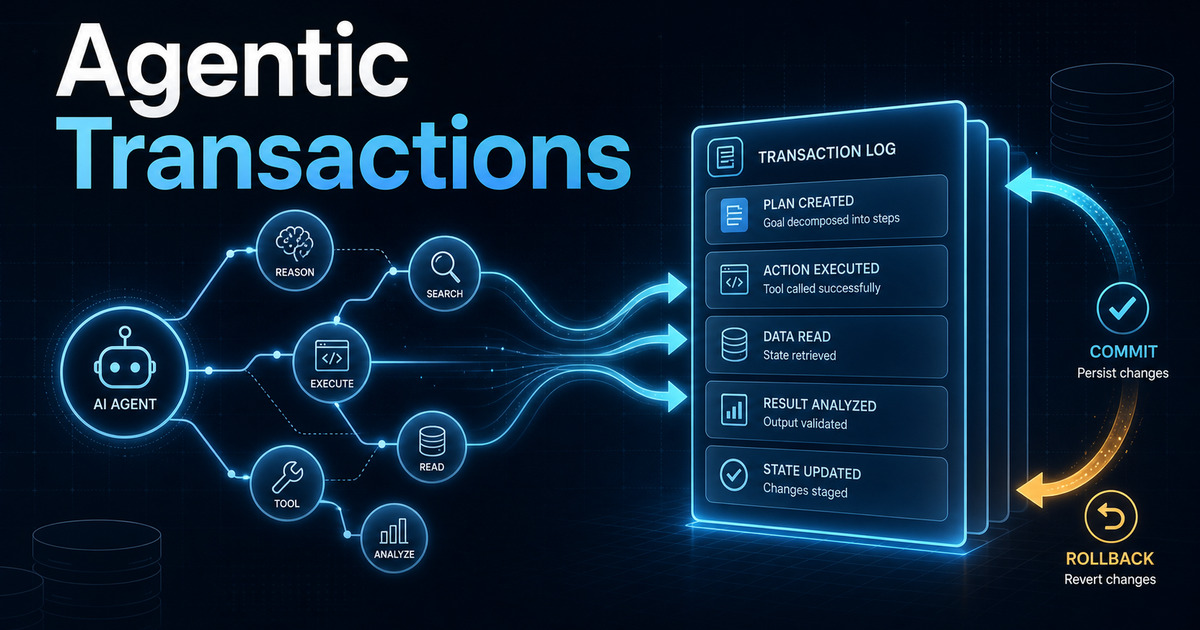
That is why a recent paper, “Agentic Transaction: Towards ACID-Compliant Agent Systems,” is worth paying attention to. The authors argue that LLM agents are beginning to face the same class of reliability problems that database systems have spent decades taming: reliable execution, consistent outcomes, safe concurrency, and durable state. Their proposal is not to pretend that agents are databases. It is to borrow the discipline of transactions and reinterpret it for messy, semantic, tool-using work.
That framing is useful because most agent products still treat execution as a task list. A task list says what the agent intends to do. A transaction boundary says what must be committed, rolled back, isolated, validated, and remembered.
ACID, translated for agents
In databases, ACID stands for atomicity, consistency, isolation, and durability. Those words have precise meanings in storage engines. With agents, they become more semantic and less absolute, but the shape is still powerful.
Semantic atomicity asks: what is the smallest meaningful unit of work that should either complete or be compensated? If an agent updates a CRM field, sends an email, and creates a follow-up task, the platform needs to know whether those actions form one business operation or three independent actions. If the email fails, should the CRM update remain? Should a compensating note be added? Should the whole workflow stop before any external side effect happens?
Semantic consistency asks whether the final state satisfies the task, the policy, and the business rules. A support agent that “resolved” a ticket by inventing a refund policy did not reach a consistent state, even if every API call succeeded. Consistency for agents has to include domain constraints, permission constraints, evidence requirements, and sometimes human approval.
Semantic isolation asks what happens when multiple agents operate in the same environment. This is not theoretical. Enterprise agents will share inboxes, ticket queues, patient records, repositories, calendars, and customer accounts. If two agents race to update the same case, or one agent acts on a workspace another agent is still changing, the failure may look like bad reasoning when the real bug is concurrency control.
Semantic durability asks whether the organization can reconstruct what happened. A durable agent run is not just a transcript. It needs the request, plan, evidence, tool calls, tool outputs, validation checks, decisions, approvals, retries, and final side effects in an event history that can survive crashes and audits.
The arXiv paper proposes an ACID-compliant data-agent framework with exploration-execution-validation cycles, transactional skill hubs, confidence-divergence validation, semantic dependency-aware isolation, and transaction-aware state management. The authors report a 10.6% improvement over state-of-the-art agents, including Claude Code. That number should be treated as a research result to inspect, not a law of nature. The larger point is more important: agent reliability is becoming a systems problem, not only a model-quality problem.
The workflow world already knows this
This is not an alien idea for infrastructure teams. Temporal’s workflow model is built around durable execution, event history, retries, and replay. LangGraph’s documentation now treats durable execution as a core concept for agent workflows. Anthropic’s guidance on effective agents also pushes teams toward systems composed of models, tools, and workflows rather than monolithic “smart prompts.”
The pattern is clear: serious automation systems do not trust one process, one prompt, or one memory buffer to carry the whole burden of correctness. They externalize state. They record events. They make retries explicit. They give operators a way to inspect and recover.
Agent builders should do the same. The difference is that LLM agents add semantic uncertainty on top of ordinary distributed-systems uncertainty. A payment API can fail. A retrieval result can be stale. A model can choose the wrong customer because two names look similar. A policy can be interpreted too loosely. Transaction design does not eliminate those problems, but it gives the platform places to catch them.
What this changes in the build plan
A transaction-minded agent starts with a different design checklist.
First, define the transaction boundary before tool use. “Handle this refund request” may include lookup, eligibility analysis, draft response, manager approval, ledger update, and customer notification. Some of those steps are exploratory. Some are side effects. Some require commit semantics. If the boundary is not explicit, every failure becomes a custom incident.
Second, separate exploration from execution. Let the agent inspect, search, reason, and prepare a proposed action package before it touches production state. The commit step should be narrower than the thinking step.
Third, require action receipts. Every side-effecting tool call should produce a durable receipt: target entity, parameters, authorization context, timestamp, result, and idempotency key where possible. A transcript that says “updated the record” is not enough.
Fourth, design compensating actions. Many real-world operations cannot be rolled back like a database write. You cannot unsend an email. You can send a correction, create a reversal entry, reopen a case, or escalate to a human. Transaction design should name those compensations before launch.
Fifth, isolate shared entities. If agents can act on the same account, ticket, repository, or calendar, the platform needs locks, leases, queues, or a coordinator. Otherwise the organization is debugging race conditions through natural-language transcripts.
Sixth, validate before commit and after commit. Pre-commit validation asks whether the proposed action is allowed and supported. Post-commit validation asks whether the system actually reached the intended state. Both matter because tool success is not the same thing as business success.
Finally, preserve the event log. If an agent’s work is important enough to automate, it is important enough to replay. Durable history is what turns “the agent did something weird” into an inspectable, fixable incident.
The caveat: semantic ACID is not database ACID
There is a trap here. The industry should not pretend that adding the word “ACID” to an agent makes it as deterministic as a database transaction. Database consistency can be defined against schemas and constraints. Agent consistency often depends on policies, evidence, user intent, and domain judgment. Isolation is harder when the shared state includes documents, conversations, and human decisions. Durability is not just storage; it is preserving enough context to understand why a choice was made.
That means agentic transactions should be bounded. Use them around specific workflows with known entities, known tools, known policies, and testable outcomes. Do not sell them as a magic wrapper for arbitrary autonomy.
But also do not ignore the concept because it is imperfect. The alternative is worse: agents that can act but cannot cleanly fail.
The next maturity step for enterprise agents is not giving them longer task lists. It is giving their work the same respect we give any other production operation: explicit boundaries, commit points, isolation rules, validation gates, compensating paths, and durable history.
Autonomy is only useful when failure is recoverable. A transaction log is how an agent earns the right to touch the real world.
Build AI Systems That Survive Contact With Real Work
We help teams turn AI research into practical automations, agent workflows, and operational systems that can be evaluated and improved.
Get the Field Guide — $10 →