
The first time an AI agent breaks in production, everyone wants the trace.
What did the user ask? Which tools did the agent call? What did the model see? Which guardrail fired? Did the handoff happen before or after the failed action? Was the result wrong because the model reasoned poorly, because the tool returned stale data, or because the workflow let a risky step run without approval?
Those are exactly the questions agent observability should answer. Modern agent stacks are moving in that direction. The OpenAI Agents SDK documents tracing around agent workflows, including spans for agents, LLM generations, function calls, guardrails, handoffs, and custom application events. OpenTelemetry’s generative AI semantic conventions give teams a common vocabulary for model operations, usage, request attributes, and response attributes across providers.
That standardization is good news. It means agent teams can debug systems that used to disappear into a prompt window. It also creates a new operational risk: the trace can become an infinite recorder.
For normal software, logs are already sensitive. For agents, traces can be much richer. A single run may include the user’s original request, intermediate prompts, retrieved documents, tool arguments, model outputs, approval decisions, error messages, screenshots, API responses, and workflow state. If an agent works in sales, support, healthcare, finance, legal, or internal operations, that trace may contain customer records, credentials, internal strategy, regulated data, or instructions that were never meant to become durable analytics data.
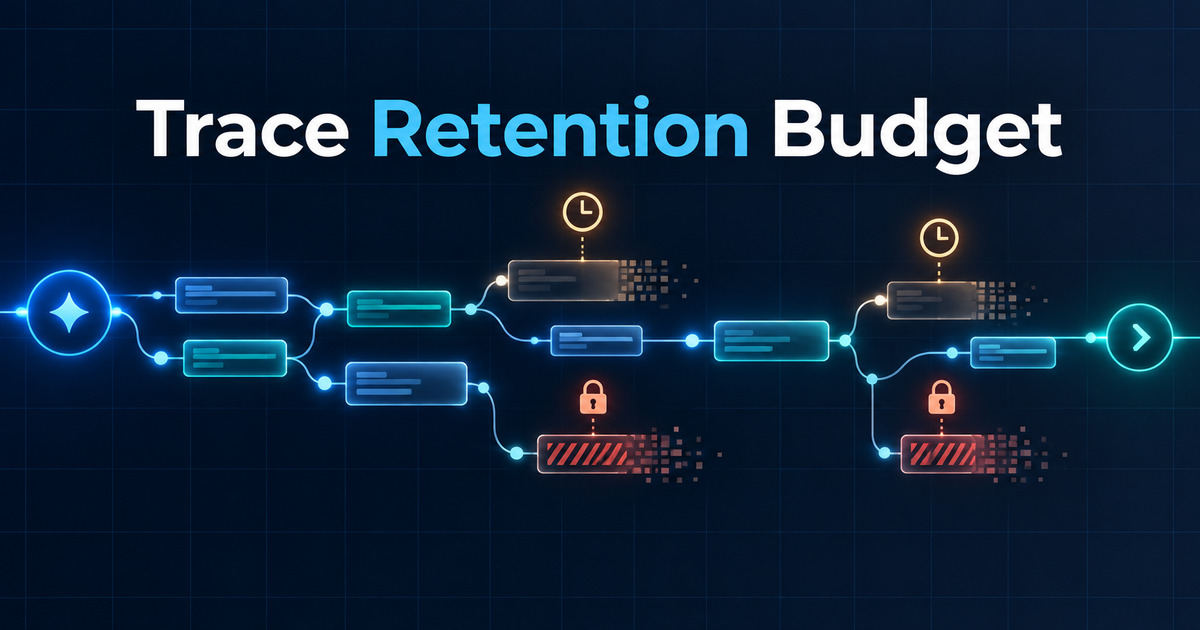
The answer is not to turn observability off. The answer is to give every agent trace a retention budget.
A retention budget is the policy that decides what the system is allowed to remember, at what fidelity, for how long, and under whose authority. It should be designed before the first production incident, not improvised after a compliance review discovers a shadow lake of raw prompts and tool payloads.
Start by separating trace metadata from trace payloads. Metadata is often safe and useful for longer retention: run IDs, agent IDs, tool names, timestamps, latency, token counts, policy decisions, approval IDs, model names, error classes, and links to durable business records. Payloads are different. Raw prompts, tool inputs, retrieved context, generated drafts, uploaded files, and API responses may need much shorter lifetimes or stronger access controls.
That distinction lets teams keep the shape of a run without keeping every sensitive word inside it. An engineer can still see that a refund agent called the account lookup tool, received a policy denial, escalated to a supervisor, and stopped before payment execution. They may not need indefinite access to the full customer message, raw account payload, or model scratch context.
A practical retention budget has tiers.
The first tier is the durable operational ledger. Keep low-risk metadata, policy outcomes, correlation IDs, checksums, and completion receipts long enough to support audit, reliability analysis, and customer support. This tier should answer: what happened, when, under which version of the workflow, and which controls approved or blocked it?
The second tier is short-lived debugging evidence. Raw prompts, model outputs, tool payloads, and retrieved context may be essential for reproducing a failure, but they should have short default TTLs. Thirty days may be too long in one environment and too short in another; the important part is that the period is explicit, enforced automatically, and tied to a real operational need.
The third tier is an incident hold. Some traces need to survive longer because they are attached to a security investigation, customer dispute, safety review, or regulated process. Holds should be deliberate events, not accidental side effects. They need an owner, a reason, an expiration, and an audit trail.
The fourth tier is no-capture or redact-before-export. Secrets, credentials, access tokens, private keys, and unnecessary personal data should not be stored just because they passed through a tool call. In regulated workflows, sensitive payloads may need tokenization, field-level masking, encryption, or storage only in the system of record rather than the observability pipeline.
This is where agent observability connects directly to agent security. The Model Context Protocol security guidance emphasizes user consent and control, least privilege, data privacy, and protections against confused deputy and token-passthrough risks. Those principles should apply to traces too. If a tool should not pass a token downstream, the tracing layer should not quietly persist it. If a user approved an action for one purpose, that approval should not become a blanket license to keep every intermediate artifact forever.
NIST’s AI Risk Management Framework uses governance, mapping, measuring, and managing as lifecycle functions. A retention budget makes those functions concrete for agent systems. Governance defines who can change trace policy. Mapping identifies which workflows produce sensitive artifacts. Measuring tracks capture rates, redaction rates, TTL exceptions, and incident holds. Managing enforces deletion, access review, and escalation rules.
The implementation does not need to be exotic. Add sensitivity labels to span attributes and application events. Redact before export, not after data has already landed in five downstream tools. Store replay pointers instead of raw payloads when the system of record can provide controlled access later. Make retention TTLs part of the trace schema. Keep deletion receipts so the team can prove that expired evidence actually left the observability store. Require elevated approval to open raw payloads, and log that access as its own auditable event.
Most importantly, design for partial visibility. Operators should be able to diagnose many failures from metadata, policy outcomes, and structured error classes. Raw payload access should be the exception path, not the default dashboard experience. If every debugging question requires opening the full prompt and every tool response, the trace design is too coarse.
A good retention budget also improves product discipline. It forces teams to define which agent events matter. It discourages “log everything and figure it out later” instrumentation. It reduces storage cost. It lowers breach impact. It makes customer conversations about AI governance less abstract, because the team can explain exactly what is captured, why it is captured, and when it expires.
The goal is not less observability. The goal is observability that can survive audit.
Production agents need traces because they act across tools, policies, users, and time. But the trace is not just a debugging artifact. It is a record of delegated work. Treat it with the same care as the work itself: scoped, minimized, governed, reviewable, and temporary unless there is a real reason to keep it.
An infinite recorder feels safe during an outage. A retention budget is safer after the outage is over.
Build AI Systems That Survive Contact With Real Work
We help teams turn AI research into practical automations, agent workflows, and operational systems that can be evaluated and improved.
Get the Field Guide — $10 →