
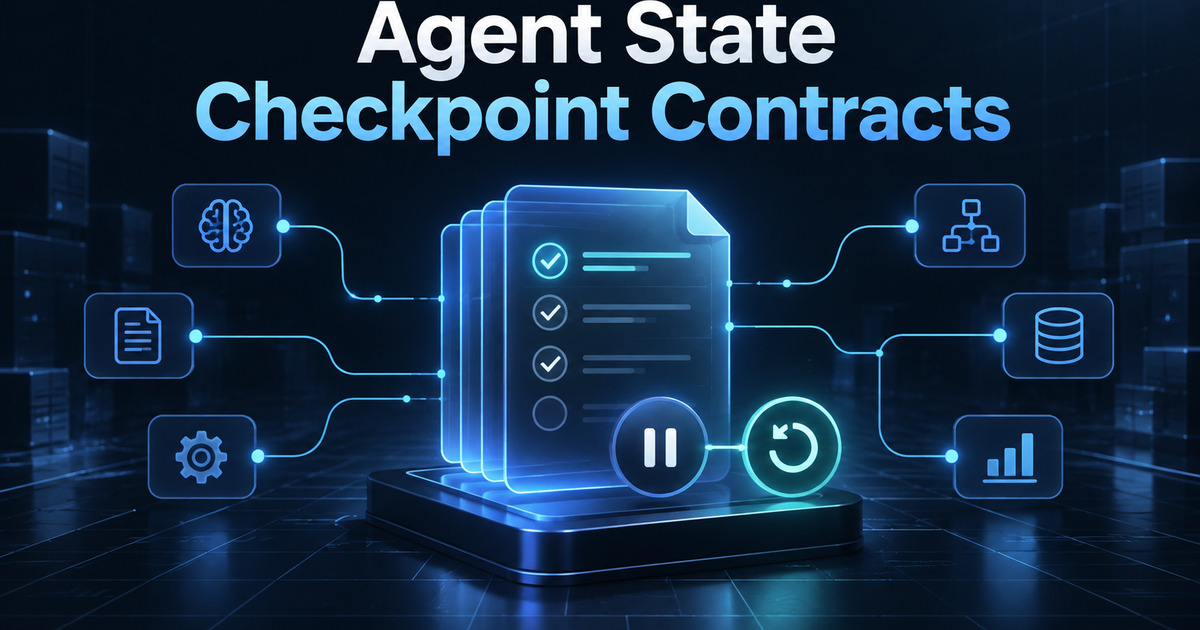
The most dangerous moment in an agent workflow is not always the tool call. It is the resume.
A long-running agent pauses for a human approval, waits for a slow API, retries after a timeout, hands off to another model, or comes back after a deploy. Everyone assumes it is continuing the same task. But unless the system can say exactly what state was preserved, what evidence was current, which side effects already happened, and which permissions still apply, the agent has quietly forked into a new reality.
That is why production AI teams need to stop treating state as an implementation detail. They need checkpoint contracts: explicit, durable records that define what it means for an agent to pause, recover, retry, or resume.
This is not the same thing as memory. Memory helps an agent carry useful facts forward. A transcript records what was said. An audit log records what happened. A checkpoint is the operational boundary that lets the system safely continue work. It should be precise enough for software to enforce and readable enough for a human reviewer to understand.
The tooling ecosystem is already pointing in this direction. LangGraph’s persistence documentation frames checkpointers and stores as core capabilities for agents that need short-term state, long-term memory, interrupts, and continuation beyond a single run. OpenAI’s Agents SDK documents sessions, interrupted-run resumption, history merging, history limits, and memory operations instead of assuming every run is a fresh prompt. OpenTelemetry’s Generative AI semantic conventions are pushing agent activity into traceable spans. NIST’s AI Risk Management Framework keeps the broader governance pressure clear: organizations need ways to govern, measure, and manage AI behavior, not merely deploy it.
The practical lesson is simple: if an agent can resume, the resume boundary deserves a contract.
A useful checkpoint contract starts with the task objective and plan version. What is the agent trying to accomplish, and which plan or workflow definition was active when it paused? If the plan changed during a deploy, the system should not silently continue as if nothing happened. It should either migrate the checkpoint through a known rule or escalate for review.
Next comes the evidence snapshot. Agents increasingly work over changing systems: tickets, customer records, repositories, calendars, policies, knowledge bases, and external web pages. A checkpoint should record the important evidence identifiers, retrieval timestamps, source versions where available, and any derived summary that the agent is relying on. Otherwise a resumed agent may reason from a compressed memory of documents that no longer say the same thing.
The third piece is a side-effect ledger. Which tool calls were attempted? Which ones committed changes? Which ones were read-only? Which ones failed ambiguously? This matters because retrying a workflow is not the same as replaying a pure function. Sending a message, creating a ticket, issuing a refund, updating a patient workflow, or modifying a repository can have external consequences. A checkpoint should make duplicate prevention explicit instead of hoping the model remembers what it already did.
The fourth piece is permission state. Human approvals, delegated authority, credential scopes, and policy exceptions should not float around as prose in a chat. A checkpoint should capture who or what granted authority, what action it covered, when it expires, and what must happen if the resumed run wants to exceed that scope. This turns approval into infrastructure rather than ceremony.
The fifth piece is runtime identity. Which model, prompt version, tool schema, policy bundle, and environment was active? The point is not to freeze every agent forever. The point is to make change visible. If a resumed run uses a different model or tool definition, that may be fine, but it should be a recorded transition rather than an accidental one.
The sixth piece is trace correlation. Checkpoints should connect to trace IDs, span IDs, and structured events. Persistence without observability creates another black box. Observability without durable state only tells you what happened after the fact. Together, they let a team answer the hard incident questions: where did the run pause, what state was restored, which decision changed, and which external side effect followed?
Finally, every checkpoint needs a resume policy. Some checkpoints can continue automatically. Some require revalidating evidence. Some require a human to reapprove the next side effect. Some should abort because the world changed too much. The policy should be encoded close to the checkpoint, not buried in operator intuition.
For enterprise teams, this is not just engineering neatness. Checkpoint contracts reduce operational superstition. They let teams deploy new agent code without guessing whether old runs are safe. They make retries safer. They make incident review less dependent on screenshots and Slack archaeology. They help compliance and security teams inspect the actual control boundary rather than arguing about whether the agent “had context.”
The smallest useful implementation is not complicated. Start with the workflows where resumption is already risky: approval gates, tool retries, customer-impacting actions, data updates, and multi-step handoffs. At each boundary, persist a structured checkpoint with the objective, evidence references, side-effect ledger, permission state, runtime identity, trace correlation, and resume policy. Make those checkpoints queryable. Add tests that kill the process mid-run and verify the system resumes safely. Treat summarization and compaction as governed transforms, not invisible cleanup.
There is also a design discipline here: do not let “memory” become a bucket for everything. Memory can personalize and accelerate. Checkpoints must constrain. They are the difference between an agent that vaguely remembers a task and an automation system that can prove where it is in the task.
The next generation of production agents will feel continuous to users. They will pick up work across hours, systems, and human reviews. But that continuity should not come from pretending nothing happened between pauses. It should come from explicit state boundaries that make recovery boring.
That is the real resume layer: not a longer context window, not a prettier transcript, and not another dashboard. A checkpoint contract is the promise that when an agent starts again, the organization knows what is starting, what came before it, and what it is still allowed to do.
Build AI Systems That Survive Contact With Real Work
We help teams turn AI research into practical automations, agent workflows, and operational systems that can be evaluated and improved.
Get the Field Guide — $10 →