
The first time an AI agent uses a well-written skill, it feels like cheating in the best possible way. A messy recurring task becomes a named procedure. The agent loads the right context, follows the checklist, calls the right scripts, and stops making the same beginner mistake every morning.
Then the skill library grows.
A support workflow gets five variants. A code-review checklist quietly conflicts with last month’s security guidance. A spreadsheet export skill still assumes the old schema. A deployment playbook includes a permission that was reasonable during a migration and reckless afterward. Nothing looks broken in isolation, but the agent is now carrying a junk drawer of procedural memory into production work.
That is why the next phase of agent operations is not simply “write more skills.” It is skill lifecycle management.
Anthropic’s Agent Skills framing is useful because it makes the artifact concrete. A skill is not magic memory and not a model weight update. It is a folder of instructions, scripts, and resources that an agent can discover and load when a task calls for specialized procedural knowledge. Anthropic compares the idea to an onboarding guide for a new hire: a portable way to package how an organization actually does work.
That analogy is strong, but it also exposes the risk. Nobody wants a new hire trained from ten stale onboarding guides, three conflicting Slack threads, and a runbook whose owner left six months ago. Agent skills need the same discipline we expect from any operational asset: ownership, tests, change history, permissions, and retirement.
A new arXiv paper, SkillProx: Self-Evolving Agent Skills via Proximal Textual Gradient Descent, gives this problem a sharper research vocabulary. The authors describe the current pattern plainly: LLM agents adapt to recurring tasks by accumulating lightweight textual skills that are loaded into context without changing model weights. The weakness is also familiar. Existing systems can keep editing those skills, but they often lack explicit diagnosis-to-outcome feedback, and they treat deletion as just another edit rather than a deliberate knowledge-consolidation step.
SkillProx proposes a two-part loop. In the forward stage, the system re-executes diagnosis-driven edits on the same task batch, measures whether the edit helped, rolls back regressions, and feeds the measured outcome into later diagnoses. In the backward stage, it decomposes the skill into auditable knowledge units, estimates the utility of each unit with a frozen leave-one-out audit, and then validates whether a unit should be consolidated, demoted, or removed. Across the authors’ reported benchmarks, this improved average accuracy by 3.0 percentage points over the strongest gradient-based baseline.
The exact method may or may not be the mechanism your team uses. The operating lesson is bigger: skill maintenance should be measured, reversible, and pruning-aware.
For an enterprise agent program, that means every skill deserves a lifecycle record. Who owns it? What task is it supposed to improve? What examples prove it still works? What tools or permissions does it assume? What newer skill supersedes it? What would make it unsafe to load?
Without those answers, a skill library becomes a shadow policy system. The agent may be following instructions that never went through the same review as the application code, support SOP, or compliance procedure they effectively modify.
Start with trigger control. A skill should describe when it applies and, just as importantly, when it does not. Broad triggers feel convenient, but they increase accidental activation. If a “production recovery” skill loads during a harmless local test, the agent may bring emergency assumptions into a low-risk task. If a “customer response” skill loads for an internal note, tone guidance can leak into operational analysis. Good skills are specific enough to be useful and narrow enough to be safe.
Next, create replay tasks. A skill that matters should have a small set of examples it must handle before and after edits. These do not need to be heavyweight benchmarks. They can be saved transcripts, synthetic tasks, fixture repos, or dry-run work orders. The important part is that edits are judged against the reason the skill exists, not against whether the new prose sounds better.
Then audit contribution. SkillProx’s leave-one-out framing is useful even as a manual habit. If a skill has fifteen rules, which five actually prevent failures? Which three are redundant with newer platform behavior? Which one causes the agent to overfit to an old incident? Teams should not be afraid to split a skill, demote a section into a reference file, or retire a rule that no longer earns its place in context.
Permissions need their own review. Anthropic’s Claude Code documentation treats skills as operational artifacts that may include supporting files, lifecycle guidance, tool pre-approval, dynamic context, and subagent patterns. That makes them powerful. It also means a skill can quietly expand what an agent is likely to do. A reporting skill that only reads files has a different risk profile from one that sends email, opens tickets, or runs shell commands. The permission surface should be visible in the skill review, not discovered after the agent acts.
Finally, connect skills to governance instead of pretending they are only engineering conveniences. Another recent arXiv paper, Taxonomy-Driven Analysis of Open-Source AI Risk Mitigation Tools, found that open-source mitigation tools cluster around technical and operational controls while governance, legal and regulatory, and financial and market controls remain comparatively under-addressed. Skill libraries sit directly in that gap. They are technical artifacts that encode organizational process. If nobody maps them to risk categories, they can create the illusion of control while bypassing the people accountable for the process.
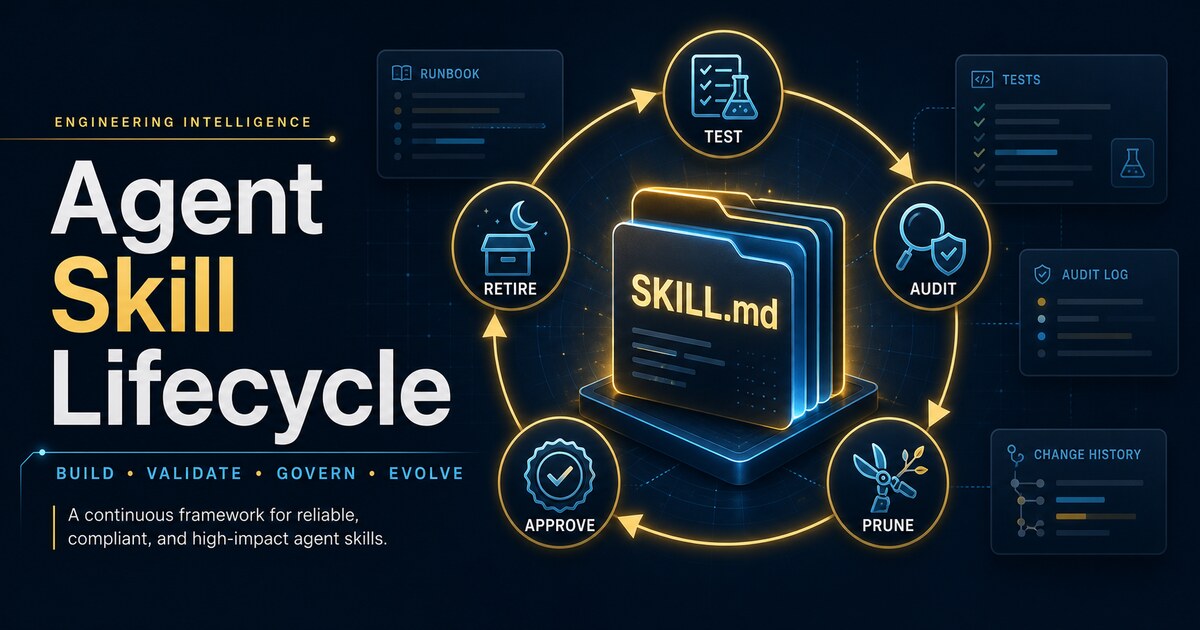
A practical agent-skill maintenance loop can be simple:
1. Give every production skill an owner and purpose. 2. Define activation boundaries and known non-use cases. 3. Keep a replay set that catches regressions. 4. Review tool permissions and side effects. 5. Track changes with reasons, not just diffs. 6. Consolidate duplicate skills before adding new ones. 7. Retire stale instructions through a visible deprecation path.
The goal is not bureaucracy. The goal is keeping procedural knowledge usable after it becomes valuable.
Agent skills are one of the cleanest ways to turn a general model into a working teammate. They let teams package hard-won context without fine-tuning a model or building a bespoke agent for every workflow. But the more they matter, the less they can be treated like prompt scraps.
A skill is a small production dependency. If your agent relies on it to act, your organization relies on it too. Maintain it accordingly.
Build AI Systems That Survive Contact With Real Work
We help teams turn AI research into practical automations, agent workflows, and operational systems that can be evaluated and improved.
Get the Field Guide — $10 →