
The easiest way to make an AI agent feel magical is to let it remember everything. Keep the whole conversation. Keep the tool traces. Keep the approvals. Keep the user’s preferences, exceptions, and half-finished plans. Then, when the next request arrives, pour all of that state back into the model and call it continuity.
That works until it does not.
A production agent can be correct inside one turn and unsafe across turns. Yesterday’s approval can look like permission for today’s action. A tool result meant for one customer can become context for another workflow. A temporary exception can survive longer than the person who granted it intended. A handoff can inherit a confident summary without carrying the evidence needed to verify it.
The fix is not simply “less memory.” The fix is a stronger boundary around the session.
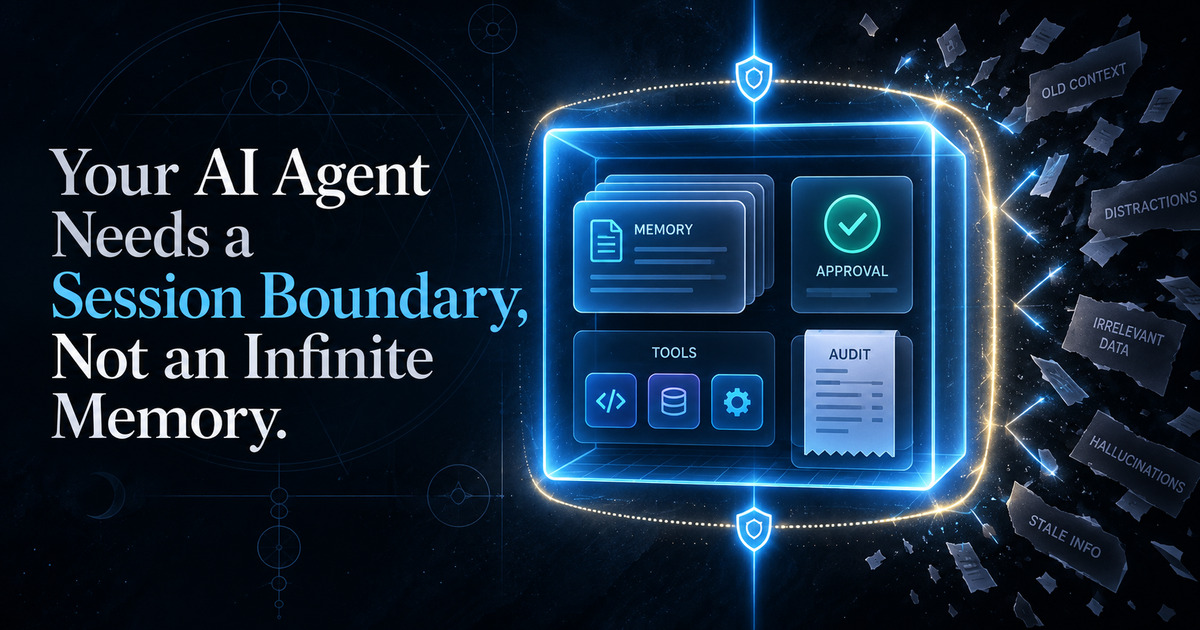
A session boundary is the operational contract that says what state belongs to this run, this user, this task, this approval window, and this set of tools. It defines what the agent may replay, what it must summarize, what it must discard, what it must ask again, and what evidence has to travel with a decision. In serious agent systems, the session is not chat history. It is policy infrastructure.
That shift is already visible in the tooling. OpenAI’s Agents SDK documents sessions as first-class containers for conversation history in a workflow or thread, with built-in and pluggable session implementations. That may sound like plumbing, but it is an important design signal: state is no longer just whatever happens to be in the prompt. It is an object the runtime can store, inspect, replace, and govern.
Once session state becomes explicit, teams can stop treating memory as a pile of text and start treating it as a scoped resource.
The first question is retention. Not every piece of context deserves the same lifetime. A user preference may be safe to keep. A one-time approval for a payment, export, deployment, or record update should expire. A raw tool output may need to be retained for audit, summarized for the model, and withheld from unrelated future turns. A failed tool call may be useful for debugging but dangerous as instruction-like context.
Without a session boundary, those distinctions blur. The model receives “context,” and the team hopes the prompt explains what still matters. With a boundary, the runtime can enforce different paths: durable memory, short-lived working state, audit-only evidence, redacted summaries, and expired approvals.
The second question is guardrails. OpenAI’s Agents SDK describes guardrails that can validate inputs and outputs and trip when a condition fails. Guardrails are more useful when they know the state they are judging. An output that is acceptable in a customer-support session may be unacceptable in an admin session. A tool call that is fine after fresh human approval may be wrong after the approval window closes.
This is where session design becomes more than developer convenience. A guardrail should not have to infer the agent’s authority from a long prompt. It should be able to ask the runtime: What session is this? Who owns it? What task is active? What approvals are fresh? Which tool outputs are evidence, and which are merely model-visible notes? What data classes are allowed in this scope?
The third question is authorization. The Model Context Protocol specification includes an authorization model for access to protected resources. That matters because agent sessions often sit between a user intent and a tool server with real privileges. If the session does not carry explicit authorization context, access can drift. The agent may start with one purpose, accumulate context from several tool calls, and later use a capability in a way that no longer matches the original reason it was granted.
A safer pattern is to bind tool access to the session’s declared purpose. The session should know which resources were authorized, by whom, for what task, under what conditions, and until when. If the task changes, the agent should not quietly reuse the same authority. It should narrow, refresh, or re-request access.
The fourth question is observability. Anthropic’s Claude Code docs describe hooks that can run deterministic commands at lifecycle events such as prompt submission, pre-tool-use, post-tool-use, and stop. The broader lesson applies beyond one product: agent runtimes need lifecycle events that policy can observe. Session start, session resume, approval grant, tool call, handoff, summary creation, and session close should be inspectable transitions.
That gives operators places to attach checks that do not depend on the model behaving well. Before a tool call, verify that the session still has authority. After a tool call, label the output as evidence, scratch data, or sensitive data. Before a summary replaces raw context, record what was omitted. At session close, expire temporary state and preserve the audit trail.
A practical session boundary does not need to be elaborate on day one. It does need to be explicit. For each production agent, define at least seven fields.
First, the session owner: user, team, system, or delegated agent. Second, the active purpose: the job this session is allowed to pursue. Third, the state classes: durable memory, working memory, evidence, secrets, approvals, and discarded material. Fourth, the tool authority: which tools and resources are in scope. Fifth, the freshness rules: when approvals, evidence, and summaries expire. Sixth, the handoff rules: what can move to another agent or workflow. Seventh, the audit record: the IDs that let a human reconstruct what happened without replaying sensitive raw context into the model.
This is not bureaucracy for its own sake. It is how agent systems avoid turning convenience into ambient authority.
NIST’s AI Risk Management Framework frames AI risk management as an ongoing lifecycle practice across govern, map, measure, and manage functions. Agent builders often agree with that at the policy level, then struggle to connect it to runtime artifacts. Session boundaries are one of those artifacts. They turn governance language into something an engineer can implement and a reviewer can test.
The test is simple: if an agent resumes tomorrow, can you prove what it is allowed to remember and do? If a user changes the task, can the runtime detect that old authority no longer applies? If a summary replaces raw context, can you trace which evidence supported it? If another agent receives a handoff, does it receive a scoped packet or a vague narrative?
Infinite memory feels powerful because it removes friction. Production systems need the right friction in the right places. A session boundary gives the agent enough continuity to be useful without letting yesterday’s context become tomorrow’s unreviewed permission.
The next generation of agent reliability will not come only from larger models or longer context windows. It will come from runtimes that treat state as governed infrastructure. The agent should remember what helps, forget what expires, ask again when authority changes, and leave behind a record that humans can trust.
That starts with drawing a line around the session.
Build AI Systems That Survive Contact With Real Work
We help teams turn AI research into practical automations, agent workflows, and operational systems that can be evaluated and improved.
Get the Field Guide — $10 →