
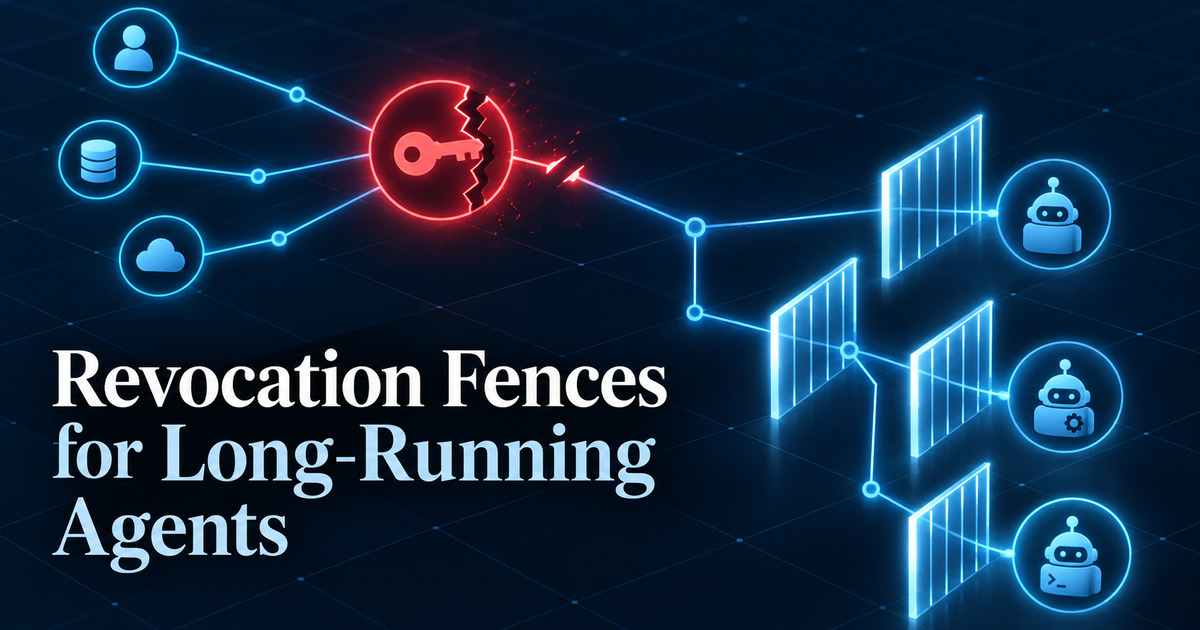
A stop button is not the same thing as stopped work.
That distinction becomes uncomfortable once an AI agent is allowed to do anything beyond draft text. A production agent may hold credentials, delegate subtasks, reserve capacity, schedule callbacks, enqueue jobs, call provider-side operations, or hand work to another service that will continue after the original chat window disappears. From the user’s point of view, they clicked cancel. From the system’s point of view, there may still be old authority moving through pipes the cancel button never touched.
This is why the next layer of agent infrastructure needs to be a revocation fence, not just a kill switch.
A kill switch answers a narrow question: did someone request that the agent stop? A revocation fence answers a harder operational question: after a root authorization is retired, what paths can still create effects, what has been blocked from expanding, and what evidence proves the boundary held?
A recent arXiv paper, “Authorization Revocation for Long-Running AI Agents: Root-Scoped Quiescence under Delegation and Asynchronous Execution,” gives useful language for this problem. The paper starts from a simple observation: long-running agents can outlive their initiating process through credentials, delegated tasks, queues, callbacks, reservations, and provider-side operations. Process exit, cancellation, and credential revocation do not automatically close every carrier that was accepted before the cut.
That is the uncomfortable part for enterprise teams. Most agent demos assume a short loop: plan, call tool, observe, answer. Most real deployments drift toward a longer shape: plan, call tool, wait, retry, hand off, resume, reconcile, notify, and maybe continue tomorrow. Authority does not stay in one neat process. It gets materialized into tokens, queued messages, pending tool calls, provider requests, scheduled jobs, and downstream records.
If the business says “revoke this agent’s authority,” the platform has to do more than send a polite cancellation event.
The paper’s core concept is root-scoped authorization quiescence. In plain English, the system chooses a root authorization epoch, cuts it, fences old-root expansion, accounts for relevant acceptances, and produces a certificate about the bounded manifest it inspected. The important word is bounded. This is not magic proof that the whole business is idle. It is evidence that, within the registered paths and assumptions, retired authority cannot keep expanding into protected sinks.
That framing is useful because it avoids two common overclaims.
The first overclaim is “we revoked the token, so we are safe.” Revoking a token may prevent new uses of that token at one boundary. It does not necessarily explain what happened to work already accepted under that token, work copied into another channel, or work that has been rebound to another support set.
The second overclaim is “we canceled the run, so nothing else can happen.” Canceling a run may stop one runtime from taking another step. It does not automatically cancel a provider-side operation, recall an email already handed to a delivery service, reverse a queued payment instruction, or invalidate a callback that another worker already accepted.
A revocation fence is a design pattern for refusing those overclaims.
At minimum, the control plane needs an authority manifest. The manifest says which root authorization allowed which agent, run, tool, credential, queue, reservation, callback, and downstream provider request to exist. Without this map, revocation becomes theater. The system can invalidate the obvious credential while missing the quiet carrier that matters.
Next, the platform needs explicit cut points. A cut point is the moment the old root is retired. After the cut, the system should prevent old-root expansion: no new delegated tasks, no new protected tool calls, no new queue acceptances, no new callback registrations, and no new provider operations that depend only on the retired root.
Then come provider frontiers. Every real system has boundaries it does not fully control: a payment processor, an email provider, a cloud job runner, an EHR interface, a browser automation environment, an MCP server, or a partner API. The revocation fence should ask each frontier for evidence: what was accepted before the cut, what was rejected after the fence, what remains pending, and what has independent authority to continue?
That last clause matters. The goal is not to freeze the company every time one agent loses authority. Some work may have a separate, current, independently sufficient authorization basis. A team member may re-approve it. A different root may validly support it. A policy may require completion of a safety or compliance task even after the initiating agent is retired. A serious revocation system needs to distinguish old-root residue from independently authorized continuation.
This is where the idea lines up with the broader movement in agent infrastructure. The Model Context Protocol authorization specification is a reminder that tools are no longer just functions inside one process; they are protocol boundaries with authorization semantics. Agent SDKs increasingly model execution as runs, sessions, hooks, tools, interruptions, and resumable state. NIST’s AI Risk Management Framework gives the governance language: map the risk, measure it, manage it, and govern it.
A revocation fence turns that governance language into an engineering artifact.
The receipt should be boring and specific. It should name the retired root. It should name the manifest version. It should list the carriers inspected. It should show which frontiers were fenced. It should record which acceptances were pre-cut, which attempts were post-cut and rejected, which items were independently rebound, and which items remain indeterminate because evidence was missing or conflicting.
Indeterminate is not failure. Indeterminate is honesty. It tells operations, compliance, and product owners that the system found a path it could not prove safe. That path can then move to an exception queue, require human review, or trigger a narrower containment action. The worst outcome is not an indeterminate item. The worst outcome is a green checkmark that quietly ignores a carrier the platform never modeled.
For builders, the implementation sequence is straightforward.
First, stop treating agent authority as a single API key. Track the root authorization that created each run and every durable carrier created from it. Second, make tool adapters return durable acceptance records, not just success strings. Third, require long-running providers and queue workers to expose fence operations or at least auditable frontier status. Fourth, block old-root expansion before trying to reconcile every old effect. Fifth, issue a revocation certificate that is scoped, testable, and humble.
This also changes how teams should test agents. A good revocation drill is not “press cancel and see whether the UI stops spinning.” It is: start an agent, let it delegate work across at least two boundaries, revoke the root, restart a worker, replay a callback, attempt a stale tool call, and verify that protected sinks reject old authority. Then inspect the certificate. Does it explain what happened? Does it identify the frontier evidence? Does it preserve legitimate independently authorized work? Does it clearly mark anything unknown?
That is the bar production systems are moving toward.
As agents become more useful, they will become more asynchronous. As they become more asynchronous, authority will become harder to see. The teams that win will not be the ones with the most dramatic stop button. They will be the ones that can prove what the stop button actually fenced.
The question for a production agent platform is no longer “can we cancel the run?”
The better question is: after revocation, what old authority can still create effects — and where is the receipt that says it cannot?
Build AI Systems That Survive Contact With Real Work
We help teams turn AI research into practical automations, agent workflows, and operational systems that can be evaluated and improved.
Get the Field Guide — $10 →