
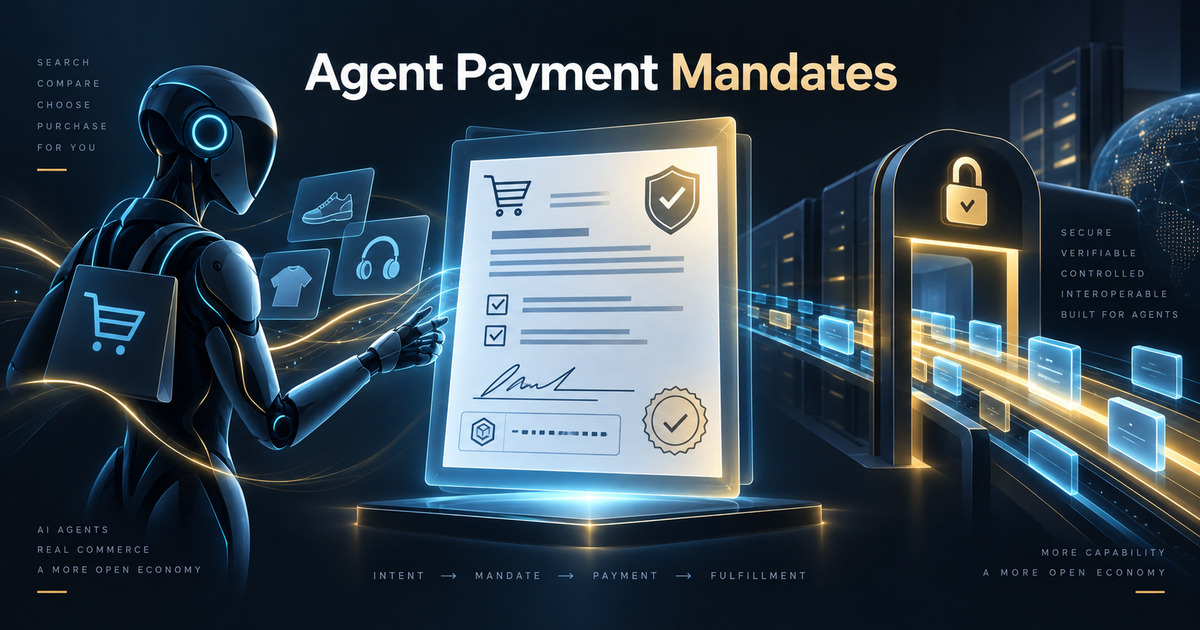
The easiest version of agentic commerce is also the least useful one: give an AI assistant a payment method, let it browse, and hope the transcript proves that whatever happened was what the user meant.
That might be enough for a demo. It is not enough for a chargeback, a fraud review, a billing audit, or a customer asking why an agent bought the wrong thing.
Payments are where vague agent consent stops working. A calendar mistake can be embarrassing. A bad support reply can be escalated. A payment creates liability. It moves value. It involves merchants, processors, credential providers, dispute rules, privacy obligations, and a user who may not be present when the final action occurs. If the only evidence is “the model seemed to understand,” the system is not ready.
That is why Google’s open Agent Payments Protocol work is worth paying attention to. The important lesson is not simply that agents may soon shop on a user’s behalf. The lesson is that autonomous commerce forces agent builders to separate probabilistic planning from deterministic authorization.
AP2 frames the problem plainly: existing payment infrastructure assumes a human is directly interacting with a trusted interface. Agentic commerce breaks that assumption. A shopping agent may research products, assemble a checkout, negotiate constraints, and act later. The hard questions become operational, not conversational: what proves the user gave this agent authority, what exact checkout was approved, what limits applied, who verified them, and what evidence survives a dispute?
The protocol’s answer is the mandate.
In AP2, a Checkout Mandate provides cryptographic proof that the shopping agent is authorized to purchase a particular checkout. A Payment Mandate authorizes payment for that checkout. Receipts come back after verification. The specification splits responsibility across roles such as the Shopping Agent, Credential Provider, Merchant, Merchant Payment Processor, and Trusted Surface. That may sound like payments plumbing, but the architectural pattern is broader: the agent can propose and coordinate, while deterministic components verify authority before consequential action.
The Trusted Surface is the most important detail. AP2 says the Trusted Surface must be non-agentic. In plain English: the place where the user gives consent cannot itself be another probabilistic agent improvising over the rules. Validation and processing must happen in deterministic code even when other roles involve LLMs.
That boundary is exactly what many enterprise agent deployments are missing.
Too many systems treat approval as a button in a chat thread. The model says, “I’m going to buy replacement monitors under $900,” the user clicks yes, and the agent continues. But what did the user actually approve? Which merchant? Which tax and shipping range? Which substitution policy? Which delivery window? Which payment credential? Can the agent reuse that approval tomorrow? Can it retry after a timeout? Can it split the order? Can a verifier challenge the agent to prove its authority without reading the whole chat?
A mandate turns those fuzzy questions into a bounded artifact.
AP2’s authorization model breaks the process into two steps. First, mandate delegation: the user approves mandate content on a trusted surface and delegates the resulting mandate to the agent. Second, action authorization: a verifier challenges the agent to prove it is authorized to perform an action, the agent presents the relevant mandate, and the verifier returns a receipt. The useful pattern is not “ask the model if it has permission.” The useful pattern is “make authority portable, scoped, challengeable, and receipt-producing.”
The security posture is also refreshingly unsentimental. AP2’s security notes assume preventing prompt injection is infeasible and explicitly include all LLMs and agents in the threat model. That single assumption changes the design. If the agent might be manipulated, then the system cannot rely on the agent’s interpretation of the user’s intent as the control surface. It needs signed constraints, checkout hashes, mandate binding, signature verification, token release only in authorized contexts, and receipts that are protected from the LLM.
This is the right mental model for serious agent infrastructure. The model may be helpful. The model may be honest. The model may still be wrong, confused, injected, stale, or overly confident. Consequential systems should not require the model to be incorruptible. They should bound what the model can cause.
That is especially visible in AP2’s treatment of discovery. A shopping agent might choose poorly because of prompt injection or simple error. The mitigation is not “build a perfect shopping model.” The mitigation is to ensure merchant-signed offers and constraint enforcement bound the worst-case financial and logical impact. In other words, let the agent search and reason, but make deterministic systems enforce the payment envelope.
For businesses building AI workflows, this is the part to generalize beyond commerce.
Any agent that can spend money, update customer records, trigger shipments, change production systems, send legal documents, schedule care, or commit code needs a mandate-like boundary. The artifact may not be called a payment mandate. It may be an approval grant, execution claim, deployment ticket, care-plan authorization, procurement envelope, or change-control record. The shape is similar: who delegated authority, what action class is allowed, what constraints apply, when it expires, what verifier must check it, what receipt proves the outcome, and what evidence can be replayed later.
This is different from ordinary OAuth. OAuth can answer whether a client has access to a protected resource. It does not automatically prove that this specific autonomous action matches the user’s intended transaction. Agent payment mandates sit closer to transaction-level evidence: not just “this agent can use a payment credential,” but “this agent was authorized to complete this checkout under these constraints, and here is the receipt.”
It is also different from a consent ledger alone. A ledger says an approval happened. A mandate must be usable by another party to verify a proposed action. That distinction matters. Enterprise agents increasingly cross organizational boundaries: merchant to wallet, agent to processor, internal workflow to SaaS vendor, healthcare system to external order network. The receiving system should not have to trust the sender’s transcript. It should be able to challenge the agent and validate a structured proof.
A practical checklist falls out of this:
- Do not let a consequential agent act on broad standing permission when a scoped mandate would do.
- Keep the consent surface deterministic and inspectable.
- Bind approval to concrete transaction details or explicit constraints, not a loose natural-language summary.
- Require verifiers to check signatures, hashes, limits, expiration, and role-specific rules before action.
- Return receipts and store them outside the model’s editable memory.
- Use selective disclosure and data minimization so proof of authority does not become unnecessary data leakage.
- Design for disputes and replay from the beginning, not after the first incident.
The broader shift is cultural. Agent builders like to talk about autonomy as if the goal is fewer boundaries. Payments show the opposite. The more consequential the action, the more explicit the boundary needs to be. Autonomy is useful only when the organization can prove what the agent was allowed to do.
That is the first real test of autonomous commerce. Not whether an agent can click buy. Not whether it can find a cheaper flight or refill an office supply order. The test is whether every participant can distinguish inferred intent from verifiable intent.
When agents start moving money, “the model thought this was okay” will not be a control. A signed, scoped, verifiable mandate might be.
Build AI Systems That Survive Contact With Real Work
We help teams turn AI research into practical automations, agent workflows, and operational systems that can be evaluated and improved.
Get the Field Guide — $10 →