
A benchmark score is a resume. It tells you something useful about the candidate, but it does not tell you how they behave on their first day inside your company.
That distinction matters more as AI agents move from demos into operational workflows. The hard question is no longer only, “Can this model solve a task?” It is, “Can this agent enter a messy workplace, discover the local rules, triage competing requests, ask for missing information, and improve after feedback without making avoidable mistakes?”
Most organizations are still answering that question with the wrong testing shape. They run a few static tasks, look at final success, maybe add a security review, and then debate how much autonomy to grant. That is better than nothing, but it misses the lived reality of work. Real workflows are partially documented. Priorities change. Policies conflict. Information is scattered across tickets, files, calendars, and people. Some actions are reversible; others are not.
The next useful evaluation unit is the agent’s first week on the job.
Recent research points in that direction. In [“The Agent’s First Day”](https://arxiv.org/abs/2601.08173), the authors introduce Trainee-Bench, a workplace-style evaluation environment built around a “trainee” agent entering a novel setting. The benchmark emphasizes three capabilities that static tests often under-measure: dynamic scheduling, active exploration under uncertainty, and continuous learning from experience. The agent has to handle streaming work, incomplete information, deadlines, interruptions, and feedback.
That framing is valuable because it sounds less like a puzzle contest and more like operations.
A production agent does not just need to answer correctly when all facts are placed in front of it. It needs to decide whether it has enough context to act. It needs to know when to search a policy document, when to ask a human, when to defer an irreversible action, and when to keep a low-priority task from crowding out something urgent. Those are not “nice to have” behaviors. They are the difference between a useful teammate and a confident process hazard.
The same shift shows up from another angle in [AgentProcessBench](https://arxiv.org/abs/2603.14465), which focuses on step-level process quality in tool-using agents. The paper’s premise is simple and important: tool-use failures can have side effects, so final-answer scoring is not enough. The benchmark includes 1,000 tool-augmented trajectories and 8,509 human-labeled step annotations, using labels that account for exploratory behavior rather than treating every non-final action as noise.
That matters for enterprise evaluation because bad agents often fail in the middle, not only at the end. One agent may stop early and appear safe because it avoided difficult steps. Another may eventually complete the task after making unnecessary risky calls. A third may explore responsibly, gather context, and then act. If your metric only checks whether the final box got ticked, those three behaviors can collapse into a misleading score.
An onboarding eval should separate them.
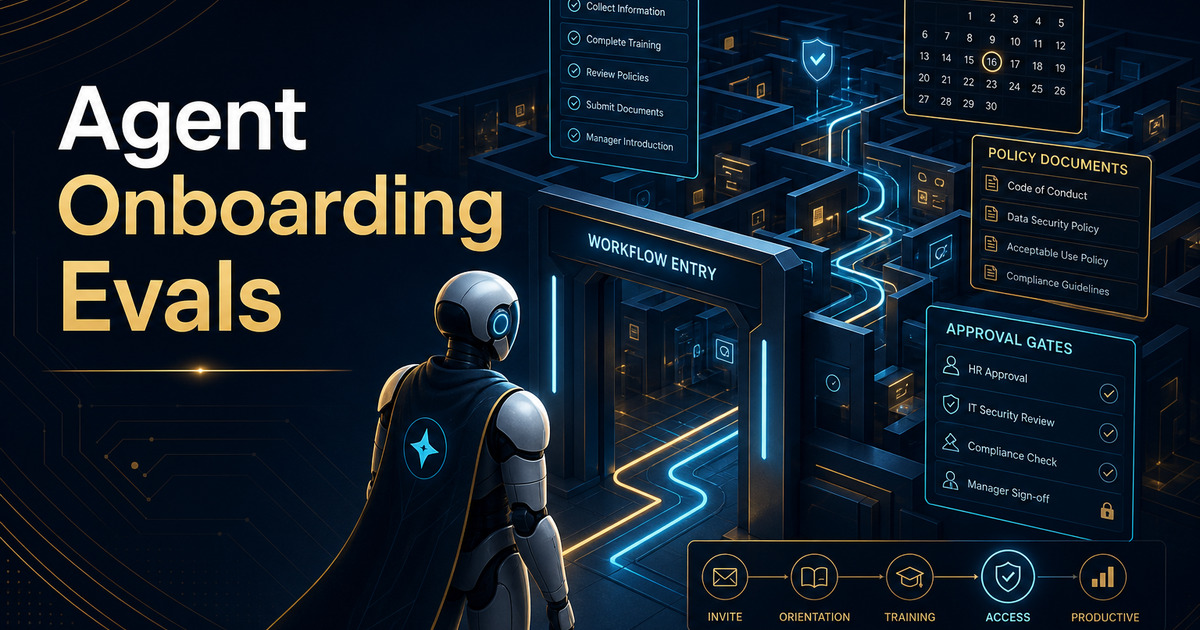
Start with a simulated queue. Give the agent a realistic inbox or task list with changing priorities, deadlines, dependencies, and interruptions. Do not make every task equally important. Work is not a neat sequence of prompts; it is a stream. The agent should show that it can preserve context, resume paused work, and explain why it chose one task before another.
Then hide some local rules. Put critical information in the places your organization actually uses: a procedure page, a support ticket, a meeting note, a calendar invite, a customer record, or a coworker-style interface. The goal is not to trick the agent with trivia. The goal is to test whether it searches before guessing. A good onboarding eval rewards prudent information acquisition. It should treat “I need to check the policy before doing that” as a positive behavior, not a failure to be autonomous.
Next, label the process. For each trajectory, mark steps as helpful, neutral exploration, or erroneous. This is more work than final-answer grading, but it produces a much better signal. Exploration is not automatically bad. Some uncertainty-reducing actions are exactly what you want. The eval should distinguish responsible discovery from wasted motion, and wasted motion from harmful tool use.
You also need repeated tasks with feedback. A one-shot benchmark can tell you whether the agent got lucky, but an onboarding eval should ask whether it learns. If the agent receives a correction about a local policy, does it apply that correction to the next similar case? Does it overfit the exact example, or does it extract a useful operating rule? The Trainee-Bench framing is useful here because it treats workplace readiness as adaptation over time, not just isolated completion.
Finally, connect the result to autonomy tiers. The output of the eval should not be a vague “pass” or “fail.” It should answer a deployment question.
Maybe the agent is ready for read-only analysis. Maybe it can draft actions but needs human approval before sending, scheduling, purchasing, or updating records. Maybe it can use tools autonomously only inside a narrow sandbox. Maybe it fails active exploration and should not receive write access at all. The point is to convert evidence into scope.
This is where agent evaluation becomes governance. The [LLM agent evaluation survey](https://arxiv.org/abs/2507.21504) highlights the broader challenge: agent evaluation is fragmented, and enterprise deployments introduce requirements around reliability, role-based access, dynamic long-horizon interactions, and compliance. Those concerns line up with the [NIST AI Risk Management Framework](https://www.nist.gov/itl/ai-risk-management-framework) mindset: define the context, measure the risk, manage the system, and document the limits.
An onboarding eval is not a replacement for security review, policy controls, observability, or human escalation. It is the bridge between a lab benchmark and a production permission decision. It gives teams a concrete way to ask, “What has this agent demonstrated inside conditions that look like our work?”
The practical version does not need to be grand. Pick five recurring workflows. Build a small simulated queue. Add incomplete information, a few local rules, and one or two irreversible-action traps. Label the steps. Run the agent more than once. Track whether it asks, searches, escalates, prioritizes, and improves.
If that sounds like onboarding a new employee, that is the point.
Agents are not just models answering questions anymore. They are becoming operational actors. Before giving them keys to the workflow, make them survive the first day.
Sources
- https://arxiv.org/abs/2601.08173
- https://arxiv.org/abs/2603.14465
- https://arxiv.org/abs/2507.21504
- https://www.nist.gov/itl/ai-risk-management-framework
Is your agent ready for real work?
The Agent Readiness Kit turns ideas like these into templates you fill in this week: a permission matrix, approval policy, eval suite, failure drills, incident runbook and a 60-point readiness checklist.
Get the Readiness Kit · $19 →