
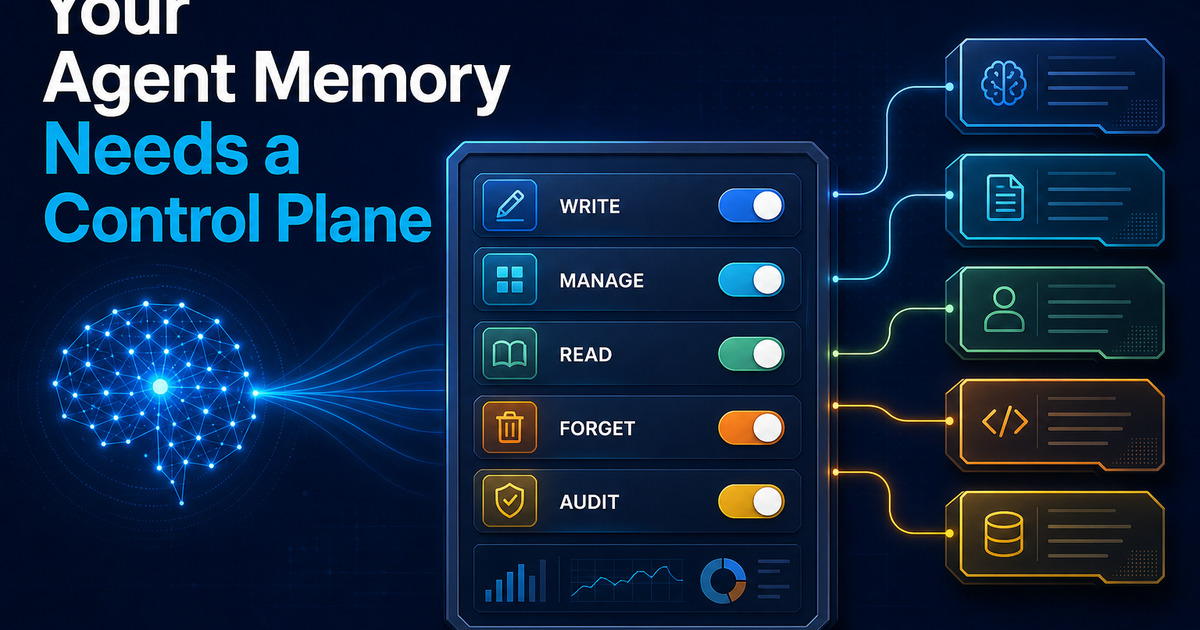
A bigger context window makes a single conversation cheaper to run. It does not tell you what your agent learned last Tuesday, whether that lesson was correct, who could see it, or whether it quietly steered an action this morning. Those are different questions, and they are the ones that decide whether a long-running agent is safe to deploy. Long-term memory is becoming part of the agent runtime, and treating it as "just add a vector database" creates operational and governance risk that no amount of context length will absorb.
Storage is not memory
A vector index is a place to put things. Memory is a process. The recent survey [Memory for Autonomous LLM Agents](https://arxiv.org/abs/2603.07670) frames memory as the mechanism that turns a stateless generator into an adaptive autonomous agent, and it formalizes that mechanism as a write–manage–read loop rather than a passive append-only store. The "manage" step is where most production systems are thinnest. The survey argues that memory management should include summarization, deduplication, priority scoring, contradiction resolution, and appropriate deletion or forgetting. It also organizes the field by temporal scope, representation substrate, and control policy, and it names the tensions builders actually live with: utility, efficiency, adaptivity, faithfulness, and governance.
That vocabulary matters because embeddings plus nearest-neighbor retrieval addresses exactly one of those steps — read — and even then only as similarity, not as judgment. Nothing in a raw vector store decides whether a memory is still true, whether it contradicts another memory, whether it should have been written at all, or when it should expire. Those decisions are the system. If they are implicit, they are still being made; they are just being made without policy, logging, or review.
Why this is operationally urgent
For a chatbot, a bad memory is an awkward reply. For an agent that calls tools and acts over time, a bad memory is an action taken on stale or contaminated grounds. Memory changes future behavior, which means a fault written today can surface as a wrong decision weeks later, far from the prompt that caused it. This is precisely why monitoring cannot stop at the current request.
[OpenAI's account of monitoring its internal coding agents](https://openai.com/index/how-we-monitor-internal-coding-agents-misalignment/) describes reviewing conversation history, tool calls, outputs, and reasoning traces, and reports monitoring tens of millions of internal agentic coding trajectories over five months while escalating moderate-severity cases for human review. The post argues that monitoring internally deployed agents helps identify and mitigate emerging risks from real-world autonomy, and that similar safeguards should be standard across the industry. The implication for memory is direct: if memory influences behavior, then the artifacts that get monitored have to include what the agent wrote into memory and how that memory later shaped an action — not just the visible turn.
There is an access-control dimension too. Agent memory usually sits next to tools and enterprise data. The [Model Context Protocol authorization guidance](https://modelcontextprotocol.io/docs/tutorials/security/authorization) recommends authorization when servers access user-specific data, require auditability, expose APIs requiring consent, or run in enterprise environments, and it distinguishes local STDIO servers using local credentials from remotely hosted HTTP servers that need stronger, OAuth 2.1-oriented patterns with protected-resource discovery. The same reasoning applies to memory: what a memory store can read, write, and replay is an access-control surface, and it should live inside the same consent and audit boundaries as the tools it sits beside.
What a control plane includes
A control plane is the set of explicit, inspectable policies that govern the memory lifecycle. Concretely:
- Typed memory classes and scopes. Separate durable facts, task scratch, user preferences, and learned procedures. Scope them to a user, a tenant, or a session so retrieval and deletion can be reasoned about. The survey's organizing axes — temporal scope, substrate, control policy — are a usable starting taxonomy.
- Write gates. Not every observation deserves to persist. A write policy decides what is eligible, with priority scoring so low-value or unverified content does not become tomorrow's grounding.
- Consolidation jobs. Summarization, deduplication, and contradiction resolution should run as managed processes, not as accidental side effects of retrieval. When two memories disagree, something has to decide which wins, and that decision should be logged.
- Retrieval budgets and policies. Bound how much memory enters a task and from which classes, so retrieval is a deliberate policy rather than whatever the index returns.
- Forgetting, deletion, and retention controls. Appropriate deletion is a first-class operation. Retention windows and honored deletion requests are both correctness and governance requirements.
- Audit logs and monitors. Record writes, consolidations, deletions, and the memories that fed a given action, so memory-influenced behavior is reconstructable in the sense OpenAI describes.
None of this requires exotic infrastructure. It requires deciding these policies on purpose instead of inheriting them by default.
Evaluation has to become lifecycle-aware
If memory is behavior over time, a one-shot recall test will not catch the failures that matter. [MemoryAgentBench](https://openreview.net/forum?id=DT7JyQC3MR), accepted as an ICLR 2026 poster, argues that reasoning, planning, and execution get evaluated far more often than memory itself. It identifies four memory-agent competencies — accurate retrieval, test-time learning, long-range understanding, and selective forgetting with conflict resolution — and transforms long-context datasets into incremental multi-turn interactions to better approximate realistic assistant use. Its empirical results indicate that current memory methods do not master all four. The [reference implementation](https://github.com/HUST-AI-HYZ/MemoryAgentBench) is public. The practical lesson is to test memory the way it will actually be used: across many turns, including whether the agent can drop or override stale and contradictory information, not just whether it can fetch a fact.
Builder's checklist
- Define typed memory classes with explicit scopes; no single undifferentiated store.
- Put a write gate in front of persistence, with priority scoring for eligibility.
- Run consolidation — summarize, deduplicate, resolve contradictions — as managed jobs that log their decisions.
- Set retrieval budgets and policies per task and per memory class.
- Implement retention windows and honor deletion; treat forgetting as a supported operation.
- Log writes, consolidations, deletions, and the memories that influenced each action.
- Apply the same authorization and consent boundaries to memory that you apply to tools and enterprise data.
- Evaluate memory across multi-turn interactions: retrieval, test-time learning, long-range understanding, and forgetting/conflict resolution.
Takeaway
For teams putting agents into production this year, the honest test is simple. If you cannot say what your agent is allowed to remember, when it forgets, who can see a memory, and how a memory influenced an action — and you cannot show that under multi-turn evaluation and monitoring — then the memory layer is not yet trustworthy, regardless of how large the context window is. A control plane is what turns memory from an emergent liability into a governed part of the runtime.
Sources
- https://arxiv.org/abs/2603.07670
- https://openreview.net/forum?id=DT7JyQC3MR
- https://github.com/HUST-AI-HYZ/MemoryAgentBench
- https://openai.com/index/how-we-monitor-internal-coding-agents-misalignment/
- https://modelcontextprotocol.io/docs/tutorials/security/authorization
Build Agents That Prove Their Work
If you are wiring agent workflows into real operations, Alchemic can help design the checkpoints, traces, and validation gates that keep automation honest.
Get the Field Guide - $10 ->