
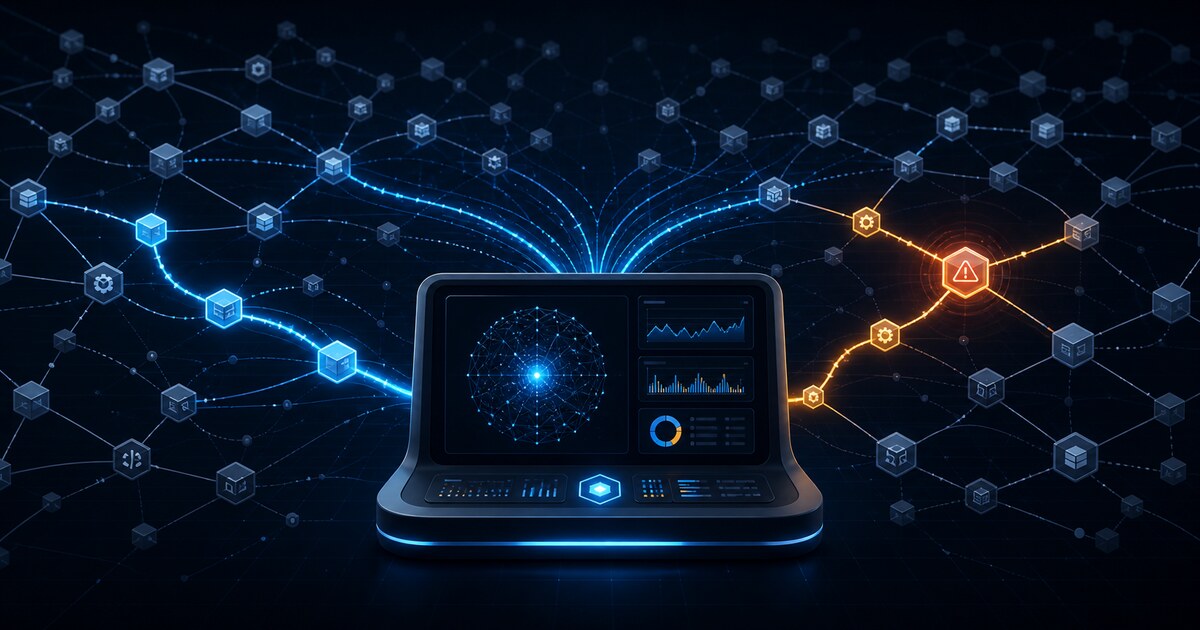
The easiest way to make an incident-response agent look impressive is to give it access to every dashboard, every trace, every log stream, and every runbook, then ask it to explain what happened. The hard part is making that explanation operationally trustworthy.
Real outages are not clean puzzles. They are distributed-system arguments. A user-facing error rate moves. A database queue grows. A downstream dependency starts timing out. A deployment happened nearby, but not necessarily causally. A human SRE does not solve that by reading the whole company’s telemetry lake from left to right. They narrow the search through a mental model of the service graph: what calls what, which symptoms are upstream or downstream, which signals are authoritative, and which mitigations carry unacceptable blast radius.
That is the useful lesson in the new arXiv paper “GALA: Graph-Augmented LLM Agents for Root Cause Analysis and Incident Response in Microservices”. The details will need normal research scrutiny, but the direction is right. The paper frames microservice root-cause analysis as a graph-grounded investigation problem, not a generic chat problem. Its GALA+ framework uses service dependencies to bound exploration, combines multiple telemetry signals, produces ranked diagnoses and incident summaries, and adds stratified action recommendations. The authors also introduce SURE-Score, an SRE-informed evaluation framework for judging RCA output quality beyond text similarity.
The headline is not “LLMs can do incident response now.” The better headline is: incident agents need topology.
A service graph changes the shape of the problem. Without it, an agent with tool access can wander. It may find a correlated metric, narrate a plausible chain, and recommend an action that sounds reasonable but is disconnected from the real dependency path. With a graph, the agent’s search area can be constrained to the neighborhood of affected services. Evidence can be localized. Hypotheses can be ranked against actual call paths. Recommendations can be attached to the specific components they would affect.
That sounds less magical than a giant prompt, which is exactly why it is more useful.
For teams building operational AI, the architecture should be topology first, telemetry second, language last. Start with the dependency map: services, queues, databases, third-party APIs, batch jobs, user-facing surfaces, and ownership. Then attach signals to that map: traces, logs, metrics, deploy events, feature flags, incidents, and alerts. Only after that should the language model enter the loop, and its job should be bounded: summarize evidence, compare hypotheses, ask for missing signals, draft incident notes, and suggest next actions by confidence and risk.
OpenTelemetry’s work on GenAI semantic conventions and the Gen AI attribute registry points in the same direction for agent operations. Standardized spans and attributes are not paperwork. They are how you keep agent behavior inspectable when the system is under stress. If an incident agent calls tools, reads traces, invokes a runbook, or drafts a mitigation, those steps should be recorded with enough structure that another system—or a tired human at 3 a.m.—can reconstruct the chain.
This is where many “AI for operations” demos are still too loose. They show the model reading an alert and producing a polished incident summary. But production incident response is not a writing task. It is a claims task. Every sentence the agent writes should be backed by a signal, a dependency edge, a runbook step, or a known uncertainty. “The payments API is slow because Redis is saturated” is not acceptable because it is fluent. It is acceptable only if the trace path, metric window, and dependency relationship support it.
The Google SRE guidance on monitoring distributed systems is a useful antidote to context hoarding. Monitoring is not about collecting infinite data at infinite granularity. The signal has to match the reliability goal and the operational question. An agent that can query everything is not automatically better than an agent that can query the right few things in the right order. In fact, broad access can make failure modes worse: more spurious correlations, more irrelevant evidence, and more chances to recommend a risky action outside the actual blast radius.
A practical incident agent should therefore have a small set of design rules.
First, build or import the service graph before you build the chat interface. If the agent cannot answer “what is upstream, what is downstream, and who owns this component,” it is not ready to investigate production incidents.
Second, restrict tools by dependency neighborhood. A checkout-service incident may need payment, inventory, identity, and database context. It probably does not need unrestricted access to unrelated admin systems. The graph can become a permissions layer, not only a visualization.
Third, separate diagnosis from action. It is reasonable for an agent to recommend mitigations with confidence levels, expected blast radius, and required approvals. It is much more dangerous to let the same free-form reasoning loop execute changes without gates. Rollbacks, traffic shifts, cache flushes, and feature-flag changes should sit behind explicit policies.
Fourth, evaluate with SRE-shaped rubrics. Text similarity is too weak for incident response. A good answer identifies the affected service, explains the causal path, distinguishes root cause from symptoms, names missing evidence, recommends safe next steps, and avoids overclaiming. GALA+’s SURE-Score idea matters because it recognizes that operational quality is not the same as natural-language quality.
Fifth, log the agent’s claims as first-class artifacts. The NIST AI Risk Management Framework is broad, but its governance lesson applies cleanly here: if AI is part of a consequential workflow, the organization needs accountability, monitoring, and risk controls. For incident agents, that means claim provenance, tool-call traces, reviewer identity, approval state, and post-incident review data.
The opportunity is real. An agent that can assemble the first incident brief, pull the relevant traces, list recent deploys, compare likely hypotheses, and draft a safe mitigation plan could remove a lot of toil from on-call work. It could also improve handoffs between engineering, support, and leadership. But only if it is designed like operational infrastructure instead of a chatbot with root access.
The safest incident agent is not the one with the largest context window. It is the one that knows the system’s shape, knows where not to look, and can show its work before anyone touches production.
Build AI Systems That Survive Contact With Real Work
We help teams turn AI research into practical automations, agent workflows, and operational systems that can be evaluated and improved.
Get the Field Guide — $10 →