
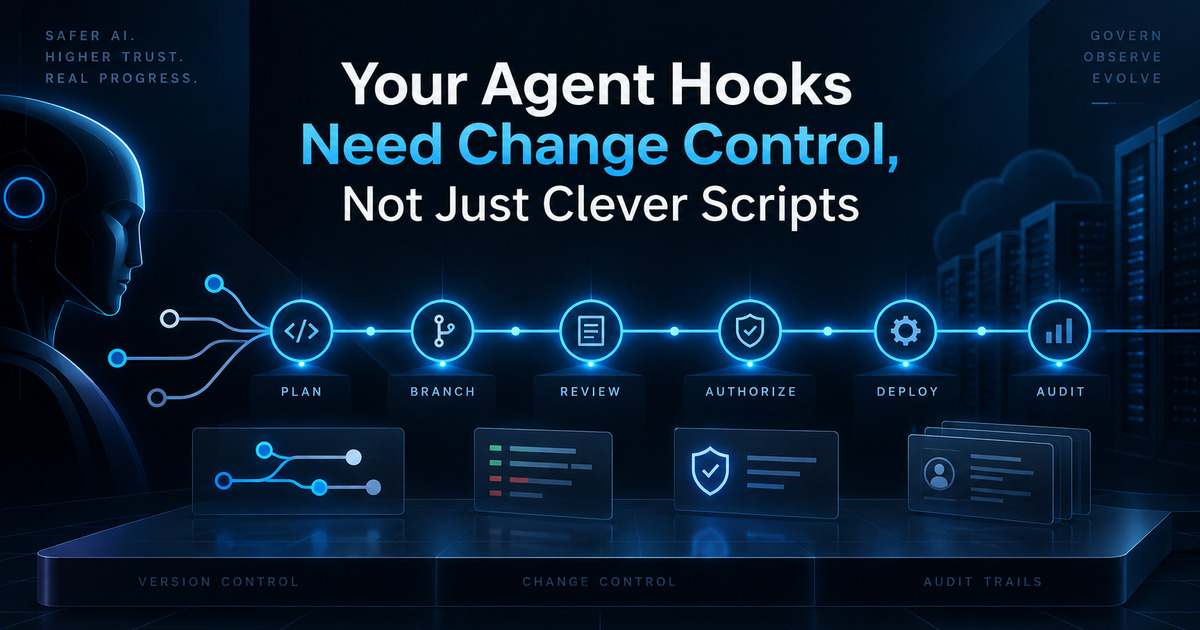
Agent hooks start innocently. A team adds a pre-tool check so a coding agent cannot touch production files. Someone adds a post-tool annotation so failed commands are easier to diagnose. A platform engineer wires a prompt-submit hook into an internal policy service. A security lead asks for an HTTP callback before a high-risk MCP tool runs. Each step feels practical. None of it looks like a new platform.
Then, one morning, the hooks are the platform.
That is the moment many AI teams are approaching now. Claude Code’s hook system is a useful signal because it makes the pattern explicit: hooks can run at session boundaries, on user prompt submission, on stop events, and around individual tool calls. They receive structured JSON context. They can be shell commands, HTTP endpoints, MCP tool calls, prompts, or subagents. They can inspect the event, take action, return decisions, time out, and participate in permission-related flows.
That is not just developer automation. It is execution middleware for agents.
The risk is not that hooks are bad. The risk is that teams will treat them like personal scripts long after they have become production change-control assets. A hook that blocks a file edit, annotates a tool result, injects context, defers an action, or calls an authorization service is shaping the agent’s behavior. If it is stale, unowned, untested, or invisible to tracing, it can create the exact kind of operational ambiguity that agent platforms are supposed to reduce.
The hidden runtime around the agent
Most agent architecture conversations focus on models, tools, prompts, memory, and evaluation. Hooks live in the seams between those pieces. That makes them easy to underestimate.
A pre-tool hook may decide whether a shell command should run. A post-tool hook may classify the result for later routing. A session-start hook may set environment context. A prompt-submission hook may enforce a policy before the model sees the request. An HTTP hook may call an enterprise service. An MCP hook may sit near the boundary where external capabilities enter the agent loop.
Those seams are where real systems fail.
The Model Context Protocol authorization specification is relevant here because it frames tool access as an authorization problem, not merely a convenience problem. For HTTP-based transports, MCP describes authorization flows grounded in OAuth-related standards and calls out security concerns such as token handling, audience binding, token theft, communication security, open redirects, confused deputy risk, and privilege restriction. If a hook can approve, deny, reshape, or log access to an MCP-backed tool, it has to align with that authorization story. Otherwise the hook becomes a shadow path around the system of record.
The same applies to observability. OpenTelemetry’s generative AI semantic conventions, now maintained in a dedicated GenAI conventions repository, point toward a world where model calls, agent spans, events, exceptions, metrics, and MCP interactions can be observed consistently. OpenAI’s Agents SDK documentation similarly emphasizes tracing, spans, custom processors, sensitive data handling, guardrails, workflow boundaries, tool guardrails, and tripwires. Hooks belong in that picture. If a hook makes a decision that changes the agent’s behavior, that decision should be observable beside the model call, tool call, approval, denial, retry, or incident.
Local logs are not enough once the hook is part of production behavior.
Hooks need owners, not folklore
The first maturity jump is simple: every production hook needs an owner.
That owner does not have to be a committee. It can be a platform team, security team, application team, or named service owner. But the ownership has to be explicit. If nobody owns a hook, nobody knows whether its policy is current, whether its dependencies are alive, whether its failure mode is safe, or whether its logs contain sensitive data.
Ownership should include five responsibilities.
First, the hook’s purpose must be written down. “Blocks unsafe shell commands” is not enough. What is unsafe? Which users, repos, environments, and tools does the policy cover? What is intentionally out of scope?
Second, the hook’s decision modes must be explicit. Can it allow, deny, defer, warn, annotate, inject context, request permission, or fail closed? Which mode applies when the hook times out? Which mode applies when the policy service is unavailable?
Third, the hook must have fixtures. A production hook needs test cases for the ordinary allow path, the expected deny path, malformed input, missing fields, timeout behavior, dependency failure, and sensitive-data handling. Without fixtures, hook changes become vibes-based policy edits.
Fourth, the hook must be versioned with its policy assumptions. The code and the policy should move together. If a tool’s permission model changes, the hook should not silently continue enforcing last quarter’s model.
Fifth, the hook’s decisions must be reviewable after the fact. An incident review should be able to answer: what event fired, what context was supplied, which hook version ran, what decision was returned, what downstream action changed, and whether a human approval or escalation was involved.
That is change control, not bureaucracy.
Design the failure mode before the success path
Agent hooks are usually written to make the happy path safer or smoother. Production hooks need the opposite discipline: define failure behavior first.
If a pre-tool hook cannot reach its policy service, should the agent block, continue, defer, or ask for human review? The answer may differ by environment. A local development hook might warn and continue. A production data-export hook might fail closed. A customer-support workflow might defer and escalate. A coding-agent hook touching generated test files might allow, while the same hook touching deployment configuration might block.
This should not be discovered during an outage.
Timeouts deserve the same care. A hook that blocks every tool call for thirty seconds can turn an agent into a denial-of-service machine. A hook that times out and allows everything may create a silent policy bypass. A hook that times out and blocks everything may strand a workflow mid-task. The right answer depends on the action’s blast radius, the user’s authority, the reversibility of the operation, and the evidence needed for review.
Sensitive data is another failure surface. Tracing is necessary, but tracing everything is reckless. Hook events can contain prompts, file paths, tool arguments, command output, resource identifiers, and sometimes regulated or proprietary context. The OpenAI tracing documentation’s attention to sensitive data is a useful reminder: observability systems need filtering and intentional processors, not raw dumps of agent state.
A lightweight maturity ladder
Teams do not need a giant governance program to start. They need a ladder.
Level 0 is local helper scripts: personal productivity aids with no production authority.
Level 1 is named hooks with code review: clear purpose, owner, and review path.
Level 2 adds fixtures and trace coverage: allow, deny, failure, malformed-input paths, and decisions visible beside the relevant agent run.
Level 3 binds hooks to identity and authorization: actor, tool, resource, environment, and policy version are part of the decision.
Level 4 adds release gates, rollback, and incident evidence: changes can be staged, dry-run, reversed, and explained.
Most teams can move from Level 0 to Level 2 quickly. The important step is cultural: stop calling production hooks “just scripts.”
The boring interface where safety happens
NIST’s AI Risk Management Framework describes risk management in terms of governance, mapping, measuring, and managing. That can sound abstract until it meets a concrete runtime surface. Hooks are one of those surfaces. They are where governance can become a decision, measurement can become a trace, and management can become a rollback path.
The future of enterprise agents will not be secured only by better prompts or larger models. It will be secured by boring interfaces that consistently connect intent, identity, tools, evidence, and accountability.
Hooks are one of those interfaces. Treat them accordingly.
Build AI Systems That Survive Contact With Real Work
We help teams turn AI research into practical automations, agent workflows, and operational systems that can be evaluated and improved.
Get the Field Guide — $10 →