
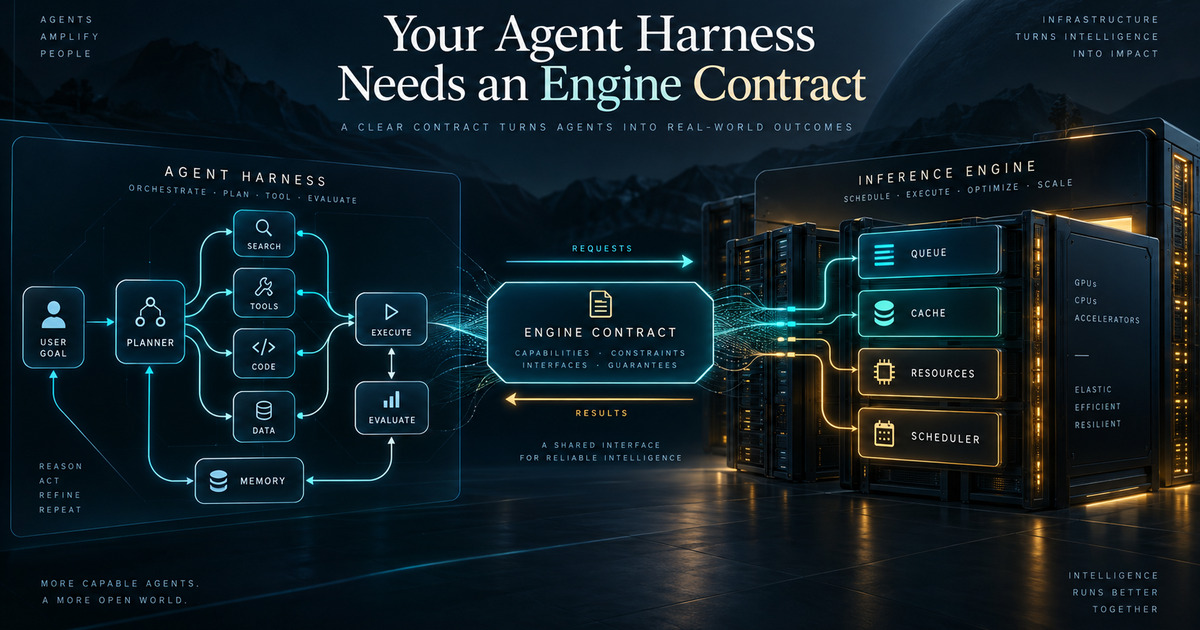
Most production-agent conversations start at the harness layer. That is where the prompts live. It is where tools are registered, handoffs are defined, approvals are requested, sessions are resumed, and traces are stitched together. If you are building with modern agent frameworks, this is the layer that feels like the product.
But the harness is only half of the operating system.
Underneath it, the inference engine is making a different set of decisions. It sees queues, batching opportunities, KV-cache pressure, context-window limits, model availability, memory constraints, and hardware saturation. It knows whether a request can be served cheaply, whether a cache is hot, whether a model is overloaded, and whether a supposedly simple call is about to block a whole workflow.
That split is fine for ordinary chat. A user asks a question, the application sends a request, the model responds. The harness does not need to explain much beyond the prompt and sampling parameters. Agents are different. A multi-step agent may fan out into parallel workers, call tools, wait for external state, resume after a human approval, summarize intermediate context, and then route one branch into another. In that world, the harness sees intent and dependency. The engine sees capacity and execution reality. If they only communicate through a generic inference request, both sides are operating with partial information.
That is why the most interesting agent-infrastructure idea this week is not another bigger prompt. It is a contract between the agent harness and the inference engine.
A recent paper, “Can Agent Harnesses and Inference Engines Hear Each Other? The HEAR Protocol for Agentic LLM Serving,” gives this boundary a useful name. The authors argue that efficient agent serving requires decisions spanning two layers with complementary information: the harness understands workflow dependencies, context lifecycles, and execution objectives, while the inference engine observes request queues, KV-cache state, resource pressure, and execution capabilities. HEAR proposes a bidirectional Harness–Engine Pairing protocol so the harness can communicate workflow intent and requirements, and the engine can return runtime state, capabilities, and outcomes.
The important part is not that every team should adopt HEAR tomorrow. It is that the paper names a missing interface. Today, many agent stacks ask the serving layer to optimize without knowing the workflow shape, while asking the harness to orchestrate without knowing the real serving constraints. That is a weak contract for systems that are becoming more parallel, more tool-heavy, and more expensive to run.
You can see the pressure building in the rest of the ecosystem. OpenAI’s Agents SDK treats agents, tools, handoffs, sessions, guardrails, tracing, and context management as first-class framework concepts. Anthropic’s guidance on effective agents highlights routing, parallelization, orchestrator-worker patterns, and evaluator-optimizer loops. MCP standardizes how applications connect models to tools, data, and contextual capabilities. OpenTelemetry’s GenAI semantic conventions are pushing observability for model interactions toward a shared vocabulary.
Those are all necessary layers. They still do not fully answer the harness-engine question.
Telemetry can tell you what happened. MCP can define how tools and context are exposed. Agent frameworks can define how work is decomposed. But the inference engine also needs to know which calls are on the critical path, which are speculative, which can be delayed, which share context, which must preserve latency for a human waiting on screen, and which belong to a background research branch. Without that information, the engine is forced to infer workflow semantics from a stream of similar-looking model calls.
The reverse problem matters too. The harness should not plan as if serving capacity is infinite. If the engine is under memory pressure, if a long-context model is saturated, if a cheaper model is available for a background summarization step, or if a cache-aware execution mode would materially reduce latency, the harness needs a clean way to receive that signal. Otherwise it will continue to launch work according to an abstract plan that no longer matches runtime conditions.
For enterprise teams, the practical move is to define a small internal contract before the system becomes too large to reason about. Start with five fields.
First, mark dependency shape. Is this model call blocking the user, feeding a downstream tool decision, evaluating another agent’s output, or running as background enrichment? “Priority” is not enough. A low-priority call can still be on the only path to completion, and a high-priority call can be speculative.
Second, pass context lifecycle hints. Tell the serving layer when context is likely to be reused, when a branch is disposable, when a session is being resumed, and when a summary has replaced a larger history. This is where cache-aware serving stops being magic and starts being engineering.
Third, expose runtime capability and pressure signals back to the harness. The harness does not need raw hardware metrics for every decision, but it does need structured answers: available models, degraded modes, queue pressure, context limits, timeout risk, and whether an execution strategy changed.
Fourth, record these exchanges as traceable control events. If the engine downgrades a model, delays a branch, rejects a context size, or reports a capability limit, that should appear in the same operational story as the agent’s tool calls and approvals. Otherwise cost and latency decisions become invisible failure modes.
Fifth, keep optimization policy separate from business semantics. HEAR’s useful design lesson is the separation between protocol semantics and optimization policy. The harness should express what the workflow needs; the engine should express what the runtime can do; the policy that maps one to the other should be testable and replaceable. Do not bury business intent inside serving heuristics, and do not hard-code serving assumptions into prompts.
This boundary also makes agent evaluation more honest. If your benchmark only measures final task success, you may miss the fact that an agent required fragile timing, wasteful parallel calls, or context handling that will collapse under load. A harness-engine contract gives you artifacts to inspect: what the harness asked for, what the engine said was possible, what policy chose, and what actually happened.
The near-term takeaway is simple: treat agent serving as a coordination problem, not just an API call. A production agent is no longer a single prompt pointed at a model. It is a workflow with dependencies, state, tools, humans, traces, and resource constraints. The harness knows why the work matters. The engine knows what the runtime can bear.
If those two systems cannot hear each other, your agent will still run. It will just run expensively, opaquely, and with failure modes you only discover after the queue backs up.
The fix does not have to be grand. Add a small contract now. Name the call’s role. Mark the dependency. Carry context lifecycle hints. Return capability and pressure signals. Trace the decision. Then, when standards mature, you will already have the habit that matters: your agent stack will treat serving decisions as part of the system design, not as an invisible side effect of asking a model for the next token.
Build AI Systems That Survive Contact With Real Work
We help teams turn AI research into practical automations, agent workflows, and operational systems that can be evaluated and improved.
Get the Field Guide — $10 →