
The first agent does the research. The second agent writes the code. A third agent reviews the change. A fourth agent opens the ticket, updates the customer, or prepares the release note.
On a demo screen, that looks like a team.
In production, it often looks like a relay race where every runner receives a sticky note that says, “Keep going.”
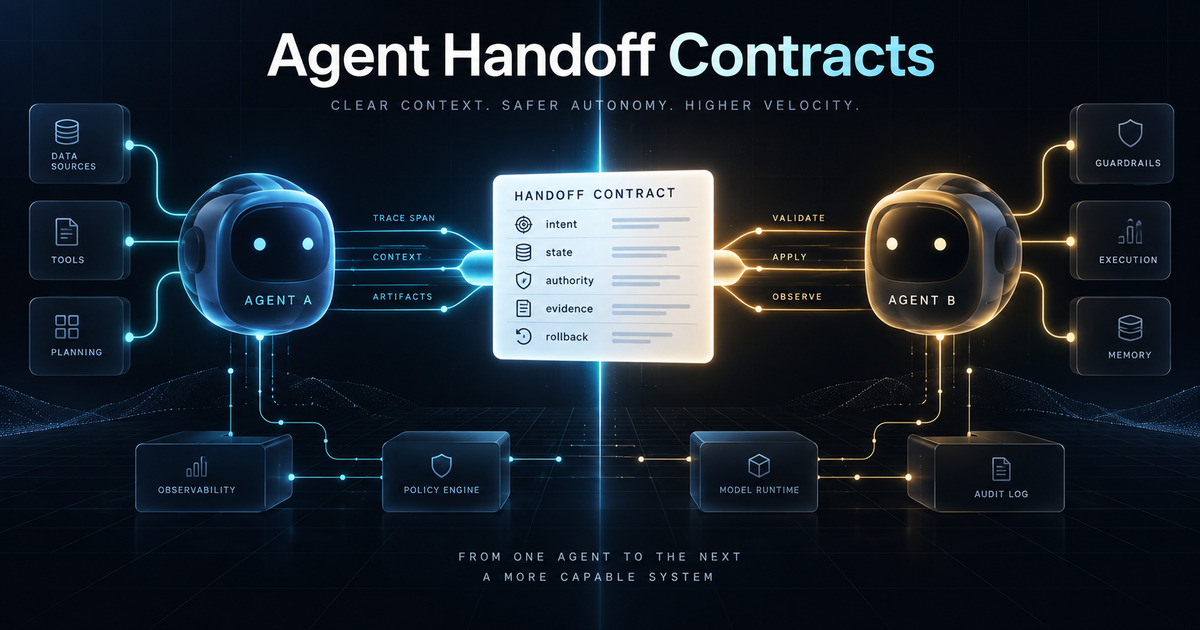
That is the quiet failure mode in many multi-agent systems. The problem is not only that one model might hallucinate, misuse a tool, or misunderstand a user. The problem is that ownership moves from one worker to another without a reliable interface. The receiving agent inherits a summary, not the actual operating context. It knows the next task, but not the authority behind it, the evidence that supports it, the guardrails that still apply, or the trace that will let a human reconstruct what happened.
That gap deserves a name: the missing handoff contract.
Handoffs are becoming real infrastructure
Agent handoffs are no longer just a prompt-engineering trick. OpenAI's Agents SDK documents handoffs as part of agent orchestration: one agent can delegate to another, customize the handoff, define handoff inputs, filter context, and receive results. The same SDK also treats tracing and guardrails as first-class concerns, with traces and spans for execution visibility and input, output, and tool guardrails for workflow boundaries.
Those pieces point in the same direction. Once agents specialize, the boundary between them becomes an operational surface. It needs a shape. It needs telemetry. It needs rules.
Anthropic's guidance on effective agents makes the same idea practical from another angle: successful systems often rely on simple, composable patterns rather than elaborate frameworks. A handoff contract should be one of those patterns. It should not be a sprawling new platform. It should be a boring, typed packet that says, “Here is what is being transferred, why, under whose authority, with which evidence, and what to do if the next step fails.”
That is enough to change the reliability profile of an agentic workflow.
The seven fields every handoff should carry
A useful handoff contract starts with intent. Not just the user's latest message, but the operational objective: resolve the billing discrepancy, draft the prior-authorization appeal, update the dependency, reconcile the failed import, or gather three vendor options. Intent keeps the receiving agent from optimizing for the wrong local task.
Second, it needs a state snapshot. What has already been tried? Which files, records, tickets, browser pages, tool outputs, or data rows are relevant? Which assumptions are confirmed and which are provisional? A state snapshot prevents the second worker from repeating the first worker's exploration or treating stale evidence as fresh.
Third, it needs an authority envelope. This is where many agent teams get dangerous. If the first agent was allowed to inspect a record, that does not automatically mean the next agent may update it. If a user approved a quote, that does not automatically authorize payment. The Model Context Protocol authorization specification is a useful reminder that tool-connected systems need explicit client and server authorization expectations. Handoffs should preserve the authorization basis and make scope changes visible. Some actions should require the receiving agent to re-request approval.
Fourth, it needs an evidence bundle. A handoff summary is not evidence. The contract should point to the source outputs, trace spans, documents, API responses, or human approvals that justify the next step. If the receiving agent cannot inspect the evidence, it should treat the task as incomplete.
Fifth, it needs the applicable guardrail set. OpenAI's guardrails documentation separates workflow boundaries, input guardrails, output guardrails, tool guardrails, and tripwires. Those boundaries should not disappear just because a task moved from a planner to an executor. The contract should say which checks already passed, which checks still apply, and which tripwires should abort the workflow.
Sixth, it needs trace continuity. If the handoff breaks the trace, the organization loses its black box recorder at the exact moment work becomes distributed. OpenAI's tracing documentation and OpenTelemetry's generative-AI semantic conventions both reinforce the same operational lesson: agent activity should be observable as structured events, not buried in chat transcripts. A handoff should create a traceable event with parent and child context, not a private whisper between prompts.
Seventh, it needs a rollback or escalation plan. What happens if the receiving agent finds contradictory evidence? What if a tool call partially succeeds? What if the user's approval has expired? What if the next agent is not confident enough to proceed? A production handoff should include the failure path before the failure occurs.
The receiving agent should be allowed to reject the work
The strongest version of this pattern is not merely “send more context.” It is “make incomplete handoffs invalid.”
If the authority envelope is missing, reject the handoff. If the evidence bundle contains only prose, reject it. If the trace parent is absent, start an exception path. If the state snapshot is older than the data being modified, ask for refresh. If the guardrail set says a human approval is required, stop before the tool call.
This sounds strict, but it is how ordinary engineering systems become reliable. APIs reject malformed requests. Payment systems reject unsigned messages. Databases reject invalid transactions. Agent teams should not accept vague summaries at their most fragile boundary.
The practical implementation can be simple. A handoff can be a JSON object on a queue, a row in an orchestration table, an event in a workflow engine, or a structured message in an agent SDK. The important part is not the transport. The important part is that the receiving agent validates the fields before acting.
Start where the blast radius is highest
Teams do not need to redesign every workflow at once. Start with the handoff where ambiguity is most expensive: triage to remediation, research to execution, support to billing, planner to code agent, or browser agent to API agent.
Write down the minimum contract. Require intent, state, authority, evidence, guardrails, trace context, and escalation. Add telemetry so every handoff can be searched later. Add tests with intentionally incomplete contracts. Confirm that the receiving worker refuses to proceed.
That one boundary will teach the organization more than another abstract agent architecture diagram.
Multi-agent systems will keep getting more capable. Specialist workers will become normal. But capability does not remove the need for interfaces. It makes interfaces more important.
A handoff contract is not glamorous. It is not a new agent personality. It is not a bigger prompt. It is the operational document that lets one worker stop and another worker begin without losing intent, accountability, or control.
That is exactly the kind of boring infrastructure production AI needs more of.
Build AI Systems That Survive Contact With Real Work
We help teams turn AI research into practical automations, agent workflows, and operational systems that can be evaluated and improved.
Get the Field Guide — $10 →