
The easiest way to sell an agent framework is to show motion. The agent opens a ticket, searches a knowledge base, edits a document, calls an API, reports success, and looks like it has crossed the line from chatbot to coworker.
That demo is useful. It is also the wrong unit of evaluation.
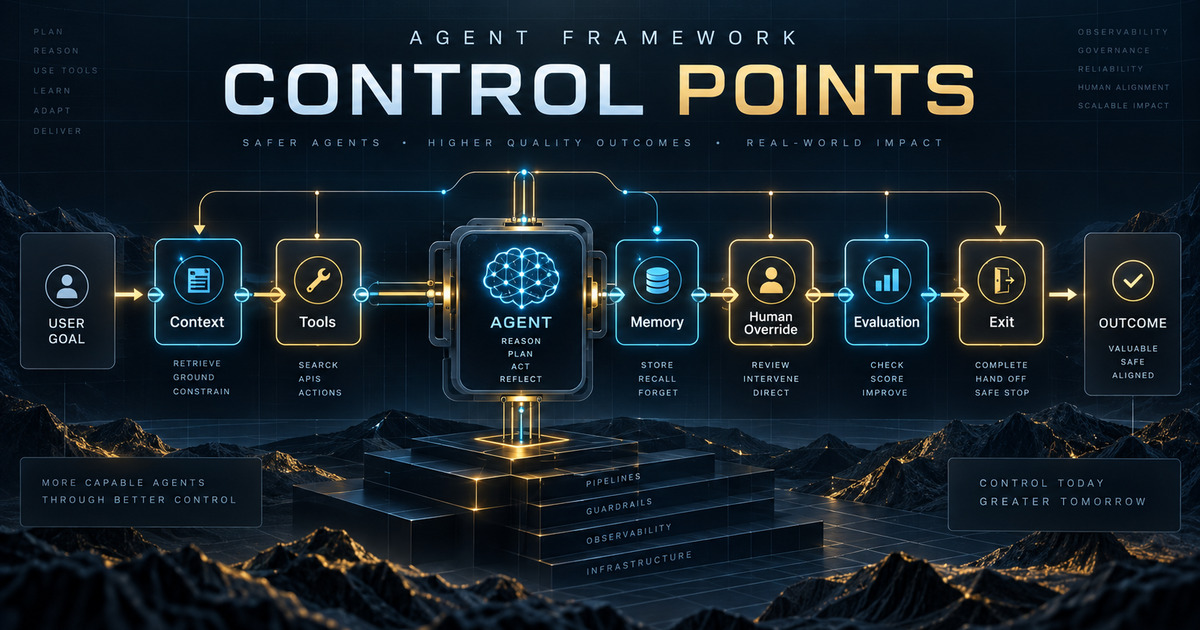
The harder question is not whether the framework can make an agent do more. The harder question is where the system can be inspected, constrained, redirected, measured, and replaced when the work becomes real. In other words: where are the control points?
A control point is an operational seam. It is a place where a team can see what the agent is about to do, limit the authority it has, change the context it is using, pause or escalate the run, evaluate the result, or swap one component without rebuilding the entire workflow. If those seams are invisible, the framework may still be powerful, but it is not ready to become infrastructure.
Anthropic’s guidance on building effective agents makes a useful distinction between workflows and agents, and argues that many successful systems use simple, composable patterns rather than overbuilt abstractions. That point matters because composability is not only a developer preference. It is a governance feature. When a workflow is assembled from visible steps, the business can decide where policy enters, where tools are allowed, where humans review, and where logs become evidence.
The same lesson gets sharper in multi-agent systems. Anthropic’s write-up on its multi-agent research system describes a planner coordinating parallel research agents, while also calling out new challenges in coordination, evaluation, and reliability. Once one model can delegate to another, the control surface expands. It is no longer enough to ask whether the lead agent produced a plausible answer. You need to know what work was delegated, which evidence came back from which subagent, how conflicts were merged, and what stopped the system from pursuing a bad branch forever.
That is why framework selection should start with a control-point review, not a feature comparison chart.
First, inspect the context boundary. A serious framework should make it obvious how prompts, retrieved documents, memory, user data, policies, and tool outputs enter the model’s context. If context assembly is hidden behind a convenient helper, you will struggle to debug stale facts, contaminated memory, and accidental authority creep. LangChain’s writing on agent frameworks puts context control near the center of the reliability discussion for a reason: the agent’s behavior is often downstream of what the framework decided to show it.
Second, inspect the tool and action boundary. Before an agent can send email, update a CRM, issue a refund, change code, or touch production data, the framework should expose a clean approval and policy layer. Tool calling is not just a function-dispatch problem. It is an authorization problem. Can the tool schema distinguish read-only lookups from side-effectful writes? Can a policy deny one action while allowing another? Can the system require confirmation only when risk crosses a threshold? If the framework treats every tool call as the same kind of event, the enterprise will eventually bolt on controls from the outside.
Third, inspect the state and memory boundary. Agent memory is attractive because it promises continuity. It is dangerous for the same reason. Teams need to know what gets persisted, what expires, what can be edited, and what is excluded by design. A useful framework should separate session state, durable memory, retrieved knowledge, and audit evidence. Those are not the same artifact. If they are blended together, the agent may start treating a compressed summary, an old user preference, or a failed tool result as if it were verified truth.
Fourth, inspect the delegation boundary. Multi-agent orchestration can be powerful, especially for research, software analysis, and operations work that naturally decomposes into parallel lanes. But delegation needs a contract. What does the parent agent ask the child agent to return? Is the result a claim, a draft, a tool receipt, a file path, or a decision? How are disagreements handled? Can a child agent take side effects, or is it limited to analysis? Without a visible merge point, “multi-agent” becomes a prettier way to hide uncertainty.
Fifth, inspect the human override boundary. The right question is not whether the system has a human-in-the-loop checkbox. The question is whether humans can intervene at the points that matter. Can they approve a high-risk action before execution? Can they correct the context without restarting the run? Can they stop a plan, reroute it, or downgrade autonomy midstream? Can the interface explain why intervention is needed in language an operator can trust? A review step at the very end is not the same as operational control.
Sixth, inspect evaluation and observability. NIST’s AI Risk Management Framework organizes trustworthy AI work around govern, map, measure, and manage functions. That language maps cleanly to agent infrastructure. Govern the authority model. Map the action surface. Measure behavior with task-specific evals and production traces. Manage residual risk with incident handling, rollback paths, and continuous improvement. A framework that cannot emit useful traces, preserve decision context, or connect runs to eval outcomes makes those functions harder than they need to be.
Finally, inspect the exit boundary. This is the control point buyers forget. If a framework owns the prompt format, memory store, tool wrappers, orchestration graph, evaluation harness, and deployment model in one opaque bundle, leaving later will be expensive. The goal is not to avoid frameworks. The goal is to avoid captivity. Good frameworks make it possible to export traces, replace tools, move state, and preserve business logic outside the vendor’s favorite abstraction.
None of this means teams should build everything from scratch. Agent frameworks can save real time. They can encode good defaults, reduce boilerplate, and make common patterns easier to ship. But the framework should make the serious seams more visible, not less.
The next generation of agent infrastructure will not be judged by the most impressive demo. It will be judged by what happens after the demo: when a customer asks why an action was taken, when a regulator asks how risk is managed, when an operator needs to stop a bad run, when a model upgrade changes behavior, or when the company needs to move from experiment to production.
A bigger demo shows capability. Control points show whether the capability can be trusted.
Sources
- Anthropic, “Building effective agents”: https://www.anthropic.com/engineering/building-effective-agents
- Anthropic, “How we built our multi-agent research system”: https://www.anthropic.com/engineering/multi-agent-research-system
- LangChain, “How to think about agent frameworks”: https://www.langchain.com/blog/how-to-think-about-agent-frameworks
- NIST, “AI Risk Management Framework”: https://www.nist.gov/itl/ai-risk-management-framework
Build AI Systems That Survive Contact With Real Work
We help teams turn AI research into practical automations, agent workflows, and operational systems that can be evaluated and improved.
Get the Field Guide — $10 →