
The agent-safety conversation is shifting. For the last year, most teams have asked whether a model can follow instructions, resist prompt injection, and avoid obviously dangerous actions. Those questions still matter. But once an agent is inside a real workflow, the sharper question becomes: can the organization steer it while it is acting?
Google DeepMind’s recent AI control roadmap is useful because it treats this as an operating-system problem, not just a model-behavior problem. The post describes a defense-in-depth approach for advanced agents, built around the cautious assumption that a highly capable agent may behave unexpectedly even when alignment work is strong. Its metaphor is simple: a driving instructor trusts the student enough to let them drive, but keeps dual controls ready to take the wheel or hit the brakes.
That metaphor should make enterprise teams uncomfortable in a productive way. Many agent deployments have something like a brake pedal buried in a policy engine, a monitoring dashboard, or a Slack escalation channel. The person doing the work, however, often sees only a chat bubble and a spinner. If the operator cannot see what authority the agent currently has, what it plans to do next, why it believes the next step is safe, and how to interrupt or redirect it, then control exists mostly on paper.
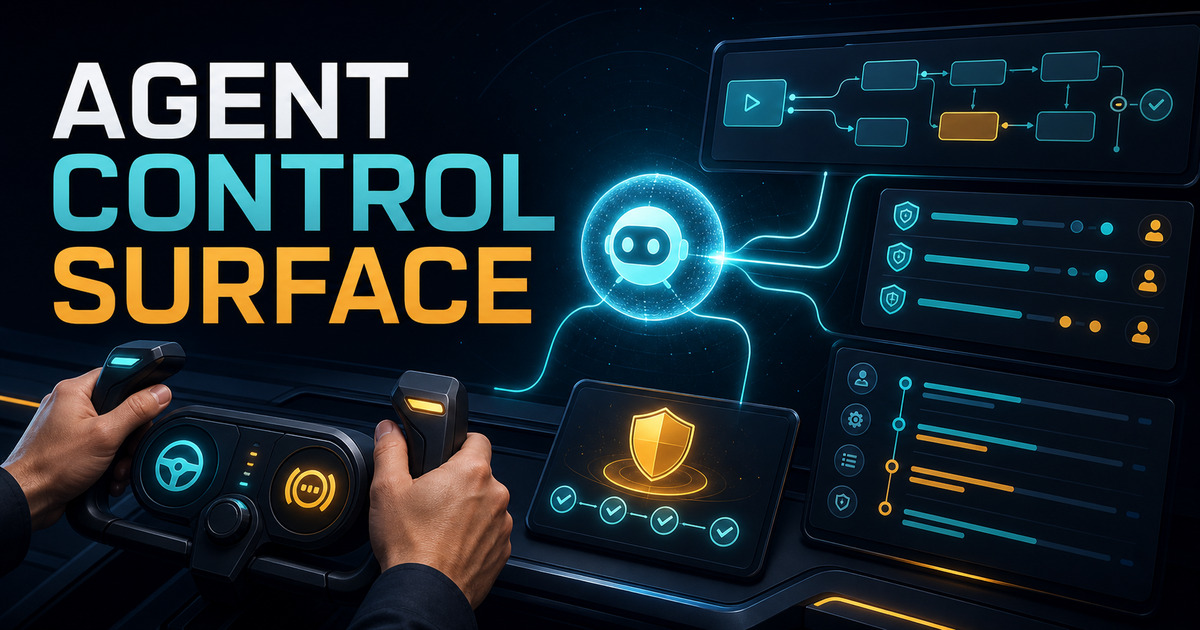
The next maturity step is not just better hidden guardrails. It is a better control surface.
A control surface is the part of an agent system where human authority remains legible. It shows the agent’s current scope, the next consequential action, the evidence or context behind that action, and the available interventions. It makes it obvious when the agent is drafting, when it is recommending, when it is executing, and when it has crossed into a higher-risk zone that needs review.
This is not a soft UX concern. It is core infrastructure for safe automation.
The business-context research on human-AI agent interaction makes the same point from another angle. Enterprise agents are not predictable desktop tools waiting for a click. They are goal-directed systems that can plan multiple steps, perceive context, make or recommend decisions, and interact with workers through natural language. Traditional UX patterns were designed for systems where the user directly controlled the sequence of actions. Agent UX has to support different questions: what is the system trying to do, what does it know, what can it change, what is reversible, and where does the human still hold meaningful control?
That last phrase matters. “Human in the loop” is cheap to say and expensive to design. A confirmation modal before every action is not meaningful control; it is alert fatigue with better branding. A weekly audit report is not meaningful control for a worker who needs to stop a mistaken workflow now. A permissions matrix that only the platform team can interpret is not meaningful control for the operations lead whose customer record, invoice, order, or deployment pipeline is about to be touched.
For most organizations, the realistic near-term pattern is controlled partial autonomy. Koch and Wellbrock’s paper on small and medium-sized companies phrases this well: the model is not “deploy an AI agent”; the model is “design a controlled work system in which an AI agent is one component.” That is the right frame even for larger enterprises. The unit of design is not the prompt. It is the work system: people, knowledge, tools, permissions, escalation paths, logs, and recovery procedures.
A useful agent control surface starts with authority. The user should be able to answer, at a glance: what systems can this agent access right now, what can it read, what can it write, and what actions are outside its current lease? If the answer requires a security engineer to inspect backend configuration, the deployment is not ready for broad operational use.
Second, the surface should expose the next high-impact action before it happens. Not every token or search query needs review. But actions that send messages, update records, change permissions, spend money, trigger customer-facing workflows, or modify production systems deserve a pre-action checkpoint. The checkpoint should say more than “Approve?” It should summarize the intended action, the reason, the source evidence, the expected downstream effect, and the rollback path if one exists.
Third, the system should distinguish confidence from authority. An agent can be highly confident and still lack permission to proceed. It can also be uncertain in a low-risk drafting task where execution is harmless. Blending these concepts creates bad controls. The UI should make clear whether the stop sign is about missing evidence, missing authorization, irreversible impact, policy conflict, or user preference.
Fourth, overrides and escalations should become first-class records. If a human redirects the agent, rejects a step, expands scope, or takes over manually, that event is operational data. It should be attached to the run, available for QA, and visible in later evaluation. This is how a control surface becomes a learning loop rather than a collection of one-off interruptions.
Fifth, teams should test the control surface with the people who actually run the process. Developers can verify that the policy engine blocks a prohibited call. Operators can tell you whether the warning arrives early enough, whether the explanation is usable, whether the escalation path matches how work really happens, and whether the “safe” recovery path creates more work than it saves.
The AI Agent Index is a reminder not to assume the vendor has solved this for you. Its review of deployed agentic systems found uneven public transparency around safety, evaluation, and impact documentation. That does not mean every product is unsafe. It means buyers and builders should ask specific questions: where is the control surface, what does it expose, what does it log, what can users interrupt, and how does the organization prove that control worked after the fact?
A policy engine without a control surface is like brakes without a pedal. The mechanism may exist, but the human in the workflow cannot reliably use it.
The strongest agent deployments will not be the ones that pretend autonomy removes people from the system. They will be the ones that make the boundary between human judgment and machine execution visible, adjustable, and recoverable. Trust is not a vibe, a brand promise, or a modal dialog. Trust is what remains when people can see the system, steer it, and recover when it gets the work wrong.
Sources
- https://deepmind.google/blog/securing-the-future-of-ai-agents/
- https://arxiv.org/html/2606.18716v1
- https://arxiv.org/html/2606.16649v1
- https://arxiv.org/html/2602.17753
Sources
- https://deepmind.google/blog/securing-the-future-of-ai-agents/
- https://arxiv.org/html/2606.18716v1
- https://arxiv.org/html/2606.16649v1
- https://arxiv.org/html/2602.17753
Build Agents That Prove Their Work
If you are wiring agent workflows into real operations, Alchemic can help design the checkpoints, traces, and validation gates that keep automation honest.
Get the Field Guide - $10 ->