
The approval button is becoming one of the most important pieces of AI infrastructure.
In the demo, it feels simple. The agent wants to send an email, change a ticket, open a pull request, query a private system, or call a tool with real side effects. The product shows a modal: approve or reject. The user clicks. The agent continues.
That works until the agent is long-running, delegated, protocol-connected, and resumable. Then the approval is no longer a moment in the interface. It is the boundary between suggestion and authority. If that boundary is not recorded as durable state, nobody can later answer the questions that matter: who granted permission, what exactly did they see, which server or tool requested it, what scope was authorized, when did it expire, and what happened after the run resumed?
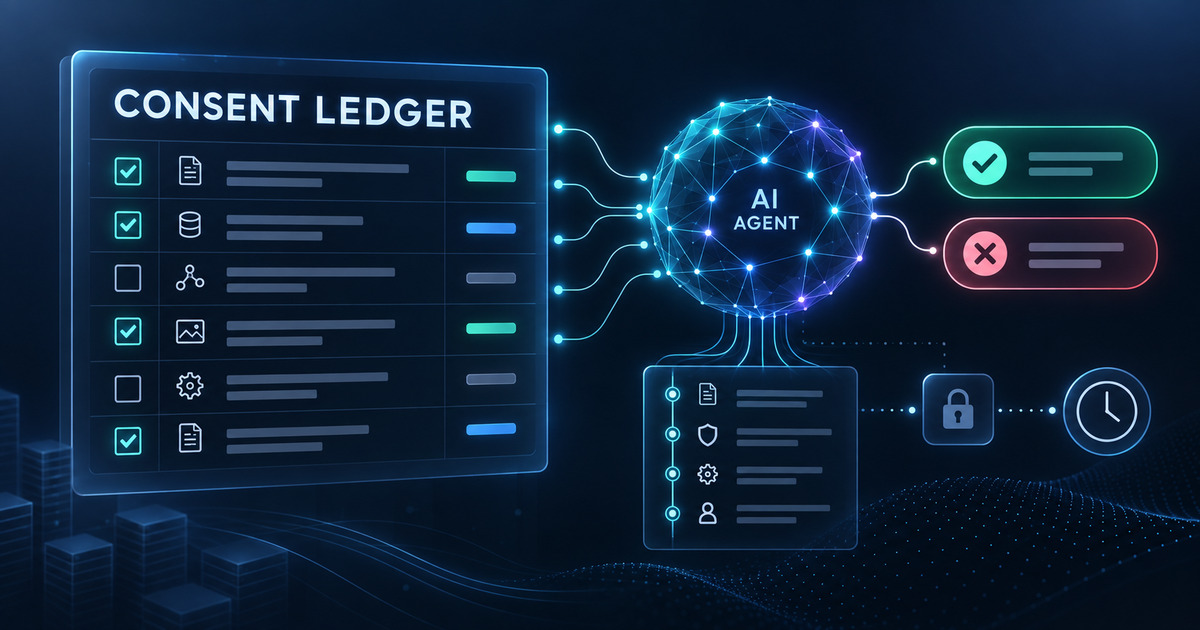
Production agents need a consent ledger.
Not a bigger prompt. Not a prettier confirmation dialog. Not just another trace view. A consent ledger is the system of record for human authorization inside an agent workflow. It records requests, declines, approvals, schema-bounded user inputs, resumptions, expirations, and outcomes as first-class runtime events.
That may sound bureaucratic. It is actually the minimum structure required once agents stop behaving like chatbots and start behaving like operators.
Approval is becoming runtime state
The tooling ecosystem is already moving in this direction.
OpenAI’s Agents SDK documentation describes human-in-the-loop execution where an agent can pause until a person approves or rejects sensitive tool calls. Tools can declare that they need approval. Pending approvals surface as interruptions. Run state can be serialized, then resumed after a decision. The important detail is not the specific SDK API; it is the shape of the runtime. Approval is not just a UI click. It is part of the execution model.
MCP’s 2025-06-18 elicitation specification points at the same shift from another angle. It gives servers a standardized way to request additional information from users through the client. The spec emphasizes that clients maintain control over user interactions and data sharing. It also says servers request structured data with JSON schemas, must not use elicitation to request sensitive information, and applications should make clear which server is asking, allow review and modification, and provide decline and cancel options.
That is consent-shaped infrastructure. A server asks. A client mediates. The user responds within a structured boundary. The resulting input changes what the agent can do next.
Anthropic’s guidance on effective agents adds a useful architectural lens: the strongest production systems often rely on simple, composable patterns rather than ornate frameworks. Consent ledgers fit that pattern. They are not a monolithic agent platform. They are a narrow, composable control surface that makes autonomy explainable.
NIST’s AI Risk Management Framework is broader than agent runtime design, but its governance, mapping, measurement, and management language is relevant. If an organization cannot map where consent was required, measure how decisions affected behavior, or manage the risk of stale authority, it does not have an accountable agent system. It has a transcript and some hope.
What a consent ledger records
A useful consent ledger is not merely an append-only list of approvals. It should preserve the operational context that made the decision meaningful.
At minimum, each entry should include:
- the agent run, session, tenant, and user context;
- the server, tool, workflow, or nested agent requesting authority;
- the proposed action and its side effects;
- the exact parameters or schema shown to the user;
- the data classes involved;
- the risk tier or policy rule that triggered approval;
- the user decision: approve, decline, cancel, modify, or time out;
- the timestamp, actor, and authentication context;
- the scope and expiration of the granted authority;
- the paused run state or checkpoint reference;
- the action executed after resumption;
- the outcome and any linked trace, ticket, or rollback artifact.
This turns “Justin approved it” into a verifiable statement: Justin approved tool X, from server Y, for action Z, with parameters A and B, after seeing context C, for one execution, expiring at time T, and the resumed run produced outcome O.
That level of detail matters because agents blur boundaries. A top-level assistant may hand work to another agent. A server may ask for structured data. A paused run may resume minutes, hours, or days later. Without a ledger, the product may remember that something was approved while forgetting what the approval actually meant.
Why traces are not enough
Observability is necessary, but it is not the same as consent.
A trace tells you what happened. A consent ledger tells you why the system was allowed to do it. A policy engine may decide that approval is required. A ledger records the decision, the presented context, and the authority that resulted.
Those artifacts should be linked, not collapsed into one another. The trace helps debug execution. The policy engine defines requirements. The consent ledger preserves the human boundary condition.
Declines should be first-class
Most teams over-design the happy path and under-design the refusal path.
A mature consent ledger records declines, cancellations, modifications, and timeouts with as much care as approvals. Declines are not failures to hide. They are signals about risk, unclear context, bad tool descriptions, poor timing, or excessive scope. If users repeatedly reject a specific tool call, the product has learned something.
Declines also protect users. When a user says no, the resumed run should not quietly find a different route to the same side effect. The ledger should make the declined authority visible to the runtime. The agent can revise its plan, ask for narrower scope, or stop. It should not treat rejection as an obstacle to route around.
That is where consent ledgers become more than audit paperwork. They can actively shape execution.
The implementation can be simple
A consent ledger does not require a giant governance platform. Start with a table or event stream dedicated to authorization events. Give every approval request a stable ID. Require tools and MCP servers to provide a human-readable action summary, a machine-readable schema, a risk tier, and an expiration policy. Store the rendered prompt or confirmation text the user actually saw. Link the decision to the agent run state and the subsequent tool execution.
Then enforce three rules.
First, no side-effecting action runs on implied consent. The runtime checks the ledger for an unexpired grant that matches the requested action and scope.
Second, consent is narrow by default. Approval for one refund is not approval for all refunds. Approval for one repository branch is not approval for the organization. Approval for one elicited field is not permission to ask for secrets later.
Third, consent expires. Long-running agents need this most. If a run resumes after the operational context has changed, the system should ask again or downgrade authority.
The point is not to slow every agent down. The point is to make authority explicit enough that safe paths can be fast and risky paths can be reviewed.
The product test
A production agent should be able to answer a simple question after every important action: why did you have permission to do that?
If the answer is buried in a chat transcript, the system is not ready. If the answer depends on a screenshot of a modal, the system is not ready. If the answer is “the user approved something earlier,” the system is definitely not ready.
The better answer is structured: here is the request, here is the context shown, here is the user decision, here is the exact scope granted, here is when it expired, here is the resumed run, and here is the outcome.
That is the consent ledger.
As agent frameworks add approvals, interruptions, handoffs, elicitation, and resumable execution, the teams that win will not be the ones with the flashiest confirmation dialog. They will be the ones that treat consent as durable infrastructure.
Build AI Systems That Survive Contact With Real Work
We help teams turn AI research into practical automations, agent workflows, and operational systems that can be evaluated and improved.
Get the Field Guide — $10 →