
The first generation of enterprise AI-agent observability made a reasonable bet: capture the prompt, the tool call, the model response, and the final answer. For chatbots, that is often enough to reconstruct what happened. For operational agents, it is only the table of contents.
Once an agent can run a shell command, modify a file, call an internal API, open a browser, or touch a Kubernetes cluster, the important question is no longer just “what did the model say?” It is “what changed in the environment, under whose authority, and can we prove that the change matched the approved task?”
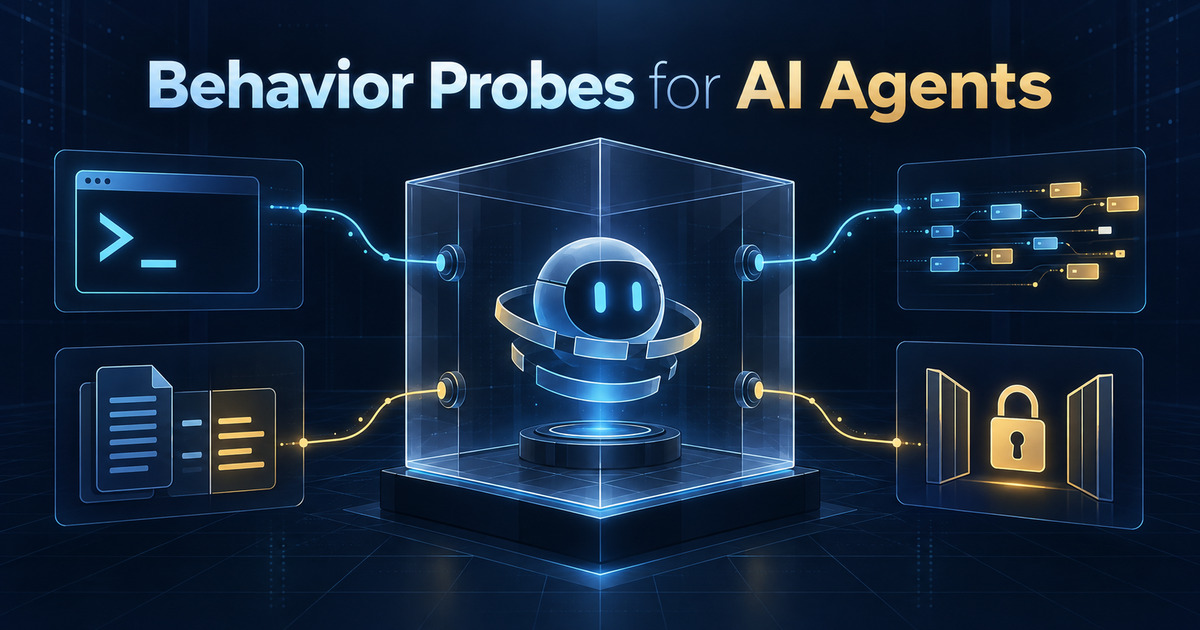
That is why the next useful layer is behavior probes. A behavior probe is independent runtime evidence about what the agent actually did outside the transcript: commands executed, files read and written, processes spawned, domains contacted, API scopes used, cloud resources touched, GUI actions attempted, and policy gates crossed. The transcript still matters. But it should be treated as intent evidence, not as the full operational record.
The research signal is getting louder. The new AgentSpy paper frames the core problem clearly: LLM agents now run shell commands, read and write files, and reach the network, often with the user’s privileges, while tests tend to assert only on the final result and framework trajectories only capture what the framework records. That leaves a blind spot between the nice agent trace and the messy execution surface.
Agentic network monitoring points at one slice of the same gap. If an agent can browse, fetch dependencies, call APIs, or exfiltrate context accidentally, network traffic becomes part of the behavior record. A clean task summary does not tell you whether the agent contacted an unexpected host, retried a sensitive endpoint, or mixed production and sandbox traffic. Network evidence is not a replacement for model logs; it is the environmental receipt that the model log cannot reliably generate by itself.
Task-scoped authorization research adds another important distinction: compromise is not the same as consequence. A model can follow a malicious instruction while using credentials that are technically valid. The control question is whether the authorization layer constrains the action to the approved task. Paired replay, where the same proposed action is tested under broad bearer permissions and narrower task-scoped permissions, is a practical mental model for agent QA. Do not only ask whether the model resisted the bad instruction. Ask whether the surrounding system made the bad side effect impossible or at least observable.
Infrastructure agents make the issue even sharper. A recent Kubernetes-focused agent-security paper describes agents moving into operations where they read telemetry, call tools, generate and execute code, and change production cluster state. That collapses a boundary many cloud teams still assume: that humans decide and automation executes. With agents, the deciding and executing loop can sit inside one workload. If the only durable artifact is an agent transcript, the platform team is being asked to debug production state from a diary entry.
So what should a behavior-probe layer look like?
Start with read-only probes. Capture command invocations, exit codes, working directories, file paths touched, outbound domains, API routes, cloud resource identifiers, and process trees. Do not begin by building a giant policy engine. Begin by making side effects visible and joinable to a task ID.
Then normalize the events. A shell command, a browser click, a database query, and a Kubernetes patch are different mechanics, but the governance record needs common fields: task, actor, tool, target, action, authorization context, timestamp, result, and evidence pointer. OpenTelemetry’s generative-AI semantic conventions are useful because they push teams toward shared trace vocabulary for model and agent operations. The missing move is to join those traces with environmental probes rather than stopping at the model boundary.
Next, separate explanation from verification. The agent can explain why it believes a command was safe. The probe can show what command actually ran. The agent can summarize a browser workflow. The probe can show which domains were contacted and which files changed afterward. The agent can say it only inspected staging. The probe can show whether production credentials or production endpoints appeared in the execution path.
Once the evidence exists, policy becomes more concrete. You can require that a deploy agent may read production telemetry but cannot mutate production resources without an approval event. You can require that a coding agent may install packages only from approved registries. You can require that a research agent may browse the public web but cannot post, purchase, message, or upload. These are not personality traits of the model; they are runtime contracts enforced and audited outside the model.
The practical rollout can be small.
Pick one high-risk agent workflow and instrument it as a workload, not a chatbot. Give every run a task ID. Record its tool calls and transcript as usual, then add command, file, and network probes around the sandbox. Store the evidence with enough structure to answer three questions later: What did the agent intend? What did the environment observe? Which policy allowed or blocked the side effect?
After that, add replay. Take incidents, near misses, and red-team fixtures and run them through broad permissions and task-scoped permissions. If both paths allow the same dangerous action, the model is not your only problem; your permission design is too wide. If the narrow path blocks or flags the action, you have a control worth measuring.
Finally, make receipts part of completion. An agent should not simply report “done.” It should return a completion receipt: task ID, changed resources, commands executed, external systems touched, approvals used, policy exceptions, and links to the underlying evidence. That receipt is what a reviewer, auditor, or on-call engineer can trust when the transcript is too verbose, too incomplete, or too self-serving.
This does not mean every agent needs a surveillance-grade platform on day one. It means production agents deserve the same basic respect we give other production workloads. We log network egress for services. We audit privileged cloud actions. We trace background jobs. We preserve deployment evidence. An agent that can create side effects should not be exempt just because it speaks in paragraphs.
The operating principle is simple: traces explain the plan; probes confirm the execution. If you would not let a junior engineer make a production change with only a Slack message as the audit trail, do not let an AI agent do it with only a chat transcript.
Build AI Systems That Survive Contact With Real Work
We help teams turn AI research into practical automations, agent workflows, and operational systems that can be evaluated and improved.
Get the Field Guide — $10 →